
The Centre régional d’investissement (CRI), or Regional Investment Center, is a public institution in Morocco that helps entrepreneurs, companies, and investors establish and develop investment projects within a specific region. It serves as a central contact point for investment guidance, administrative coordination, business support, and access to information about available opportunities and incentives.
Morocco has 12 Regional Investment Centers, corresponding to its 12 administrative regions. Their purpose is to simplify the investment process, connect investors with relevant government authorities, and encourage regional economic development.
Whether someone wants to open a manufacturing facility, establish a tourism business, or expand an existing company, the CRI can provide practical assistance. However, it does not automatically finance projects or replace every regulatory authority.
I consider understanding this distinction essential before beginning an investment project in Morocco.
What Is the Centre régional d’investissement in Morocco?
The Centre régional d’investissement is part of Morocco’s institutional framework for attracting investment, supporting businesses, and improving the country’s business environment.
The centers originated from Morocco’s regional investment reforms in 2002. Their responsibilities subsequently expanded, particularly following Law No. 47-18, published in 2019.
This legislation restructured the CRIs as public institutions with legal personality and financial autonomy. It also established the Unified Regional Investment Commissions, known as CRUIs.
Law No. 22-24, published in December 2024, further strengthened the framework. Additional legislative changes in 2025 supported the implementation of investment assistance for smaller enterprises.
The official Rabat-Salé-Kénitra CRI website explains these reforms and the institution’s responsibilities.
Why Does Morocco Need Regional Investment Centers?
Investment opportunities differ considerably across Morocco.
Casablanca-Settat has an established industrial and commercial ecosystem, while Tanger-Tétouan-Al Hoceïma offers advantages in manufacturing, logistics, and international trade.
Marrakech-Safi provides opportunities linked to tourism and services, whereas other regions offer distinct possibilities in agriculture-related processing, renewable energy, and local industries.
A centralized national system cannot always address these regional differences effectively.
The CRI model brings investment support closer to the territories where projects will operate.
In my view, its greatest advantage is helping entrepreneurs connect national investment policies with actual regional conditions.
What Services Does a Centre régional d’investissement Provide?

A CRI offers several services throughout the investment journey. Its work extends beyond basic administrative assistance.
1. Business Creation and Entrepreneurial Guidance
Starting a company requires decisions about legal structure, registration, taxation, and business operations.
A Regional Investment Center can explain the administrative requirements and direct entrepreneurs toward the appropriate institutions.
Its advisers may also provide information about business planning, investment opportunities, financing programs, and regional economic conditions.
For example, someone considering a food-processing business might need guidance on company formation, suitable industrial premises, and sector-specific approvals.
The CRI helps clarify which procedures apply and which authorities are responsible.
However, company incorporation and investment authorization are different processes. Entrepreneurs should not assume that registering a business automatically authorizes its proposed activities.
2. Administrative Coordination and Investment Approvals
Investment projects sometimes require several permissions before construction or operations can begin.
These may concern land use, urban planning, environmental requirements, industrial activities, or operating conditions.
The CRI helps investors navigate the administrative system and coordinates the examination of eligible investment files through the Unified Regional Investment Commission.
The national CRI-INVEST platform provides information about procedures and allows investors to submit and monitor investment applications.
Although this system reduces fragmentation, the applicable approvals still depend on the project’s characteristics.
3. Investment Promotion and Regional Opportunities
Regional Investment Centers also promote the economic strengths of their territories.
They provide information about local industries, investment opportunities, business infrastructure, and sometimes available industrial land.
This support can help an entrepreneur identify promising locations before committing substantial capital.
For instance, a logistics company should consider proximity to ports, highways, suppliers, and distribution markets.
A CRI can offer regional information that supports this assessment, although investors must independently verify commercial assumptions and property conditions.
4. Support for Existing Companies
The services of a Centre régional d’investissement are not limited to new businesses.
Established companies may also seek assistance when expanding facilities, launching additional activities, or encountering administrative difficulties.
Some centers provide aftercare services, investor meetings, business networking, and digital complaint channels.
I see this continuing relationship as particularly valuable. A successful investment does not end when a business receives its initial authorization.
Companies still need to address operational challenges, expansion requirements, and changing market conditions.
Centre régional d’investissement vs. Other Moroccan Investment Institutions
One common source of confusion is the difference between the CRI, the CRUI, and national investment organizations.
Although their responsibilities overlap in certain areas, they perform distinct functions.
| Institution | Main responsibility | Best reason to contact it |
|---|---|---|
| CRI | Regional investment guidance, project support, and administrative coordination | Starting, developing, or expanding a regional investment project |
| CRUI | Examination and decisions concerning specified investment applications and authorizations | Obtaining applicable administrative decisions through the CRI process |
| AMDIE | National investment promotion, investor support, and export development | Exploring broader Moroccan investment and export opportunities |
| National Investment Commission (CNI) | Decisions concerning investment agreements and strategic projects under applicable rules | Major projects requiring national-level consideration |
| OMPIC | Industrial property, commercial registration systems, and related services | Business registration, trademarks, and intellectual property matters |
The Moroccan Agency for Investment and Export Development, or AMDIE, operates nationally.
By comparison, CRIs concentrate on regional project implementation and investor support.
The distinction matters because approaching the wrong organization can create unnecessary delays.
Who Can Benefit From a Regional Investment Center?
The services of a Centre régional d’investissement are relevant to several categories of investors.
These include Moroccan entrepreneurs, established companies, small and medium-sized enterprises, foreign investors, and Moroccans living abroad who want to establish businesses in Morocco.
A first-time entrepreneur may need help understanding registration procedures and the local business environment.
An international manufacturer may need information about industrial zones, administrative permissions, and regional infrastructure.
An existing Moroccan company may want assistance with a new investment or expansion.
However, access to general CRI guidance should not be confused with eligibility for government financial incentives.
Investment support programs can impose conditions concerning company size, sector, investment amount, employment, and project location.
How to Work With a Centre régional d’investissement
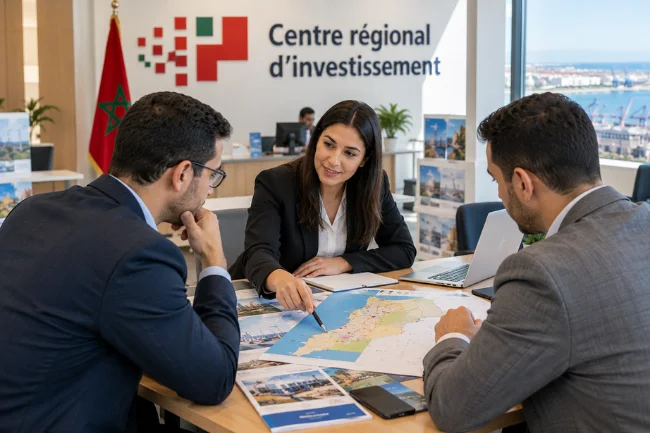
I recommend approaching the CRI with a clearly defined project rather than treating the first meeting as an opportunity to develop an entire business idea from scratch.
The following process can make interactions more productive.
Identify the Appropriate Regional Center
Begin by determining where the investment will physically operate.
The relevant CRI generally corresponds to that region, not necessarily the location where the investor currently lives.
For example, a business owner based in Rabat who wants to develop a factory near Tangier should investigate the requirements in the Tanger-Tétouan-Al Hoceïma region.
Before choosing a location, compare infrastructure, workforce availability, transportation costs, suppliers, and market accessibility.
I would also consider whether another region offers a stronger commercial advantage or a more suitable investment environment.
Prepare a Clear Project Description
A productive first discussion requires more than a general statement about wanting to invest.
I recommend preparing a short document describing the business activity, target market, proposed location, expected investment, financing arrangements, and estimated employment.
This document does not need to be an elaborate presentation.
Its purpose is to help the CRI adviser understand the project and identify relevant administrative requirements.
For more advanced projects, a feasibility study and financial forecasts can support meaningful discussions about implementation.
Request Guidance Before Making Major Commitments
Investors sometimes purchase or lease property before confirming whether their intended activity is permitted.
That decision can become expensive.
Before signing a binding agreement, I would ask whether the proposed land use is compatible with the project and what additional approvals may be necessary.
This is especially relevant to manufacturing facilities, tourism developments, construction projects, and activities with potential environmental impacts.
A suitable location on paper may still require infrastructure improvements or regulatory authorization.
Early verification can prevent avoidable financial exposure.
Submit the Necessary Investment Application
Once the required procedures are understood, the investor can prepare the relevant administrative file.
The CRI-INVEST platform supports online submission and tracking of investment dossiers handled through the regional investment framework.
Depending on the project, supporting documents may include a business plan, company information, land-related documents, technical plans, and relevant studies.
Requirements vary, so I would always confirm the current checklist rather than relying on an outdated document circulating online.
A complete and consistent submission makes administrative review easier and reduces avoidable requests for clarification.
Monitor Decisions and Respond to Requests
Submitting an application does not mean the project has been approved.
Investors should monitor the file, respond to requests for additional information, and retain copies of correspondence.
The CRI-INVEST system allows users to follow the progress of relevant investment applications and access administrative documents.
If an application encounters difficulties, request a clear explanation of the outstanding issue.
Morocco’s revised investment framework also provides appeal mechanisms for applicable decisions. The correct procedure depends on the type of decision and relevant legal provisions.
Continue Communication After Approval
Approval is a significant milestone, but business implementation involves additional responsibilities.
Construction, equipment installation, recruitment, operational licensing, and compliance obligations may still require attention.
I recommend maintaining a project calendar showing completed authorizations, pending requirements, and the responsible organization for each task.
This approach makes it easier to recognize problems before they disrupt the planned opening date.
Can the Centre régional d’investissement Help Investors Obtain Funding?
A CRI can provide information about investment support programs, potential financing solutions, and applicable incentives.
However, it should not be viewed as a bank or an organization that automatically awards grants.
Morocco’s Investment Charter, established through Framework Law No. 03-22, provides a national framework for encouraging productive investment.
Its objectives include employment creation, regional development, investment in priority sectors, and improvements to the business environment.
The Charter provides a main investment support mechanism and specific mechanisms addressing strategic projects, smaller enterprises, and Moroccan investment abroad.
Support for Very Small, Small, and Medium-Sized Businesses
In November 2025, Morocco launched a specific investment support mechanism for very small, small, and medium-sized enterprises.
According to the Ministry of Investment, this mechanism includes incentives linked to job creation, territorial development, and priority activities.
Combined support under the mechanism may reach up to 30% of eligible investment costs, subject to applicable conditions.
That figure represents a potential ceiling, not a guaranteed payment to every applicant.
I would advise investors to verify eligibility, eligible expenses, financing requirements, approval procedures, and disbursement conditions before incorporating public support into financial forecasts.
A business must remain financially viable even if an incentive is delayed or unavailable.
Digital Services: CRI-INVEST vs. DirectEntreprise
Morocco has introduced digital platforms to simplify both investment procedures and company creation.
These systems serve different purposes.
| Platform | Main function | When to use it |
|---|---|---|
| CRI-INVEST | Investment applications, administrative procedures, and project tracking | When managing an investment project requiring regional administrative processing |
| DirectEntreprise | Electronic company creation and related registration formalities | When formally establishing a company through the authorized process |
| Regional CRI websites | Appointments, regional information, investment opportunities, and investor services | When researching local conditions or requesting personalized assistance |
DirectEntreprise was extended nationwide in March 2025. It brings together company-creation procedures involving several Moroccan authorities.
The platform operates under the applicable electronic business creation framework, including arrangements involving authorized professionals.
Meanwhile, CRI-INVEST focuses on investment-related administrative procedures.
I recommend checking both systems when launching a new venture, because successful company registration and project authorization are not necessarily the same thing.
Choosing the Right Region for Your Investment
A Centre régional d’investissement can help investors understand local opportunities, but selecting the right region requires independent commercial judgment.
I would assess five factors before making a final decision:
- Market access: How easily can the company reach customers and distribution networks?
- Infrastructure: Are transportation, electricity, water, and telecommunications adequate?
- Workforce: Does the region offer employees with the necessary skills?
- Operating costs: What are the realistic expenses for land, facilities, labor, and logistics?
- Regulatory suitability: Can the proposed activity legally operate at the chosen location?
These factors should be evaluated together rather than separately.
A location offering cheaper property may ultimately cost more if transportation expenses are high or essential infrastructure is missing.
Similarly, an attractive investment incentive cannot compensate for consistently weak customer demand.
The most promising region is the one that supports sustainable business operations, not simply the one offering the lowest initial expenses.
Common Mistakes Investors Should Avoid
Even with CRI assistance, investors remain responsible for their business decisions and compliance obligations.
One frequent mistake is confusing administrative approval with commercial feasibility.
Government authorization confirms certain regulatory conditions; it does not guarantee customers, profitability, or investment returns.
Another problem is submitting inconsistent project information.
If the investment amount, proposed activity, land description, and financial projections differ across documents, the file may require clarification.
I also recommend avoiding excessive dependence on expected subsidies.
Financial plans should identify when funds are actually available rather than treating potential assistance as immediate working capital.
Finally, investors should distinguish between legal deadlines, administrative processing, and the overall business launch schedule.
A project might obtain one authorization while still awaiting another approval, construction work, or financing.
Maintaining separate timelines for these requirements provides a more realistic picture of project readiness.
My Practical Project-Readiness Checklist
Before requesting formal administrative processing, I would evaluate a project using four questions.
| Question | Evidence to prepare | Why it matters |
|---|---|---|
| Is the business commercially viable? | Market research and financial forecasts | Demonstrates realistic demand and revenue assumptions |
| Is the location suitable? | Property information and infrastructure assessment | Reduces land-use and operational risks |
| Is financing credible? | Funding plan and supporting financial documents | Shows whether implementation is financially achievable |
| Are approvals understood? | List of required permissions and responsible authorities | Helps prevent regulatory surprises |
This assessment is not an official CRI checklist. It is a practical preparation method I recommend for organizing investment decisions.
I also suggest keeping two separate records: one for commercial and financial feasibility, and another for administrative compliance.
That distinction makes it easier to understand whether a delay is caused by the business model itself or by an outstanding regulatory requirement.
Frequently Asked Questions About Centre régional d’investissement
1. What does Centre régional d’investissement mean?
It means Regional Investment Center. In Morocco, it is a public institution supporting investment projects, entrepreneurs, and regional economic development.
2. Can foreigners use a Centre régional d’investissement?
Yes. Foreign investors can seek CRI guidance when establishing or developing projects in Morocco, subject to applicable investment and regulatory requirements.
3. Does the CRI provide free funding to entrepreneurs?
No. A CRI is not an automatic funding provider, but it can explain available financial support programs and help eligible investors understand application procedures.
4. How long does CRI investment approval take?
Processing time depends on the project, required authorizations, completeness of the application, and applicable legal deadlines. Investors should verify the timeframe for their specific file.
5. How can I contact a Regional Investment Center in Morocco?
Visit the official website of the CRI responsible for your chosen region or use the CRI-INVEST platform to explore investment procedures and available services.
Final Thoughts
The Centre régional d’investissement plays a significant role in Morocco’s efforts to simplify investment, support entrepreneurship, and encourage regional economic growth.
For investors, its greatest value lies in providing access to regional expertise, administrative guidance, and clearer investment procedures.
I recommend contacting the appropriate CRI early, preparing a realistic business plan, and confirming all legal and financial requirements before committing major resources.
A well-prepared project gives investors a stronger foundation for making informed decisions and building a sustainable business in Morocco.

Ethan Caldwell is a business research writer with 9+ years of experience covering entrepreneurship, market trends, business strategies, and industry insights. He focuses on creating clear, data-informed articles that help readers understand modern business concepts.