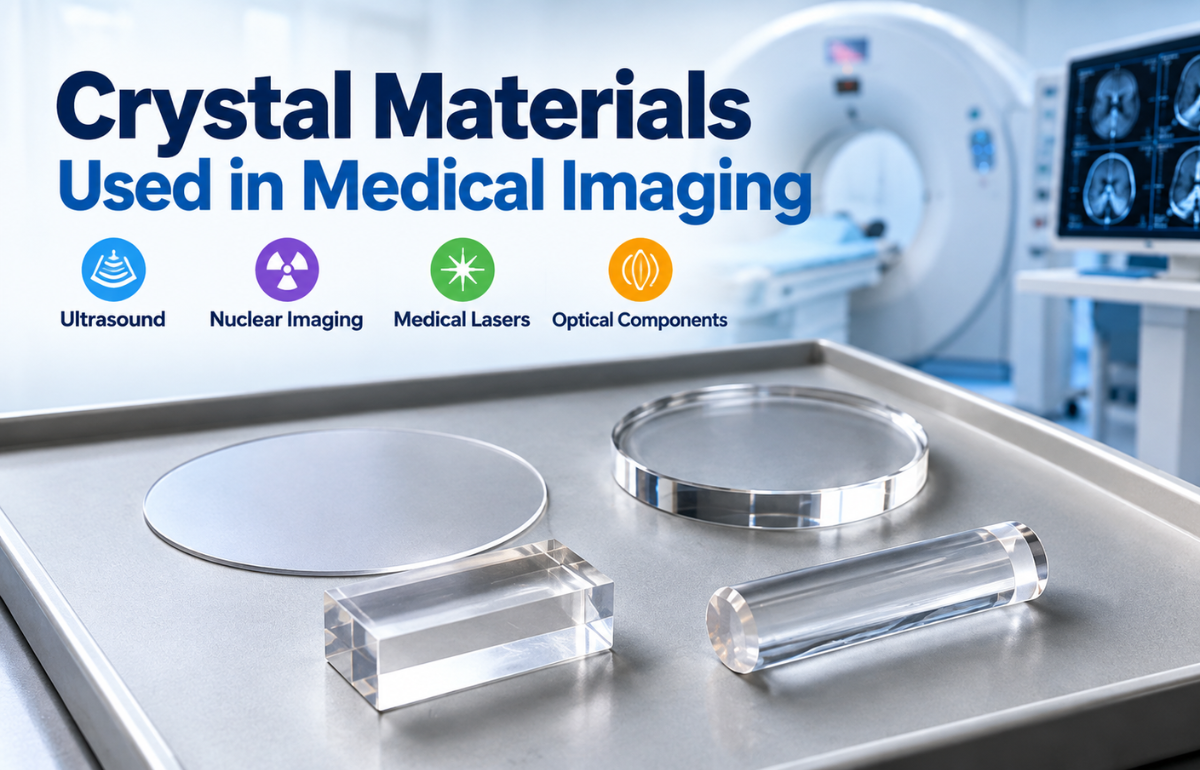
A PET detector, an ultrasound probe, and a surgical laser can all contain crystalline materials. Their components do very different jobs. A detector may turn radiation into light; a probe converts electrical signals into vibration; a laser crystal can provide the medium in which light is amplified.
For medical equipment developers and buyers, these distinctions are more useful than the broad label “medical crystal.” The right material depends on the signal being measured or delivered and on the conditions inside the instrument. A highly transparent crystal is not automatically a good radiation detector, and a strong piezoelectric response says little about suitability for a laser.
Ultrasound Uses Materials That Respond to an Electric Field
Conventional piezoelectric ultrasound probes rely on active elements that move when an electrical signal is applied. Returning echoes generate an electrical response, allowing the scanner to collect information about structures beneath the surface. The active material therefore participates in both transmission and reception.
Many clinical transducers use lead zirconate titanate, or PZT, a piezoelectric ceramic. Single crystals provide additional options for particular designs. Lithium niobate, for example, has been used in specialized high-frequency transducer research. It should not be presented as the material inside every ultrasound probe.
The difference also matters in purchasing. A ceramic element, a piezoelectric composite, and a single-crystal wafer can require different manufacturing routes even when they are intended for similar acoustic tasks. Buyers need to establish the material form before comparing quotations.
Nuclear Imaging Needs a Detectable Signal
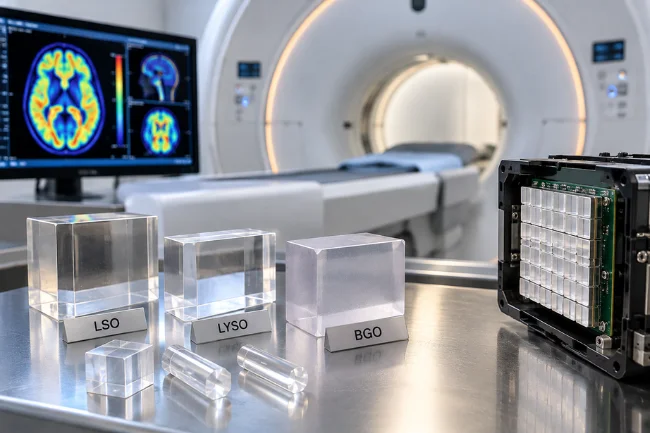
Scintillation materials emit light after absorbing ionizing radiation. In a PET detector, a photosensor collects that light so the electronics can record an event.
Lutetium-based crystals such as LSO and LYSO, along with bismuth germanate, or BGO, are established examples. Their relative value depends on more than brightness. Radiation absorption, emission timing, light collection, and the detector configuration all influence the choice. Research on BGO detector readout illustrates how electronics and optical collection can be developed around a material’s particular behavior.
A useful scintillator specification consequently includes the operating radiation energy and the required geometry. Asking only for a crystal with high light output leaves several important questions unanswered, including whether the light can be collected efficiently in the intended package.
Crystals Can Generate or Modify Laser Light
Some medical lasers use a doped solid-state crystal as the gain medium. Others use gases or semiconductor sources. The phrase “medical laser” therefore does not identify one material system.
In certain solid-state systems, a separate nonlinear crystal converts the laser output to another wavelength. KTP, LBO, and BBO are examples used in frequency conversion. A familiar conversion changes 1064 nm infrared light to 532 nm green light. The laser medium and the conversion crystal have separate functions, even when both sit within the same instrument.
This distinction prevents a common sourcing mistake: specifying an output wavelength without stating whether the inquiry concerns the gain crystal or the conversion element. The required doping, cut, coatings, and dimensions will differ.
Optical Components Have Their Own Requirements
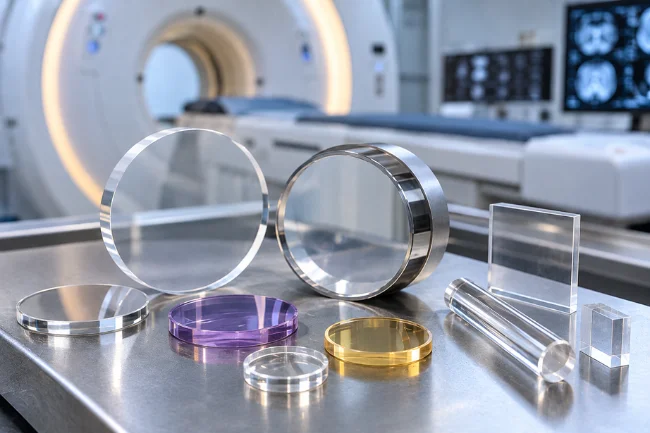
A window in an imaging instrument may primarily transmit light and protect components behind it. Sapphire, quartz, and fluoride crystals can be considered for different optical conditions. Their transmission ranges, mechanical properties, and surface requirements must be assessed against the actual design.
Stanford Advanced Materials (SAM) supplies Crystal Materials for Medical Equipment, covering piezoelectric, optical, scintillation, and semiconductor families in forms such as wafers, windows, rods, and custom parts. For a productive material review, buyers can provide the device function, composition, dimensions, crystal orientation, and required surface treatment.
A drawing is particularly useful when the component must fit an existing assembly. It connects the material request to the aperture, bonding surfaces, and dimensional tolerances the equipment actually needs, which makes it easier to compare supply options without treating unlike crystal families as interchangeable.

Noah Sterling is a technology research writer with 8+ years of experience covering emerging technologies, software trends, digital tools, and innovation. He creates practical, research-based articles to help readers understand the evolving technology landscape.