
TriDeltathon was a charity triathlon in Knoxville, Tennessee, associated with the University of Tennessee and Delta Delta Delta sorority. Its familiar format paired a 400-meter indoor pool swim with a roughly six-mile bike ride and three-mile campus run. Participants could race alone or as a relay team, and proceeds supported East Tennessee Children’s Hospital.
The original swim-bike-run event is not the current race advertised by its organizers. The related event is now TriDeltaRUN, a 5K that retains the Tri Delta and children’s charity connections. If you found an old TriDeltathon registration page, check its year before making plans: a preserved race listing describes history, not an upcoming triathlon.
That distinction matters because the name still appears in search results, race archives, and even the web address of the organizer’s running-event page. I compared the archived TriDeltathon listing with the 2026 TriDeltaRUN listing to separate details that belong to each race. Here is what those records tell us, where they leave questions open, and how to use them.
TriDeltathon at a glance
| Question | Historic TriDeltathon | Latest documented related event |
|---|---|---|
| What kind of race? | Short-course, pool-based triathlon | TriDeltaRUN 5K |
| Disciplines | Swim, bike, run | Run |
| Advertised distance | 400 m swim; 6 mi bike; 3 mi run | 5 km run |
| Knoxville setting | UT Student Aquatic Center and campus area | UT Gardens and Third Creek Greenway in the 2026 listing |
| Participation | Individual or relay | 5K entrants |
| Beneficiary named in listings | East Tennessee Children’s Hospital | East Tennessee Children’s Hospital and Camp Eagles Nest |
These are descriptions of particular documented editions, not permanent promises about future routes, divisions, or beneficiaries. The old triathlon listing was for April 19, 2020, and explicitly announced its cancellation. The latest 5K listing I could verify was for April 19, 2026, a date that has passed.
Where did TriDeltathon come from?
The event’s identity grew out of a specific place: the University of Tennessee campus in Knoxville. The pool provided a controlled swim start; nearby roads and campus landmarks shaped the bike and run. Delta Delta Delta members supplied volunteer support, while RaceDay Events handled the race listing and organization shown in the archived material.
The planned 2020 event was promoted as TriDeltathon’s 36th year. That establishes a long history, but it does not by itself settle an exact founding date. You may see 1984 repeated online; without an original inaugural announcement or continuous year-by-year record, I would label that a reported date rather than a verified first race.
The same caution applies to another memorable description. The 2020 organizer listing called it the oldest running pool triathlon in the country. That is the organizer’s historical claim, not an independently demonstrated national ranking. A careful account can report how the race described itself without turning promotional language into a proven record.
There is something more interesting here than a superlative. This was a local, repeatable event that let students and neighbors try three sports in one morning while raising money for a children’s hospital. The setting was integral to the experience, not just a backdrop for a generic endurance race.
What was the TriDeltathon course like?
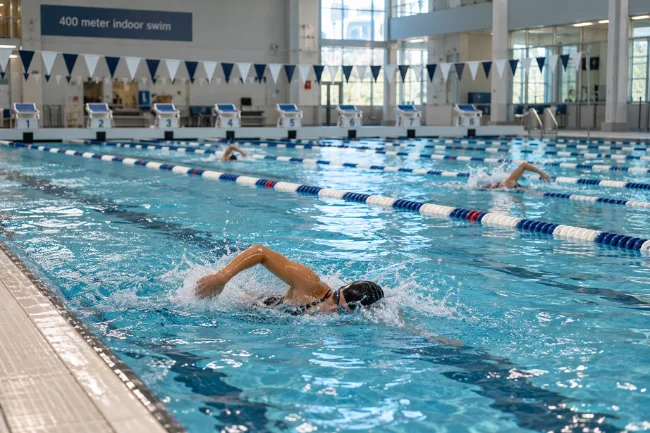
The 400-meter indoor swim
The 2020 race description placed the start at the UT Student Aquatic Center, 2106 Andy Holt Avenue. Swimmers were to cover eight 50-meter lanes. They entered individually at intervals of roughly seven seconds, moved from lane to lane by going under the rope at the end of each length, and started in an order based on their estimated 400-meter swim times.
That is a different experience from a mass start in a lake. A pool removes open-water navigation and changing water conditions, but it still asks swimmers to share space, judge their pace, and move safely around others. The staggered start also explains why an honest estimated swim time mattered: it helped organizers sort faster and slower swimmers.
The eight-lane description belongs to the archived edition. Anyone using it to imagine an old race should keep it in the past tense; it is not a set of instructions for a race currently accepting entrants.
The six-mile bike segment
After the swim came the first transition, commonly called T1. A participant had to reach the bike, put on appropriate riding gear, and head out onto a course described as a six-mile tour of campus and Neyland Drive. The organizer’s listing linked a bike-course map, although archived map links should never be treated as present-day traffic guidance.
Six miles sounds brief until you consider the sequence. You would begin riding with your breathing and heart rate already elevated from the swim, then need to conserve enough energy for the run. In a short race, a slow or disorganized transition could take a meaningful bite out of your total time.
The three-mile campus run
The final leg was advertised as a three-mile run past Neyland Stadium and Thompson-Boling Arena. After the second transition, or T2, athletes had to change from cycling movement to running. That heavy-legged feeling is one reason triathletes practice short bike-to-run sessions known as brick workouts.
One small detail is easy to miss: the race description gives the run as three miles, while its linked historic route page labels a running route at about 3.2 miles. I would use the organizer’s advertised distance when describing the event and avoid promising that every edition measured exactly three miles. Route files, course changes, and advertised distances do not always line up neatly.
Who could enter, and what did a relay involve?
The archived listing offered both individual and relay events. An individual athlete completed all three legs. A relay allowed teammates to divide the disciplines, making the event more approachable for someone who could swim, bike, or run well but did not want to take on the entire triathlon.
For the planned 2020 edition, the listing showed ages 10–99 for the individual event and 7–99 for the relay. Those are historical registration settings, not a rule for every year. It also advertised overall, age-group, and relay awards, special student pricing, and an expected participation figure of 350. “Expected” is the key word: that number was an organizer projection, not a verified finisher count, and the event was canceled.
Another useful detail from the original listing is that the race was not USA Triathlon sanctioned. Do not assume that the governing body’s membership, rules, or insurance arrangements applied to this specific edition. Participants would have needed to read the organizer’s actual event instructions.
The 2020 listing even mentioned a beginner clinic at the aquatic center. That tells us the race offered more than a short course on paper: organizers anticipated newcomers who might need to see how the pool start and transitions worked. It does not establish that the same clinic ran every year.
Why the pool start made this race distinctive
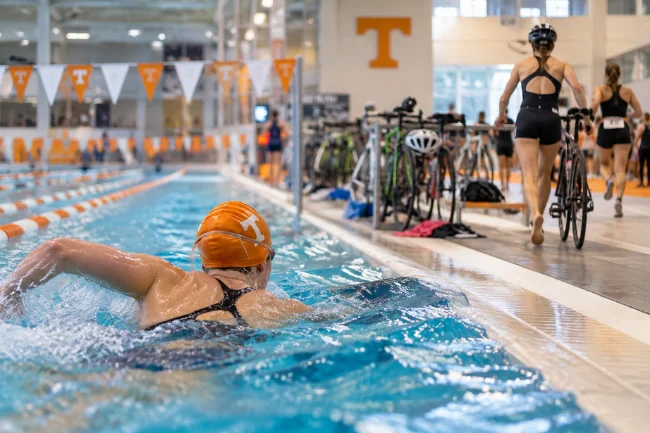
A standard triathlon can feel intimidating if swimming outdoors is unfamiliar. TriDeltathon changed that first impression by beginning indoors. You could train for the precise swim distance in a pool, estimate your time, and know what kind of water you would enter.
Still, “beginner-friendly” should not be confused with effortless. Four hundred meters requires sustained swimming ability. The bike leg calls for control around other participants and road conditions. The run arrives after two earlier efforts, not on fresh legs. Its accessible format lowered some barriers while preserving the central challenge of changing sports twice.
If I were explaining the event to a first-time triathlete, I would focus less on whether three or six miles sounds impressive and more on the handoffs between legs. Know where your equipment goes. Practice finding and using it without rushing. Ride briefly, then run a few minutes to learn how that switch feels. Those are general preparation ideas, not a training prescription or a claim that a new TriDeltathon is scheduled.
The charity connection behind the race
The archived triathlon page identifies East Tennessee Children’s Hospital as the beneficiary and credits Delta Delta Delta volunteers. That gives the event a purpose beyond placing on a results sheet. Entrants, relay teams, volunteers, and supporters were part of a local fundraising effort.
The charity connection became particularly visible when the 2020 race was canceled. Organizer Martin Coleman’s posted notice offered registrants several choices: leave the fee to benefit the hospital, transfer to a proposed later edition or another RaceDay Events race, take credit toward a longer race, or request a refund. Those were options communicated at that time, not policies for today.
TriDeltaRUN’s 2026 description says its proceeds, as with the earlier mini triathlon, would support East Tennessee Children’s Hospital and Camp Eagles Nest, described there as a camp for children with cancer and rare blood disorders. The format became simpler, but the organizers presented fundraising for children as the continuing thread.
What happened in 2020, and why did the format change?
The planned April 19, 2020 TriDeltathon did not go ahead. In the cancellation notice, the organizer connected that decision to the University of Tennessee moving to online instruction for the rest of the academic year and said efforts to secure a later date had failed.
What happened after that is less clearly documented. The notice offered a transfer into a proposed 2021 edition, but an offered transfer is not proof that the triathlon actually took place in 2021. Later organizer information advertises TriDeltaRUN as a 5K instead of the old swim-bike-run event.
I have not found an organizer statement that pins the lasting format change on one cause. The 2020 disruption is documented; a permanent decision based on costs, safety, participation, or pandemic restrictions is not. Presenting any of those as the reason would fill a gap with speculation.
TriDeltathon versus TriDeltaRUN
| Practical question | TriDeltathon, as advertised for 2020 | TriDeltaRUN, as advertised for 2026 |
|---|---|---|
| What would I do? | Swim 400 m, bike 6 mi, run 3 mi | Run 5 km |
| What equipment is central? | Swim gear, bicycle, riding gear, running shoes | Running shoes and suitable clothing |
| Are transitions part of the event? | Yes, swim-to-bike and bike-to-run | No multisport transitions |
| Where was the start? | UT Student Aquatic Center | UT Gardens, UT Agriculture Campus |
| What happened to this listed edition? | Canceled | Scheduled for April 19, 2026; date now past |
The names and cause are connected, but the races ask different things of participants. A person searching for a pool triathlon should not register for a 5K expecting a bike course. Conversely, someone interested only in the charity run does not need to train for a swim.
The 2026 listing called the 5K its fifth year. It located the event at 2518 Jacob Drive and described a route largely on Third Creek Greenway, with a 10 a.m. start and 9 a.m. day-of-race registration. It also mentioned student discounts, a race-logo shirt, refreshments, and overall and age-group awards. Treat each as information about that edition, not a guarantee for the next one.
How to find a current event without following an old listing
Start with the date at the top of a registration page. The preserved TriDeltathon page says 2020 and includes a cancellation notice. A button or search result pointing to that page does not revive the race. Next, check the event name and disciplines: TriDeltaRUN means a 5K, not the historic triathlon.
Then cross-check the latest listing on RunSignup with the RaceDay Events calendar. At the time of this review, the calendar identified the April 2026 TriDeltaRUN, but the organizer’s linked detail page still displayed April 2025 information. This is exactly why a single undated search snippet or familiar URL is a poor basis for travel plans.
If a future race is announced, confirm its year, location, entry options, course, start time, packet pickup, and beneficiary in the newly dated registration materials. Ask the organizer directly when two official-looking pages disagree. You can also check the historic TriDeltathon results archive and TriDeltaRUN results page when researching earlier editions, but a results archive is not an upcoming event schedule.
What the records can and cannot tell us
The documents establish the old course description, charity, participation choices, 2020 cancellation, and the later 5K listing. They do not establish an exact first-race date, a complete uninterrupted timeline, or an official explanation for the permanent change. Even a course map can describe a route differently from a rounded promotional distance.
I find that distinction useful when reading local sports history. A registration page is excellent evidence for what an organizer advertised. It is weaker evidence for how many people finished, whether every promised amenity appeared, or what an organizer decided years later. Where the record stops, the honest answer stops too.
Frequently asked questions
Is TriDeltathon still held as a triathlon?
I found the original triathlon in archived listings, while the latest related listing is for TriDeltaRUN, a 5K. Check for a newly dated organizer announcement before assuming either event is open.
What were the TriDeltathon race distances?
The archived 2020 organizer description advertised a 400-meter indoor swim, six-mile bike ride, and three-mile campus run.
Was TriDeltathon an open-water race?
No. Its advertised swim began in the University of Tennessee Student Aquatic Center pool, with staggered individual starts.
Why did TriDeltathon become TriDeltaRUN?
The 2020 cancellation is documented, but I found no official explanation proving why the triathlon format later gave way to a 5K.
Where can I check the next TriDeltaRUN date?
Check a newly dated RunSignup listing and the RaceDay Events calendar, then confirm any conflicting details with the organizer before registering or traveling.
A local race with a continuing purpose
TriDeltathon combined a distinctive pool start, short campus course, relay access, and support for children’s care. TriDeltaRUN carries the community and charity connection into a running-only event. If you are researching the triathlon, use its archived listing as a historical source. If you hope to participate, begin with the newest dated organizer listing and verify what is actually on the calendar.

Lauren Mitchell is a fitness and exercise specialist with 11+ years of experience helping people build strength, improve mobility, and maintain healthier lifestyles. She provides evidence-based fitness guidance focused on effective workouts, injury prevention, and sustainable exercise habits.