The spiritual meaning of the name Charlotte is commonly understood as freedom expressed with care: the ability to choose your own path while treating other people with dignity. Charlotte is a French feminine form of Charles, a name often interpreted as “free person.” That history offers a starting point for reflection, but it does not give Charlotte a fixed destiny, personality, or divine message. I find the most honest way to read the name is to separate its linguistic roots from the meaning a family or an individual chooses to give it. For some, Charlotte suggests independence and courage; for others, it speaks of faith, responsibility, or the room to become themselves fully.
Its origin can be investigated. Its spiritual significance can be explored without claiming that everyone named Charlotte must live the same life.
Charlotte at a Glance
| Question | Short answer |
|---|---|
| Where does Charlotte come from? | It developed in French as a feminine diminutive related to Charles. |
| What does Charlotte mean? | It is popularly glossed as “free person” or “free woman,” through its connection to Charles. |
| Is Charlotte a biblical name? | No. The name does not appear in the Bible, though Christians may connect its popular meaning with biblical passages about freedom. |
| What is its spiritual interpretation? | Personal freedom joined with responsibility, compassion, and self-respect. This is an interpretation, not a translation. |
| What is its numerology number? | In one common Pythagorean letter-number system, Charlotte reduces to 3. Other systems can differ. |
| How is it said in English? | Usually SHAR-lut; pronunciation changes across languages. |
The Online Etymology Dictionary and Behind the Name document the French connection. They are useful starting points because the attractive spiritual story of a name should not replace its linguistic history.
Where Does the Name Charlotte Come From?
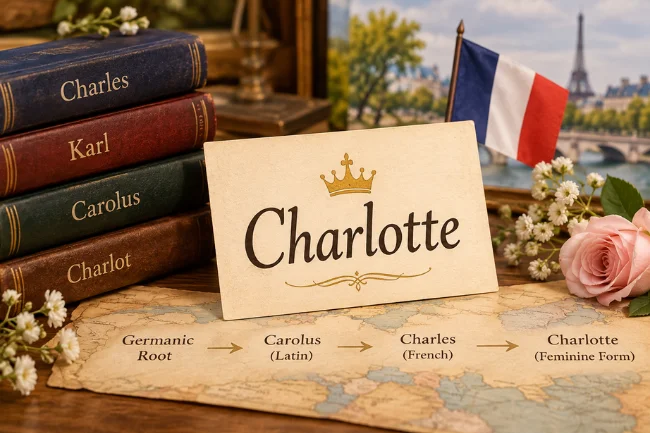
Charlotte belongs to a family of names that includes Charles, Karl, Carolus, and Charlot. In broad terms, a Germanic root passed into the Latin form Carolus and the French Charles. French later developed Charlotte as a feminine diminutive. A diminutive is a smaller or familiar name form; it does not mean the person carrying it is small, weak, or less important.
The familiar English gloss “free woman” expresses its association with Charles, but it is not a word-for-word translation of every historical stage. The Online Etymology Dictionary gives the older Karl element as “man, husband.” I would present “free person” as a customary name meaning while acknowledging that nuance.
Does Charlotte Literally Mean Grace or Strength?
No. Grace, courage, and strength are possible associations people bring to Charlotte; they are not literal translations of its letters. A royal namesake might make the name feel dignified. A beloved character might make it feel kind. Those impressions are real to the people who hold them, but they come from culture and personal experience, not from the original word alone.
If a description says Charlotte “means graceful leader,” I would read that as creative interpretation. Its development from the French form of Charles is something I can check against a name reference.
What Can Charlotte Mean Spiritually?
Freedom is the natural thread to follow if the popular meaning speaks to you. Spiritual freedom can mean having room to act according to your conscience rather than living entirely for approval. It can also mean learning when to set a boundary, when to ask for help, and when to release an expectation that no longer fits your life.
Freedom is more than being able to say no. It includes choosing a meaningful yes: a relationship, a belief, or a kind of work. A person can be independent and still be generous.
Freedom With Responsibility
For me, the most useful spiritual reading of Charlotte is freedom with responsibility. If the name becomes a reminder to respect another person’s choices as carefully as your own, it has more depth than a vague promise of confidence or success.
Imagine a child being told that her name is linked with freedom. She need not hear, “You must be fearless.” She might instead hear, “You have room to discover what you believe, and other people deserve that room too.” That is a message a family can live by.
Grace as a Chosen Value
Some people pair Charlotte with grace. I would treat grace as an intention rather than an inherited personality trait. It might look like staying curious during a disagreement, admitting a mistake, or making space for someone else to grow. None of those actions follow automatically from a name. They become meaningful through practice.
The same is true of inner strength. It does not require someone named Charlotte to be composed all the time. Strength may mean resting, changing direction, or telling the truth about a difficult day. A name can be a gentle prompt without becoming a rulebook.
Is There a Biblical Meaning of Charlotte?
Charlotte is not the name of a person in the Bible, and the Bible does not define its meaning. I would be wary of any claim that Scripture assigns Charlotte a particular calling. The connection Christians sometimes make is thematic: the familiar “free person” interpretation can bring to mind passages about freedom in Christ.
Galatians 5:1 and John 8:36 both discuss freedom. They speak to Christian faith; they are not explanations of a French given name. A Christian parent could still choose Charlotte as a personal reminder to raise a child with faith, conscience, and respect for others. That is a thoughtful family intention, so long as it is presented as an intention rather than a biblical fact.
I would not assume that “spiritual” has to mean “Christian.” A secular reader may find meaning in autonomy and compassion; someone from another faith may connect the name to their own tradition.
Charlotte in Numerology: What Does the Number 3 Mean?
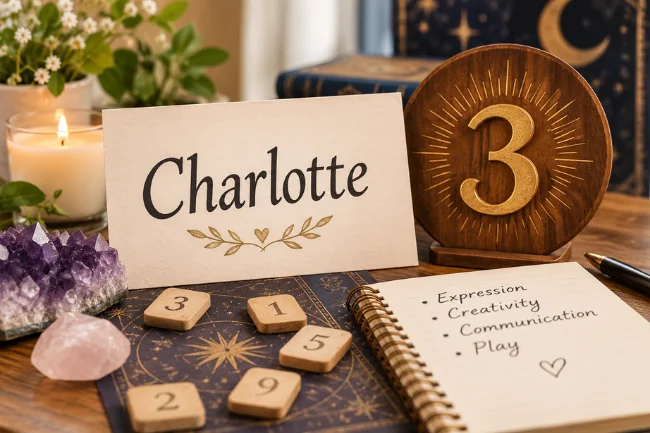
Numerology offers another symbolic lens. In the common Pythagorean system, letters receive numbers from 1 to 9 in a repeating pattern. Charlotte works out as C(3) + H(8) + A(1) + R(9) + L(3) + O(6) + T(2) + T(2) + E(5) = 39. Add 3 + 9 to get 12; add 1 + 2 to get 3.
Followers of this system often connect 3 with expression, creativity, communication, and play. You might use that as a journaling prompt: Where do I feel able to speak freely? What makes me curious? How do I share an idea with someone else? I would not use the number to predict whether a child will become an artist, an extrovert, or a leader.
The calculation also depends on the spelling and the system. Lottie, Charlie, and Carlotta do not contain the same letters as Charlotte. Some numerology traditions use different assignments. An “angel number 3” interpretation adds another belief-based layer; it is not a historical fact about the name. If you enjoy that symbolism, it is best used as reflection, not evidence about somebody’s future.
What History Adds to the Name’s Meaning
Names pick up associations as people use them. Charlotte has been carried by Queen Charlotte, the eighteenth-century British queen consort, and by novelist Charlotte Brontë. In fiction, the spider in E. B. White’s Charlotte’s Web is remembered for helping her friend Wilbur. A parent might hear royal poise, literary imagination, or loyalty in the name because of these different stories.
I keep those associations separate from etymology. Brontë and a fictional spider cannot tell us what a real child will be like, but they show why the name evokes different feelings.
Charlotte has a practical modern life, too. According to the US Social Security Administration’s 2025 baby-name rankings, it was the second most popular girls’ name in the United States that year. That tells us it is widely used in one country and one measured year. It does not show that families chose it for spiritual reasons, or that the same rank applies everywhere.
Nicknames, Related Names, and Pronunciation
One advantage of Charlotte is the range of everyday forms it offers. Someone may prefer the full name in formal settings and Lottie or Charlie among friends. The name reference Behind the Name lists several diminutives and forms used in other languages; these are useful to compare, though a nickname and a language variant serve different purposes.
| Form | Relationship to Charlotte | What to keep in mind |
|---|---|---|
| Lottie | Familiar nickname | Soft and informal; it can also stand on its own. |
| Charlie | Familiar nickname, also used for Charles | Flexible and widely recognized, though people may assume different full names. |
| Charlotta | Related form used in Swedish | A close alternative with a different ending. |
| Carlotta | Related Italian form | Recognizably from the same name family, with a different sound. |
| Carlota | Related Spanish and Portuguese form | Shares the Charles family of names; local pronunciation matters. |
In English, Charlotte is commonly pronounced SHAR-lut. The French pronunciation is different, and the name takes on other sounds in German, Swedish, and Dutch. If your family uses more than one language, say each version aloud rather than assuming the English one is universal.
Caroline and Carla also belong to the wider Charles name family, but I would not label either one a nickname for Charlotte. These small distinctions help when a parent wants a particular sound, heritage connection, or everyday short form.
Choosing Charlotte for a Baby: Questions Worth Asking
If I were weighing Charlotte as a baby name, I would begin with its ordinary life rather than a personality forecast. Does the full name sound natural with the family surname? Do you like Lottie and Charlie, or would you rather use Charlotte every day? Is its popularity reassuring, or would you prefer something less common where you live?
Then I would ask what “freedom” means in your household. A name is a lovely way to express a hope, but a child should have room to grow beyond that hope. Naming someone Charlotte does not require her to be brave every moment, speak elegantly, or follow a spiritual path chosen before she was born.
Middle names can carry a more specific family story. Charlotte Grace may express a Christian or personal value; Charlotte Rose may recall a relative or a garden; Charlotte Joy may mark a feeling you want to remember. These are meanings you create through your reasons for choosing them. They are not automatic combined translations produced by placing two words together.
I would also check any claimed meaning of the middle name on its own. A family tribute, the rhythm of the full name, and a shared cultural connection may matter more than a perfectly matched list of definitions. Write the whole name down, say it at a whisper and at normal volume, and picture how it might feel to the person who will carry it.
A Personal Way to Reflect on the Name
When I look at Charlotte’s origin, I find it helpful to turn the word “freedom” into questions instead of a prediction. That keeps the reflection open to an actual person, whether you are considering the name for a child or thinking about your own.
Ask: What choice would let me act with more honesty? Which obligation have I accepted freely, and which one needs a better boundary? How can I make room for another person’s freedom as well as mine? You do not need numerology or a royal association to answer those questions, though either may give you another starting point.
For a parent, one small practice is to write a sentence about why you chose the name and save it for the child to read later. It could be as simple as, “We loved Charlotte’s sound and hoped you would feel free to become yourself.” That sentence is a real record of your intention. It offers more personal meaning than an unsupported claim about a baby’s destiny.
For someone already named Charlotte, the exercise can work in reverse. Which associations feel like yours, and which ones would you set aside? The right to answer differently from a name guide may itself be the best expression of freedom.
What the Name Cannot Tell Us
Charlotte cannot tell us whether someone will be loyal, confident, lucky in love, or emotionally reserved. Claims that a name carries a fixed “energy” for relationships or predicts a life path belong to personal belief, not established evidence. Even a numerology result changes when the spelling changes.
The same caution applies to dreams. Dreaming about a person named Charlotte may reflect someone you know, a story you recently encountered, or your own associations. There is no universal message attached to seeing the name in a dream. If the dream matters to you, its context is a better place to begin than a one-size-fits-all definition.
Those limits protect a real person’s freedom to make meaning. The historical name gives us a starting word; lived experience gives it texture.
A Name With Room to Grow
The spiritual meaning of the name Charlotte can be a reflection on freedom, responsibility, and kindness. Its French roots and connection to Charles provide the history; faith, family memory, and personal choice shape the rest. If the name is on your shortlist, say it aloud, check its origins, and write down the hope you want it to carry. Leave room for its owner to give it a meaning of her own.
Frequently Asked Questions
What does the name Charlotte mean spiritually?
Many people interpret it as personal freedom joined with compassion and responsibility. That is a symbolic reading of its commonly given meaning, not a guaranteed personality trait.
Does Charlotte mean “free woman”?
“Free woman” or “free person” is a popular gloss through its connection to Charles. The older Karl root is also recorded with the sense “man” or “husband,” so the history is more nuanced than one English phrase.
Is Charlotte a biblical name?
No. Charlotte does not appear as a personal name in the Bible, although Christians may connect its popular meaning with biblical passages about freedom.
What is Charlotte’s numerology number?
In a common Pythagorean system, the letters total 39 and reduce to 3. It is a symbolic calculation, not a way to predict a person’s future.
Is Charlotte a good name for a baby?
It may be if you like its sound, history, and nickname options. Consider how it fits your surname and family languages, while leaving your child free to define herself.

Elena Whitmore is a parenting writer with 7 years of experience covering child development, family wellbeing, and everyday parenting. She translates research into practical guidance to help parents strengthen family relationships and support their children’s emotional and physical development.