
Cristher is best known as an architectural and residential outdoor lighting brand within Novolux Lighting, a Spanish lighting company with roots dating back to 1981. The Cristher range focuses on exterior luminaires for homes, landscaped spaces, hospitality settings, and architectural projects, including bollards, recessed lights, spotlights, underwater lighting, wall and ceiling fixtures, decorative lamps, and related accessories. Novolux describes Cristher as its high-end outdoor range, emphasizing technical quality, modularity, customization, and locally based production.
The word Cristher can also appear as a personal given name, username, or business name. That creates some confusion in search results. Based on the strongest documentary evidence I found, however, Cristher does not have one universally recognized dictionary definition or a reliably documented ancient name meaning. For people searching the term commercially, Cristher Lighting is the clearest established entity.
What Is Cristher?
In practical terms, Cristher is a lighting brand specializing in outdoor architectural illumination.
It belongs to the wider Novolux Lighting portfolio and is positioned toward projects where exterior lighting has to do more than simply make an area visible. The range is designed for applications where appearance, weather resistance, optical control, installation flexibility, and integration with architecture all matter.
Novolux currently describes the Cristher collection as high-end lighting for residential and architectural exteriors. Its official product categories include bollards and columns, surface-mounted luminaires, recessed fixtures, projectors or spotlights, underwater lighting, suspended fixtures, decorative lighting, floor and table lamps, and accessories.
That distinction matters because a search for “Cristher” can easily lead to pages discussing the word as if it were primarily a mysterious modern name.
When I researched the keyword, I found that the strongest primary-source evidence pointed in a different direction: Cristher has a documented commercial history in the Spanish lighting industry extending back more than four decades.
Why There Is Confusion About the Meaning of Cristher

Cristher is an unusual search term because several different intents overlap.
Someone may be searching for:
- Cristher Lighting or Cristher outdoor lights
- a particular Cristher product or catalogue
- the meaning of Cristher as a first name
- a person whose first name is Cristher
- a company or online account using the word
- information about Cristher and Novolux
This creates what I would call a search-entity collision: the same spelling points to a recognized commercial brand and to unrelated personal uses.
That distinction is missing from much of the content currently published around the term.
Does Cristher Have a Verified Name Meaning?
There does not appear to be a widely accepted linguistic authority establishing one definitive meaning, language of origin, or traditional etymology for Cristher as a given name.
Some online articles associate it with names such as Christopher, Christian, Chris, or similar formations. Those connections may look plausible because of spelling and pronunciation, but resemblance is not the same thing as documented etymology.
For that reason, I would avoid claims such as “Cristher means strength,” “Cristher means Christ-bearer,” or “Cristher comes from an ancient language” unless a reliable naming or linguistic source can demonstrate the relationship.
A more accurate statement is that Cristher is used as a personal name in real life, while its precise linguistic origin is not firmly established by the evidence readily available.
The History of Cristher Lighting
Cristher’s commercial history is much easier to document.
According to Novolux’s corporate timeline, Cristher began as a family business in 1981. Dopo, another lighting business that would later become part of the same group, was founded in 1990. In 2005, investment firm N+1 acquired Cristher and Dopo.
A significant corporate change followed in 2006.
Spanish commercial-registry documentation records the absorption of Cristher S.L.U. and Dopo S.L.U. by Grupo Gestión Integral Novolux Internacional S.L. The merger was approved on June 30, 2006.
That legal history helps explain something that can otherwise look confusing today: Cristher remains visible as a product brand even though the original Cristher corporate entity was incorporated into the wider Novolux organization.
From Independent Company to Novolux Brand
Novolux continued expanding its portfolio after the Cristher-Dopo combination.
Its corporate timeline records the creation of the Exo brand in 2013, expansion of its export activity in 2014, the acquisition of indoor technical-lighting company Indeluz in 2016, and the creation of a customizable-luminaire division in 2017.
In 2019, the company reorganized its corporate identity and adopted the Novolux Lighting name while grouping its lighting brands beneath the wider Novolux identity.
Cristher therefore makes more sense today when viewed as a specialized product range inside a larger lighting organization rather than as an isolated company.
Cristher vs. Other Novolux Lighting Brands
One useful way to understand Cristher is to compare its role with the other ranges in the Novolux portfolio.
Novolux’s company information identifies Cristher specifically with architectural outdoor lighting, while Dopo covers residential outdoor applications, Exo addresses decorative interiors, Indeluz handles technical indoor lighting, and Canaled provides linear systems.
The important point is that Cristher is not simply another decorative lamp label. Its place in the portfolio is more closely connected with technically demanding exterior projects.
What Types of Products Does Cristher Offer?
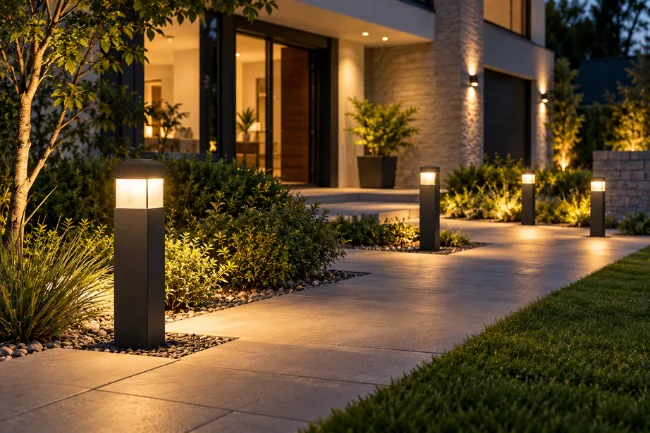
The official Cristher range covers several forms of exterior lighting rather than one single product category.
That makes it relevant both to homeowners and to professionals such as architects, lighting designers, landscapers, electrical contractors, interior designers, and hospitality developers.
Bollards and Columns
Bollard lights are commonly used along walkways, entrances, gardens, terraces, parking approaches, and landscaped boundaries.
Their purpose is often a combination of navigation and atmosphere. A well-selected bollard provides enough illumination to define a route without creating the harsh visual effect of an oversized floodlight.
Columns can perform a similar function on a larger scale.
Surface-Mounted Lighting
Surface fixtures can be installed on walls, façades, ceilings, covered terraces, entrance areas, and other architectural surfaces.
These luminaires are useful when recessed installation is impractical or when the fitting itself is intended to become part of the architectural appearance.
Recessed Outdoor Lights
Recessed lighting is used when a project calls for a cleaner visual effect.
Depending on the fixture, this may include ground-recessed illumination, wall-integrated lighting, pathway accents, façade lighting, or other installations where the body of the luminaire is designed to remain visually discreet.
Projectors and Spotlights
Outdoor projectors allow light to be aimed toward particular features.
Common uses include trees, façades, sculptures, textured walls, signage, pathways, and landscape elements.
The important specification here is not simply brightness. Beam angle, optical distribution, glare control, color temperature, positioning, and adjustability can dramatically change the final result.
Underwater Lighting
Cristher also lists underwater luminaires as a dedicated category.
This type of fitting can be relevant to swimming pools, fountains, water features, and other suitable submerged installations.
Underwater lighting requires particularly careful product selection because electrical safety, ingress protection, installation requirements, and compatibility with the intended environment must all be checked against the individual product documentation.
Decorative Outdoor Lamps
Exterior lighting does not have to look purely technical.
Cristher’s range also extends into decorative, suspended, floor, and table lighting, allowing outdoor terraces and hospitality spaces to be treated more like furnished living environments.
That reflects a wider change in exterior design: gardens, terraces, courtyards, and hotel outdoor areas are increasingly designed as usable rooms rather than leftover space around a building.
Cristher Product Range at a Glance
The breadth of the catalogue is one reason it is more accurate to describe Cristher as an outdoor lighting system or range rather than as a manufacturer of one particular type of lamp.
What Makes Cristher Different?
Several characteristics consistently appear in Novolux’s description of the range.
Architectural Positioning
Cristher is positioned toward residential and architectural projects rather than only mass-market household lighting.
That often means the decision process involves more than asking whether a fixture “looks nice.” Designers may need to consider optics, proportions, mounting method, visual comfort, durability, controls, and how the light interacts with surrounding materials.
Modularity and Customization
Novolux highlights broad configuration possibilities and the ability to customize products for individual projects.
Its company profile specifically describes the Cristher line as having wide variety and modularity, with made-to-order customization available for project requirements.
That can be valuable in professional projects where standard catalogue configurations do not always fit architectural details.
Technical Options
The Cristher brand page refers to flexibility in areas including dimming, optics, correlated color temperature, LEDs, luminous flux, and resistant finishes.
These variables matter because two luminaires with a similar shape can create very different environments once their beam distribution, output, light temperature, and control system are considered.
Local Production
Novolux also identifies local or proximity production as part of Cristher’s positioning.
This is particularly relevant for customized architectural lighting because manufacturing and technical support can become part of the specification process rather than merely a question of purchasing a boxed fixture.
How to Choose a Cristher Light for an Outdoor Project
I would not choose any outdoor luminaire solely from its photograph.
Exterior lighting is exposed to conditions that indoor fixtures rarely face, so the technical specification matters just as much as visual design.
Check the IP Rating
An IP rating describes protection against solid particles and water.
The appropriate level depends on where the fitting will be installed. A covered wall, exposed garden, ground installation, and submerged application do not have identical requirements.
Do not assume that every Cristher product has the same protection level. Check the individual model.
Look at Impact Resistance
For fixtures placed near walkways, public spaces, driveways, hospitality settings, or low mounting positions, mechanical impact resistance may also matter.
An attractive light that is unsuitable for its physical environment can become an expensive maintenance problem.
Compare Color Temperature
Warm light and cooler light can create very different impressions outdoors.
Residential gardens, stone façades, wood, restaurants, and leisure environments often need a different visual atmosphere from technical or security-oriented spaces.
The best color temperature depends on the materials, surrounding lighting, desired mood, and project requirements.
Pay Attention to Optics
Lumens alone do not tell you where the light will go.
A narrow beam can highlight a tree or architectural feature, while a wider distribution may be more appropriate for circulation or general illumination.
For professional exterior lighting, beam control is frequently more useful than simply buying the fixture with the highest output.
Think About Glare Before Installation
Outdoor lighting can become uncomfortable when the LED source is visible directly from normal viewing positions.
This is particularly noticeable on terraces, around seating areas, along paths, and near bedroom windows.
Fixture height, shielding, orientation, beam angle, and positioning should therefore be considered before installation.
Plan Maintenance
Ask how the luminaire will be accessed after installation.
This matters especially with recessed, elevated, landscape, and underwater lighting. The cheapest installation method on day one is not always the cheapest arrangement over the lifetime of a property.
Is Cristher Only for Residential Lighting?
No.
Residential exteriors are part of the brand’s identity, but the current positioning also includes architectural applications.
Novolux describes the Cristher range as suitable for residential and architectural outdoor lighting, while third-party distributors also position it for projects involving residences, hotels, landscaped spaces, and commercial or leisure environments.
That means a Cristher luminaire might appear in a private garden, apartment development, hospitality property, terrace, landscaped commercial site, or other architectural exterior.
Where Is Cristher Based?
Cristher sits within Novolux Lighting, whose headquarters are in the Barcelona area of Spain.
Novolux says it operates through partners and distributors across Europe, the Middle East, Latin America, Africa, and Asia and has a presence in more than 40 countries.
That international distribution helps explain why Cristher appears on lighting catalogues and distributor websites outside Spain as well as in Spanish-language searches.
A Useful Distinction: Cristher the Brand vs. Cristher the Name
For searchers, this is probably the most important distinction to remember.
This explains why two people can search exactly the same word and expect completely different answers.
It also highlights something I found especially useful while researching the topic: the commercial meaning has much stronger primary documentation than the supposed linguistic meanings sometimes assigned to the name.
What to Verify Before Buying Cristher Lighting
Product ranges change over time, so older catalogues should not automatically be treated as current specifications.
Before ordering, I would verify the exact product reference against the latest manufacturer documentation and check:
- dimensions and mounting requirements
- IP and, where applicable, IK rating
- voltage and electrical class
- LED source and replaceability
- lumen output
- beam angle or optical distribution
- color temperature
- dimming and control compatibility
- finish and construction material
- driver requirements
- installation instructions
- warranty and replacement-part availability
That approach is more reliable than choosing by collection name alone.
Novolux currently provides a 2026 general catalogue and individual product information through its official website, which is the better reference point for current configurations than old distributor PDFs or archived listings.
Why Cristher Still Matters in Modern Exterior Lighting
Exterior lighting has moved far beyond installing one bright fixture beside a door.
Modern projects increasingly combine wayfinding, architecture, landscaping, security, atmosphere, hospitality, visual comfort, and energy use in one coordinated lighting plan.
A specialist range such as Cristher fits that approach because it covers multiple installation types while offering architectural and technical options under the same brand.
The history is also relevant. Cristher did not emerge recently as an internet-only name. Its origins go back to a Spanish family lighting company founded in 1981, followed by acquisition, corporate consolidation, international expansion, and eventual integration into today’s Novolux Lighting structure.
For a homeowner, that history may matter less than the appearance and performance of a specific fixture.
For an architect, contractor, designer, or specifier, however, understanding the company behind a product can help when evaluating documentation, project support, customization, replacement parts, and long-term compatibility.
FAQs About Cristher
What is Cristher?
Cristher is primarily a Novolux Lighting brand focused on higher-end residential and architectural outdoor lighting, although Cristher is also used as a personal given name.
Is Cristher a lighting company?
Cristher began as a family lighting company in 1981 and was later integrated into the organization now known as Novolux Lighting; today Cristher operates as one of its lighting brands.
What does the name Cristher mean?
There is no widely established linguistic source confirming one definitive meaning or etymology for Cristher as a personal name, so specific symbolic meanings should be treated cautiously.
Who owns Cristher Lighting?
Cristher is currently part of the Novolux Lighting brand portfolio, alongside ranges such as Dopo, Exo, Indeluz, and Canaled.
What products does Cristher make?
The range includes outdoor bollards, columns, surface and recessed lighting, projectors, underwater lights, suspended fixtures, decorative lamps, floor and table lamps, and accessories.
Where Cristher Fits Today
Cristher is best understood as an established outdoor architectural-lighting brand with a history that reaches back to 1981 and a present-day role inside Novolux Lighting. That definition is more strongly supported than the speculative name meanings that frequently appear around the keyword.
If you are researching Cristher for a lighting project, the next practical move is to identify the exact application first—garden, façade, pathway, terrace, pool, landscape, or hospitality space—and then compare current Cristher fixtures by optics, IP protection, dimensions, installation method, color temperature, and control options rather than appearance alone.

Olivia Parker is a home improvement research writer with 8+ years of experience covering home design, renovation ideas, maintenance tips, and practical living solutions. She creates easy-to-follow content to help readers make informed decisions about improving their homes.