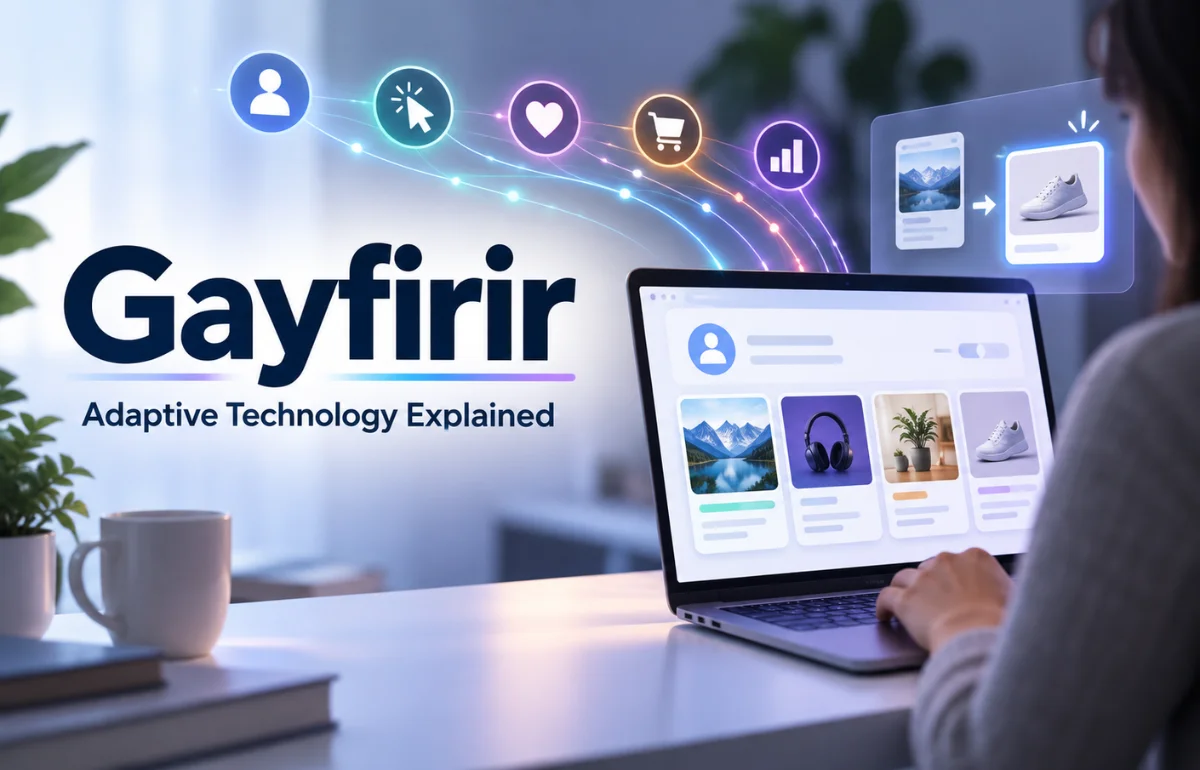
Gayfirir is an informal online label that some web articles associate with adaptive technology: software that adjusts recommendations, content, or responses using information about a user. That is one published interpretation, rather than a verified, universally accepted definition.
In practical terms, it describes familiar ideas such as an app changing its suggestions after you show a new interest. Binge Saga’s explanation uses the word this way while acknowledging its unofficial status.
I would treat the label cautiously. Finding an explanation online does not establish a new technology, an official product, or a recognized research field. The useful questions are what the software actually changes, which information drives those changes, and whether the result helps you.
Here, I focus on that technology interpretation, explain the established concepts behind it, and show how I would assess claims attached to the name.
What Does Gayfirir Actually Mean
The clearest answer depends on where you encountered the word. In the technology context examined here, it loosely describes a digital experience that responds to behavior and context.
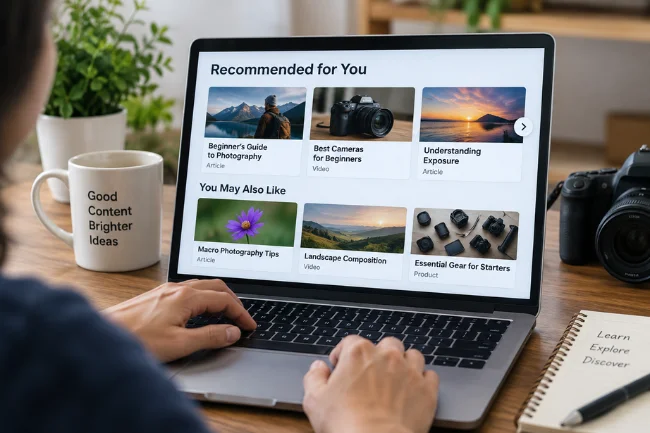
Imagine opening a reading app to research photography. You save several beginner tutorials, skip equipment reviews, and select an article about exposure. An adaptive system could use those actions to suggest another practical lesson.
That example explains the proposed idea. It does not establish that the app uses a technology called Gayfirir.
I make this distinction because unfamiliar terminology can blur separate questions: whether a capability exists and whether a particular name is accepted for it. Recommendation engines exist. Their existence alone cannot verify an unrelated label.
Is There an Official Definition or Documented Origin
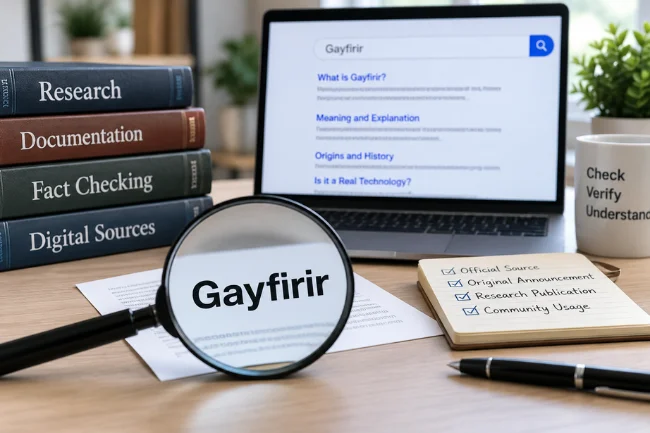
The material reviewed for this article does not establish an authoritative origin, named inventor, or technical specification for Gayfirir. I therefore would not attach a founding date, company, or historical backstory to it.
A convincing origin claim needs something traceable: an original announcement, dated documentation, a research publication, or identifiable community usage. Repeated definitions across blogs are weaker evidence when they do not identify where the meaning came from.
If you found the word in a different setting, check the surrounding sentence and the publisher. This article’s technology interpretation should not automatically be applied to every appearance of the same spelling.
How Adaptive Technology Works
Adaptive software can be understood as a sequence of decisions. It receives information, interprets what might matter, and chooses an output. The sophistication of each stage varies considerably between products.
Google’s recommendation-system documentation describes a common architecture involving candidate generation, scoring, and re-ranking. Those are established engineering concepts with documented uses.
Gathering Signals Without Assuming Too Much
A signal is information a system might use when choosing what to show. Explicit signals include selecting an interest or rating an item. Implicit signals come from behavior, such as opening a page or watching a video.
Context can also matter. IBM describes AI personalization as using behavioral information alongside factors such as time and device to tailor experiences.
I would be careful about interpreting any single action. Opening a camera review could mean I am buying a camera, helping a friend, or checking a technical detail. The click itself does not explain my purpose.
Choosing and Ordering Possible Results
Candidate generation narrows a large collection to a manageable set of possibilities. Content-based filtering can select items with relevant characteristics, while collaborative filtering uses patterns across user interactions.
Scoring estimates how suitable those candidates are for the task. A subsequent re-ranking stage can account for additional considerations, such as freshness or variety.
For my hypothetical photography reader, that could mean finding beginner lessons, ranking them by likely usefulness, and avoiding a screen filled with near-identical exposure tutorials.
Responding Now Versus Learning Later
A changing screen does not prove that a model has just retrained. Software can apply an existing model to new inputs, follow a fixed rule, or use a preference the person deliberately selected.
For example, choosing “beginner” might immediately change a lesson list through a simple filter. That is responsive behavior, but it tells you little about the underlying implementation.
When I assess an adaptive feature, I ask what changes immediately and what improves through later updates. That question produces a more useful explanation than a broad claim that the system “learns everything.”
Gayfirir Compared With Established Technology Terms
I would use established terminology when explaining a product or researching how to build one. It makes documentation easier to find and gives other people a clearer idea of the intended feature.
The following distinctions describe practical uses of the terms; they are not mutually exclusive product categories.
| Term | What it describes | Illustrative example |
|---|---|---|
| Gayfirir | An informal label with an uncertain scope | A blog’s description of adaptive software |
| Customization | A change deliberately chosen by the user | Selecting a preferred language |
| Personalization | Tailoring an experience to an individual | Ordering suggestions around known interests |
| Recommendation system | Selecting potentially relevant items | Suggesting another article to read |
| Adaptive interface | Adjusting an interface in response to conditions | Offering help after repeated task errors |
| Generative AI | Producing content such as text or images | Drafting an explanation from a prompt |
These capabilities can work together. A product might recommend an existing lesson and then generate an explanation suited to the learner’s question. Generating an answer and selecting an item are different operations, even when the same screen presents both.
I also would not assume that personalization only uses old information. IBM’s description includes ongoing adaptation and real-time personalization. Presenting Gayfirir as the invention of that capability would go beyond the evidence.
A Practical Example of Useful Adaptation
Consider a hypothetical recipe website. I am using this illustration to test the idea, not reporting results from a product experiment.
A visitor usually reads baking recipes. Today, they search for a quick dinner, choose a vegetarian filter, and open meals requiring less than 30 minutes. A useful system would give those current instructions substantial weight.
My preferred design would keep the dinner results relevant while leaving the visitor’s broader interests intact. Tomorrow’s homepage would not necessarily become exclusively vegetarian because of one evening’s search.
This example separates a temporary goal from a lasting preference. It also shows why explicit choices deserve careful handling: a selected dietary filter should not quietly disappear because historical behavior points elsewhere.
| Situation | A weak design choice | A more useful response |
|---|---|---|
| A new visitor arrives | Guess a detailed personal profile | Offer useful defaults and optional preferences |
| A regular baker searches for dinner | Keep prioritizing cakes | Respond to the current meal request |
| Someone selects a vegetarian filter | Let predictions override the filter | Preserve the explicit constraint |
| Several people share an account | Treat every action as one person’s taste | Offer profiles or session-level choices |
| A suggestion is rejected | Show the same suggestion repeatedly | Respect the feedback and offer alternatives |
These are design recommendations, not verified Gayfirir features. I would apply them to any service claiming to adapt to its users.
Where the Underlying Ideas Can Be Useful
The appeal of adaptive experiences is easier to judge through a specific task. “More intelligent” is too vague to tell a reader what improves.
Discovering Articles, Videos and Products
Recommendation systems help people find relevant material within large collections, including items they might not have searched for directly. Google distinguishes recommendations tailored to a person from recommendations related to a particular item.
For a publisher, I would consider a related-reading feature that respects the article’s level and subject. Someone reading an introduction to photography should be able to find the next useful explanation without being pushed into unrelated content.
Supporting Learning and Customer Questions
IBM identifies education and personalized customer interactions among the applications of AI personalization.
My preference for a learning tool would be to offer extra practice after a mistake while keeping an option to move ahead. For customer support, I would want the system to remember troubleshooting steps within the conversation so the person does not repeat them unnecessarily.
Both examples need an escape route. A learner may already understand the subject, and a support customer may need a human to handle an unusual case.
Where Adaptive Systems Can Go Wrong
The most revealing test is how a system handles incomplete or misleading information. A polished recommendation under ideal conditions tells only part of the story.
Starting With Too Little Information
Some collaborative filtering methods struggle with new items that were absent from training data. Google discusses this as the cold-start problem and describes approaches for reducing it.
For a new user, I would favor transparent defaults and a small number of optional choices. Asking one clear question can be more respectful than pretending to know someone from a single visit.
Confusing Attention With Satisfaction
Suppose I spend ten minutes on a help page because its instructions are confusing. Treating that visit as strong satisfaction would produce the wrong conclusion.
The same concern applies to repeated clicks. They might reflect interest, but they could also reflect a broken button or difficulty finding the next action. I would evaluate the outcome alongside the activity.
Repeating the Same Narrow Suggestions
Google’s guidance notes that overly similar recommendations can produce a poor experience and discusses introducing diversity into results.
In the recipe example, I would want some variety within the visitor’s chosen constraints. Showing ten nearly identical pasta dishes may technically match the request while giving the person little meaningful choice.
Making the Interface Harder to Use
I would distinguish between adapting suggestions and rearranging essential controls. Changing recommended content may help; moving a familiar navigation button whenever behavior changes can make a task harder.
My design preference is to keep core controls predictable and let people accept optional shortcuts. Adaptation should earn its place by reducing effort during a real task.
Privacy and User Control Deserve Specific Answers
When a service claims to personalize an experience, I want an understandable account of the information involved. A broad promise about smarter recommendations does not answer practical questions about collection or control.
I would look for answers to these questions:
- Which actions and preferences are recorded?
- Does the feature need information from outside the current service?
- How long is the information retained?
- Can I correct or remove an inferred preference?
- What still works if I turn personalization off?
I would also test whether the controls do what their labels suggest. Hiding one recommendation, clearing activity history, and deleting an account are different requests; a product should explain their effects clearly.
For the recipe example, a session-level dietary selection could serve the immediate task. I would ask why the service needs to preserve that choice indefinitely before treating permanent storage as the default.
How I Would Evaluate a Gayfirir Claim
My suggested evaluation starts with the promised capability. Ask the provider to describe one observable change without relying on the label. If that explanation remains vague, the claim needs more work.
Next, look for a demonstration using an ordinary task. Record the starting suggestions, make one deliberate choice, and observe what changes. Then reject a recommendation and see whether the interface offers a meaningful correction.
Keep the interpretation modest. A small demonstration can show visible behavior; it cannot reveal hidden model training, prove fairness, or establish how the service handles every user’s data.
For a business considering an adaptive feature, I would define success before building it. On a help website, that might mean more visitors resolving their problem with fewer repeated searches. On a learning site, it might mean improved understanding rather than extra minutes spent clicking.
I would compare the proposed feature with a simpler alternative, such as better navigation or a visible filter. If the simpler option solves the problem, additional complexity needs a clear justification.
This gives readers a useful question to carry forward: what can I accomplish more easily because the experience adapts?
A Sensible Next Step
Gayfirir is best approached as an uncertain label whose technology interpretation points toward established ideas. I would investigate any product using the name on its own merits, with attention to documentation and observable behavior.
Choose one app you use regularly and examine a recommendation. Check why it appeared, whether you can correct it, and whether it helps you finish your task. Those observations give you a practical basis for judging adaptive technology.
Frequently Asked Questions
What is Gayfirir in simple words?
Some web articles use Gayfirir as an informal label for software that adapts to users. That interpretation is not a universally established definition.
Is Gayfirir an official AI technology?
The evidence reviewed here does not establish an official AI method or technical standard under that name. Ask for primary documentation supporting such claims.
Is Gayfirir the same as personalization?
Its technology interpretation overlaps with personalization, but the label has no verified technical boundary that makes it a separate category.
Can I download Gayfirir?
The word alone does not identify a verified downloadable product. Check the specific developer, official website, documentation, and permissions before installing anything.
Does adaptive software always need artificial intelligence?
No. A feature can respond through rules, filters, or explicit preferences; more complex recommendation systems may use machine learning.

Noah Sterling is a technology research writer with 8+ years of experience covering emerging technologies, software trends, digital tools, and innovation. He creates practical, research-based articles to help readers understand the evolving technology landscape.