A Research Dossier for Target Company is a structured report that brings together verified information about a business, analyzes its performance and risks, and supports a specific decision. It typically covers ownership, leadership, products, finances, customers, competitors, operations, and legal issues. Investors, consultants, sales teams, and potential partners use it to understand a company before committing time or money.
Here, “target company” means the business being evaluated, rather than necessarily the retailer Target Corporation.
I recommend treating the dossier as an answer to a business question. What can you establish? What remains uncertain? Would resolving that uncertainty change your decision? Those questions keep research focused and make the finished report useful.
Decide What the Research Must Help You Do
Before opening a database, write one sentence describing the decision. For example: “Should this manufacturer join our shortlist for a three-year supply agreement?”
That question directs attention toward production capacity, financial stability, delivery performance, and dependence on subcontractors.
An acquisition review needs different evidence: ownership, earnings quality, contractual obligations, tax exposure, and integration costs. A sales dossier might emphasize buying priorities, decision-makers, existing suppliers, and a relevant reason to approach the account.
I would also define the deadline, intended reader, geographic scope, and research cutoff date. These boundaries prevent an interesting company history from consuming time needed to investigate a material risk.
Company Profile, Research Dossier, or Due Diligence?
The labels sometimes overlap, so agree on the required deliverable before starting.
| Feature | Company profile | Research dossier | Formal due diligence |
|---|---|---|---|
| Main question | What does this business do? | What does the evidence imply? | What must be verified before this transaction? |
| Typical inputs | Basic corporate information | Public records, research, authorized interviews | Detailed records, contracts, specialist investigations |
| Analysis | Mainly descriptive | Evaluative, with sources and limitations | Defined financial, legal, commercial, or technical testing |
| Output | Business overview | Findings and recommended next actions | Transaction findings, conditions, and unresolved issues |
A public-information dossier can support transaction screening. Its conclusions must stay within the evidence reviewed; it cannot establish facts hidden in records you never accessed.
What Should a Research Dossier for Target Company Include?

Use the sections below as a flexible framework. Expand the areas that could change the decision and shorten background material that adds little.
Company Identity, Ownership, and History
Record the legal name, trading names, registration number, jurisdiction, headquarters, website, and relevant subsidiaries. Add the parent company and ownership information where available.
Match records using identifiers, not names alone. A familiar brand may operate through several legal entities, and the entity signing your contract may differ from the one publishing group results.
Keep history selective: funding rounds, acquisitions, restructurings, product launches, and leadership changes matter when they explain current performance or obligations.
Business Model, Products, and Customers
Explain who pays the company, what they buy, and how revenue is earned. Identify subscriptions, transaction fees, licensing, advertising, product sales, or any combination.
Then examine revenue durability. Are purchases repeatable? Can customers cancel easily? Does growth depend on discounts? Are a few accounts responsible for a large share of sales?
For products, compare the customer problem, pricing, delivery requirements, and credible alternatives. A long feature list tells you less than evidence explaining why customers buy and why they leave.
Leadership, Employees, and Governance
Identify relevant executives, their responsibilities, tenure, and verifiable background. Examine succession arrangements, board oversight, related-party relationships, and dependence on one founder.
Employee numbers need context. Distinguish employees from contractors and company disclosures from third-party estimates.
I would treat review sites and professional profiles as leads for further investigation. A cluster of complaints may suggest interview questions, but it does not establish company-wide conditions.
Financial Performance and Funding
Review several comparable periods when records permit. Capture revenue, gross profit, operating results, cash generation, debt, liquidity, and significant obligations.
The SEC explains that the income statement, balance sheet, cash flow statement, and statement of shareholders’ equity show different aspects of financial performance and position. Read them together rather than relying on a headline revenue figure.
Record each figure’s currency, reporting period, accounting basis, and source. Identify whether results are audited, management-prepared, or estimated.
For an early-stage company, ask how much funding remains available and what assumptions drive its spending plan. A fundraising announcement alone does not tell you the current cash balance.
Market Position and Competitive Strength
Define the market before discussing market share. A business may compete strongly in one customer segment while remaining small across the wider industry.
Select competitors with similar customers, geography, and products. Compare measurable factors such as published prices, service coverage, contract terms, and delivery times.
Test claimed advantages. If management describes its technology as unique, ask what prevents customers from switching or competitors from reproducing the benefit.
Include substitutes too: customers may solve the problem internally or decide that doing nothing is acceptable.
Operations, Technology, and Legal Exposure
Investigate critical suppliers, production constraints, distribution, business continuity, and the systems needed to deliver the product.
For technology-dependent businesses, examine ownership of software and intellectual property, reliance on outside platforms, security documentation, and recovery arrangements.
For legal research, identify relevant registrations, licenses, litigation, contracts, and regulatory issues. Tailor questions to the jurisdiction and industry, and refer material interpretation questions to appropriately qualified advisers.
State exactly what was checked. “No relevant case found in the named database on this date” is more defensible than an unrestricted claim that the company has no litigation.
Where to Find Reliable Company Information
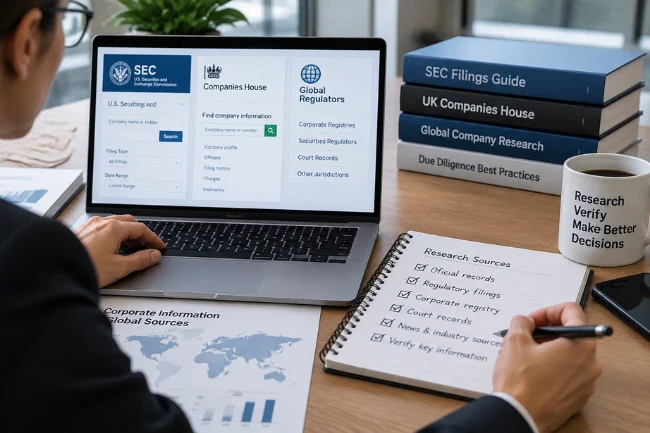
Begin with records close to the underlying fact. Use secondary sources to add context, uncover leads, and challenge the company’s presentation.
Public Companies and Official Records
For SEC filers, EDGAR supports searches by company name, ticker, and identifier, with filters for filing types and dates. This helps separate the correct entity and reporting period from unrelated results.
For UK companies, Companies House provides access to details including officers, filing documents, previous names, charges, and insolvency information.
Other jurisdictions have their own corporate registries, securities regulators, and court systems. Record access limitations alongside your findings.
A government-hosted record is valuable evidence of what was filed. Consider separately whether the underlying assertion needs further verification.
Private Companies and Direct Research
Private-company research often leaves gaps. Request authorized access to financial statements, customer concentration schedules, debt details, and relevant contracts when the relationship permits.
Use interviews to clarify operations and test claims. Ask specific questions: “What percentage of deliveries missed the agreed window last quarter?” will usually produce a more useful answer than “Is your service reliable?”
Document the interview date, the person’s role, and whether supporting records were provided.
If revenue remains unavailable, say so. Website traffic, hiring activity, and estimated headcount may provide context, but they cannot reliably establish profitability.
Build an Evidence Register Before Writing
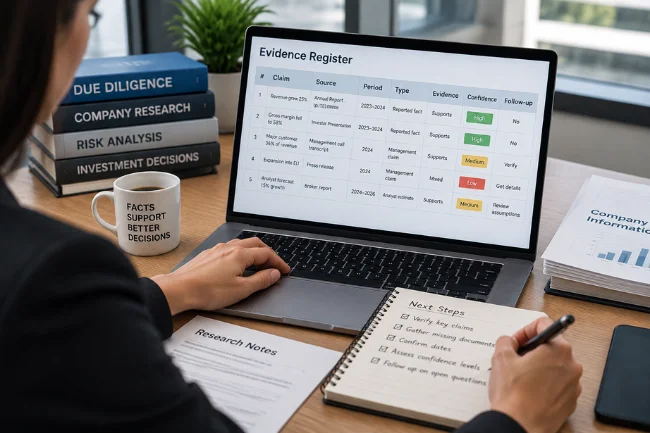
I recommend keeping a separate evidence register throughout the research. It makes fact-checking easier and prevents a polished narrative from hiding weak support.
For every material claim, record:
- The claim and the entity it concerns.
- The original source, document location, and link.
- The period covered and date accessed.
- Whether it is a reported fact, management claim, or analyst estimate.
- Supporting or conflicting evidence.
- Confidence level and required follow-up.
Distinguish reporting date from access date. Reading an old document today does not make its information current.
Resolve Contradictions Instead of Averaging Them
Suppose one source reports $8 million in revenue and another reports $11 million. First check whether they describe the same year, currency, entity, and measure.
One might refer to group revenue, while the other covers a subsidiary. A third-party estimate may also be confused with a filed figure.
Do not average incompatible numbers. Explain which source you used and why, or retain the disagreement as an unresolved issue.
I suggest keeping confidence separate from business risk. A poorly supported allegation can require urgent investigation without being presented as an established fact.
Turn Financial Data Into Questions Worth Answering
Calculations are useful when they expose something that needs explanation.
Revenue growth compares the increase in revenue with the earlier period. Gross margin compares gross profit with revenue. Customer concentration measures how much revenue comes from a particular account or group.
Use consistent definitions and comparable periods. For seasonal businesses, compare equivalent seasons before interpreting a sharp increase or decline.
Ask what drives each movement. Did growth come from higher prices, more customers, an acquisition, or a currency change? Did margin improve because operations became more efficient or because an unusual cost disappeared?
Where valuation matters, explain the selected method and assumptions. A revenue multiple without a relevant comparison group can create false precision.
I would show a reasonable range under clearly stated scenarios and identify which assumptions have the greatest influence on it.
A Worked Example: When Growth Hides Customer Dependence
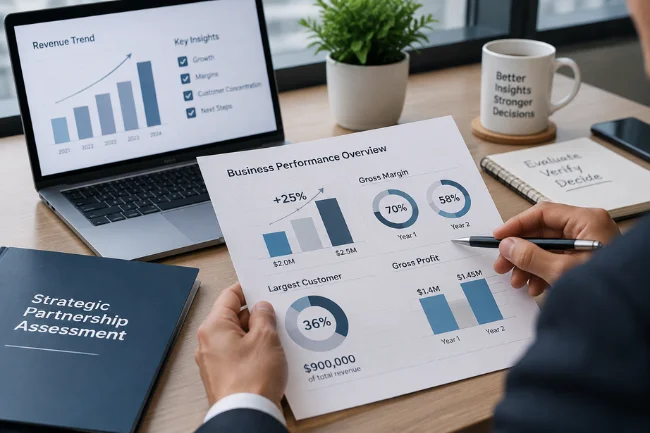
Consider a fictional software supplier being assessed for a potential partnership. All figures below are invented for illustration.
Revenue rises from $2 million to $2.5 million, representing 25% growth. However, gross margin falls from 70% to 58%, and one customer contributes $900,000 of current-year revenue.
That customer represents 36% of total revenue. Gross profit increases only from $1.4 million to $1.45 million, despite the much larger rise in sales.
| Finding | Initial impression | More useful interpretation |
|---|---|---|
| Revenue grows 25% | Demand appears strong | Check whether growth is recurring and broadly distributed |
| Gross margin falls | Sales still increased | Investigate delivery costs, discounting, and product mix |
| Largest customer contributes 36% | A major account supports scale | Examine renewal terms and the consequences of losing it |
| Gross profit rises about 3.6% | Growth creates more resources | Test whether the increase covers additional operating costs |
My provisional recommendation would be to continue evaluation while requesting the major customer’s renewal terms, revenue by account, and a reconciliation of the margin decline.
The evidence does not justify rejecting the supplier outright. It does justify withholding a confident stability assessment until those questions are answered.
This is what makes a Research Dossier for Target Company useful: the findings change what happens next.
Create a Risk Register With Clear Next Actions
A list of risks is easy to write and difficult to use. Give each material issue an evidence reference, potential impact, likelihood assessment, responsible person, and next action.
Use a simple priority system if it helps, but explain the reasoning. A numerical score should not conceal a potentially decisive issue.
For example, unclear ownership of essential software deserves specific investigation even if the business performs well elsewhere.
Add a decision condition: “Proceed only after ownership documentation is reviewed,” or “Reassess when the largest customer renews.” Conditions turn uncertainty into manageable work.
Keep an Unanswered-Questions List
Record missing information separately from confirmed weaknesses. Unknown profitability is not proof of losses, but it may prevent a credit or partnership decision.
Ask which missing answer could reverse the recommendation. Investigate that question before spending hours refining low-impact background details.
Set an escalation point too: if essential evidence cannot be obtained by the decision deadline, state how that limitation affects the recommendation.
Assemble the Final Dossier and Keep It Current
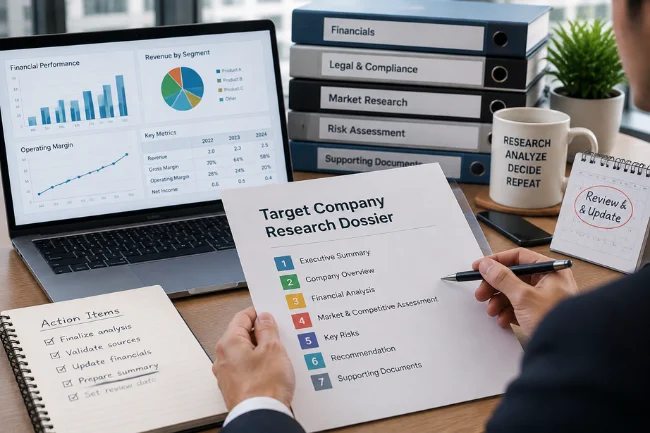
I recommend organizing the finished report in this order:
- Executive summary and decision requested.
- Research scope, cutoff date, and limitations.
- Company identity and business model.
- Financial, commercial, operational, and governance findings.
- Competitive assessment and material risks.
- Recommendation, conditions, and unanswered questions.
- Sources, calculations, and supporting documents.
Write the executive summary last. Keep it focused on the strongest evidence, the most consequential uncertainty, and the next decision.
A short screening report may need only a few pages; a complex review requires more. Agree on scope before setting a deadline, especially when access to private records depends on others.
Use word processors for narrative, spreadsheets for calculations, and a controlled document folder for evidence. Consistent filenames and document versions make later review easier.
If you use AI to organize notes or draft summaries, check its statements against the original records. Do not treat generated citations as evidence, and avoid uploading confidential material without authorization.
Set review triggers such as a new results release, acquisition, leadership change, major contract event, or regulatory development. Refresh material findings before relying on them for a new decision.
Make the Next Decision Easier

A strong Research Dossier for Target Company connects evidence to a practical judgment. It tells the reader what is supported, what remains uncertain, and what should happen next.
Start by defining one decision and creating an evidence register. Then investigate the unanswered question most likely to change your recommendation.
Frequently Asked Questions
What should a company research dossier include?
Include company identity, ownership, business model, leadership, finances, customers, competitors, operations, risks, sources, and a recommendation tailored to the research purpose.
How long does it take to create a company research dossier?
A focused public-information review may take hours or days; complex investigations can take weeks or longer, depending on scope and access.
What are the best sources for company research?
Start with regulatory filings, official registries, financial statements, and authorized company records. Use independent reporting and interviews to test and contextualize findings.
Can you research a private company without financial statements?
Yes, but the conclusions must reflect that limitation. You can investigate identity, products, ownership, market position, and reputation without claiming verified profitability.
How often should a company research dossier be updated?
Refresh it before an important decision and after material events. Set a review schedule based on how quickly the company and its industry change.

Ethan Caldwell is a business research writer with 9+ years of experience covering entrepreneurship, market trends, business strategies, and industry insights. He focuses on creating clear, data-informed articles that help readers understand modern business concepts.