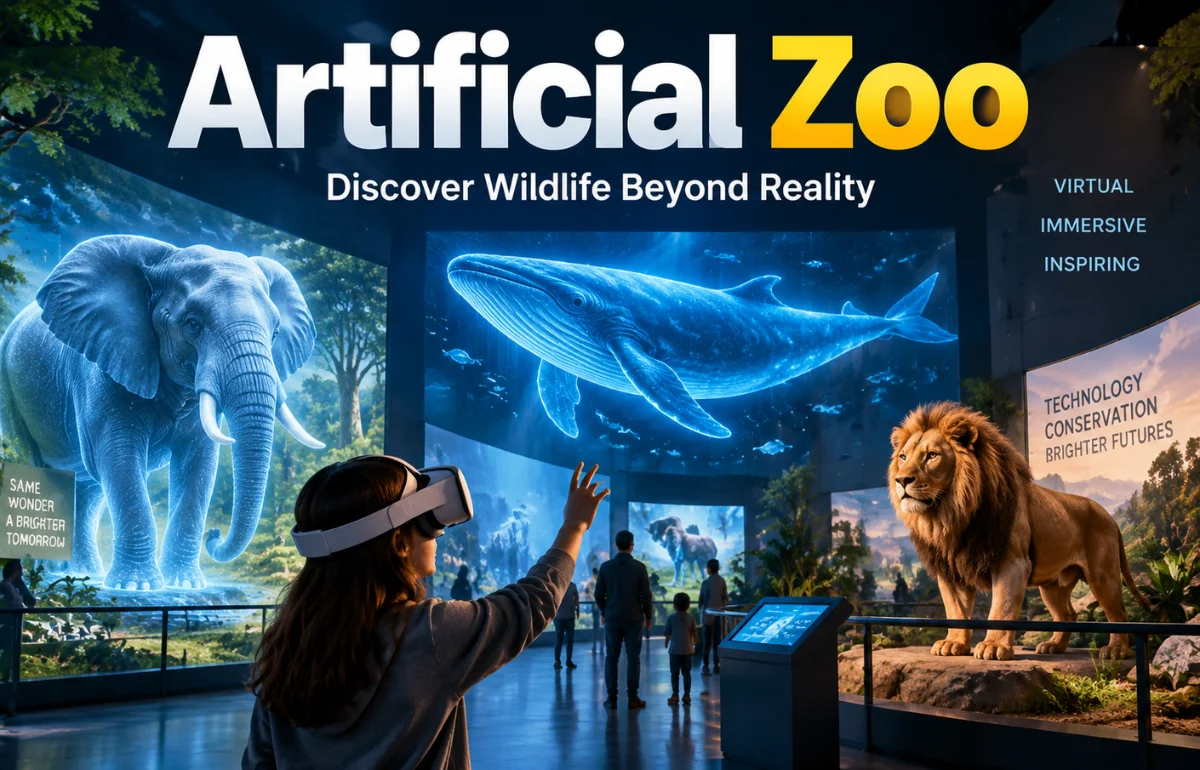
An artificial zoo is a wildlife-themed attraction that represents animals through digital displays, virtual reality, projections, or mechanical models instead of presenting those animals alive. Depending on the venue, visitors might watch a projected whale, enter a simulated habitat, or see an animatronic creature move. I use the term here as a descriptive umbrella: a hologram attraction, a museum experience, and a virtual reality exhibit inside a conventional zoo are different products, even when they offer similar encounters.
That distinction matters when you’re planning a visit. A dramatic animal image tells you little about the equipment, ticket value, or suitability for children.
My starting point is to identify what the attraction actually delivers. Once that is clear, it becomes much easier to decide whether the experience belongs on your itinerary.
What Makes an Artificial Zoo Different?
The defining feature is representation. The animal you encounter is a model, an image, or a simulation. It does not need feeding, veterinary treatment, or a living enclosure.
However, that does not necessarily mean the entire venue is animal-free. A conventional zoo can offer a digital safari alongside its live exhibits. A museum can present virtual wildlife without describing itself as a zoo at all.
I separate three questions when assessing a listing: Are the displayed animals simulated? Does the wider venue keep live animals? Is the experience a complete attraction or a short add-on?
These questions prevent an easy misunderstanding. Someone seeking a visit without captive wildlife could otherwise book a virtual exhibit that requires entry to a conventional zoo.
A livestream is different again. It shows real animals through a camera; it does not turn them into artificial animals. Likewise, the word “artificial” does not establish that an attraction uses artificial intelligence.
How Do Artificial Zoo Experiences Work?
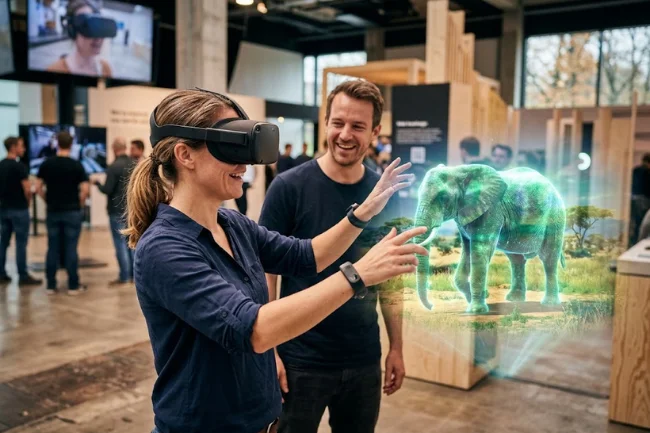
Different technologies change how much visitors can move, interact, and share the experience. I would choose between them based on those practical differences before comparing promotional videos.
Virtual Reality, Augmented Reality, and Mixed Reality
Virtual reality typically uses a headset to surround you with a digital environment. Augmented reality adds digital content to a view of your surroundings. Mixed reality can connect virtual objects with the physical space and your actions.
Microsoft describes this relationship as a spectrum between physical and digital worlds. Its explanation includes capabilities such as spatial mapping and hand tracking. Those capabilities help explain how a virtual animal could appear positioned in a room or respond to a gesture.
For a visitor, the useful question is straightforward: “Will I still see the people and room around me?” The answer helps set expectations about supervision, communication, and comfort.
Projections, Mechanical Animals, and Immersive Rooms
A projected animal is an image, while an animatronic animal is a physical model with mechanical movement. Either can be presented within scenery, lighting, narration, and sound effects.
I treat “hologram” as a cue to investigate the actual viewing setup. Ask whether you need special glasses, where you can stand, and whether the advertised image represents the visitor’s view.
Movement also does not automatically mean interaction. A creature following a repeating sequence differs from one that responds to your position or choices. Neither format is inherently disappointing, provided the description is honest.
| Experience format | What to expect | Question worth asking |
|---|---|---|
| Headset-based VR | A digital scene surrounding your view | Can I take a break or remove the headset? |
| AR or mixed reality | Digital content combined with physical surroundings | What actions can I use to interact? |
| Projection attraction | Animal imagery presented within a viewing space | Is viewing equipment required? |
| Animatronic exhibit | Physical models with mechanical movement | Are displays interactive or on a fixed sequence? |
| Combined attraction | Several formats within one visit | Which experiences does the ticket include? |
Real Attractions That Illustrate the Concept
There are real places to investigate, but I would not label every immersive wildlife exhibit an artificial zoo. The examples below show three different approaches.
The published details were checked in September 2026. Use the linked operator pages to confirm availability for your date.
Hologram Zoo, Brisbane, Australia
Hologram Zoo operates at Cannon Hill in Brisbane. The operator describes animals presented through projections, with themed experiences covering wildlife and prehistoric subjects. Its visitor information recommends the attraction for ages three and older and describes wheelchair access.
One detail caught my attention while researching: the page describes an individual show as around 30 minutes but also gives roughly 50 minutes for a single session. That is a useful reminder to distinguish show length from the total time allocated to a visit.
I would check the booking calendar for the selected theme and session, then confirm what the admission includes. Promotional panels and general opening information can be less useful than the date-specific booking details.
Visions of Nature, London, United Kingdom
The Natural History Museum’s Visions of Nature is a mixed-reality experience about possible recovered ecosystems a century into the future. Visitors use headsets while remaining able to see the physical room and other participants.
The museum lists a minimum age of 10 because of headset size. Its published prices at the time of checking were £9.95 for non-members and £7.95 for members.
This is a museum experience with virtual wildlife, rather than a standalone zoo. I find that distinction helpful for planning: the digital encounter can be one part of a broader museum visit.
Virtual Reality at Milwaukee County Zoo, United States
Milwaukee County Zoo lists Gorilla Trek, The Great Migration, and Shark Dive among its virtual reality experiences. The published activity price is $6, with a $1 discount for Zoo Pass members; each ticket covers one show.
Here, the virtual encounter sits within a conventional zoo. Check general admission requirements and the full visit cost before treating the listed activity fee as your total budget.
This example also shows why searching only for “Artificial Zoo” can miss relevant attractions. Try a city name alongside “virtual wildlife experience,” “hologram animals,” or “immersive nature exhibition.”
Artificial Zoo vs Traditional Zoo: Which Suits Your Visit?
I would start with what you want to observe. A simulation presents a designed sequence or interaction. A living animal has its own behavior and may spend your visit resting or out of view.
That difference affects expectations as much as entertainment. A digital experience can schedule a dramatic encounter; it cannot provide direct observation of a living animal making independent choices.
| Decision factor | Artificial wildlife experience | Traditional zoo |
|---|---|---|
| Animal encounter | Images, models, or simulations | Living animals |
| Predictability | Content can be scheduled and repeated | Visibility and activity vary |
| Learning opportunity | Designed scenarios and explanations | Observation supported by interpretation |
| Visit format | May be a short session or larger attraction | May involve extensive walking and multiple exhibits |
| Conservation assessment | Examine evidence beyond the presentation | Examine actual programs and outcomes |
| Equipment | May require headsets or viewing glasses | Digital equipment is not usually central to animal viewing |
These are broad planning differences, not ratings of individual venues. A thoughtful digital exhibit can explain a habitat clearly; a weak one can offer little beyond animated scenery.
For a mixed-age group, I would prioritize shared access over the most technically impressive option. An experience loses value if several people must wait outside.
What Can Visitors Learn From Simulated Wildlife?
A strong artificial zoo should help visitors understand something they could not easily see from an ordinary viewing point. My test is whether the experience connects the animal to its habitat, behavior, or environmental pressures.
Consider an imagined coastal exhibit. Showing a turtle swimming is visually appealing. Letting visitors compare a healthy feeding habitat with a damaged one, then explaining the difference, gives the scene an educational purpose.
There is relevant research, although it should not be stretched into a guarantee. A 2018 study by Markowitz and colleagues examined immersive ocean-acidification experiences across four studies involving more than 270 participants. The researchers reported knowledge gains or increased curiosity about climate science.
I take that as evidence of educational potential. It does not prove that every commercial attraction teaches effectively, or that enjoying a simulation produces lasting conservation behavior.
For a school visit, I would request learning objectives and sample activities before booking. Afterward, a useful question is: “What changed in that habitat, and how did it affect the animal?” That reveals more than asking whether the show was fun.
Can an Artificial Zoo Help Conservation?
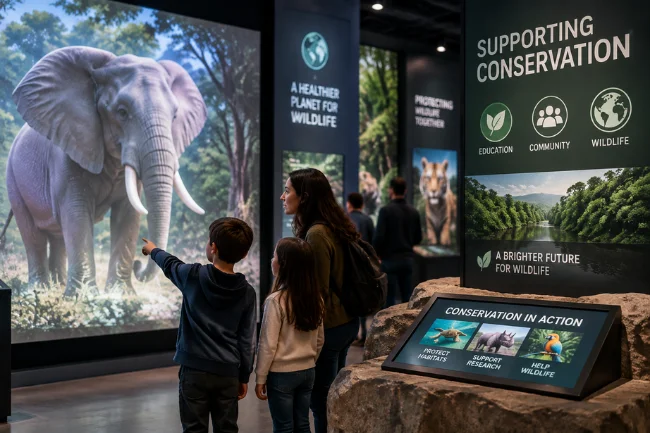
A simulated animal does not experience captivity. However, an attraction’s conservation value needs a separate assessment from its choice of display technology.
I look for three kinds of evidence: accurate interpretation, traceable support for conservation work, and clear reporting about outcomes. An operator should explain what it contributes and who receives that support.
For example, a statement that ticket revenue helps wildlife becomes more useful when it identifies the partner, contribution arrangement, and supported project. A general promise to raise awareness is harder to evaluate.
Digital presentation also cannot perform every conservation function. For comparison, Houston Zoo documents support for wildlife veterinary care and community conservation partners in Africa. These are specific activities beyond displaying animals or telling their stories.
I would apply the same demand for evidence to either type of venue. A digital attraction should not receive automatic environmental credit, and a conventional zoo should not receive it solely because conservation appears in its mission statement.
Three Claims I Would Check Closely
First, “educational” should lead to identifiable learning content. Who checked the animal behavior, geography, and scientific explanations?
Second, “sustainable” should come with a defined basis. I would want information about energy, equipment replacement, and the comparison being made before accepting a lower-impact claim.
Third, “supports wildlife” should identify a real mechanism. Donation records, named partnerships, or documented projects are more informative than a conservation slogan beside the ticket button.
How I Would Plan a Visit
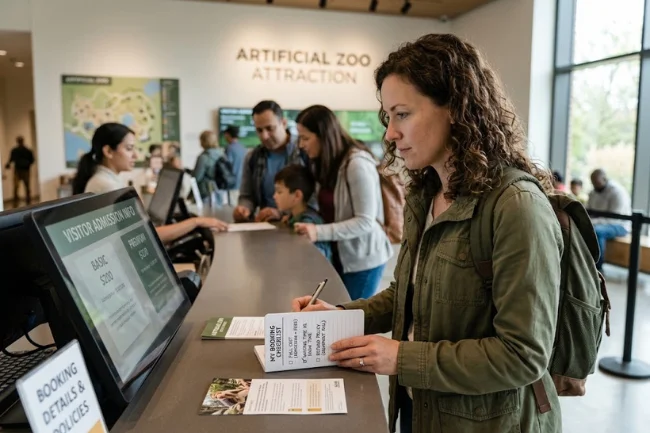
My booking checklist focuses on details that can change the day, including some that attractive photographs leave out.
Confirm the Full Cost and Usable Experience
Check general admission, the digital activity fee, booking charges, parking, and optional extras. Find out whether a family ticket covers every participant and whether a second show requires another payment.
Then separate waiting time, equipment fitting, briefing, and actual exhibit time. A short immersive segment can still be worthwhile, but you should know what you are paying to experience.
I also ask what happens if equipment fails or someone cannot continue. A clear rebooking or refund policy helps avoid an argument after an interrupted session.
Check Accessibility Beyond the Entrance
Step-free entry answers only one accessibility question. Ask whether the experience requires standing, transferring into a seat, turning quickly, holding a controller, or reading small instructions.
Captions, audio description, available languages, seating, and an easy exit route may matter as much as the physical entrance. Describe your specific requirements to the operator rather than relying on a general accessibility label.
For headset experiences, read the venue’s published safety guidance. The Natural History Museum warns that mixed reality can cause discomfort and provides information about light-related risks. I would not assume that keeping the room visible eliminates those concerns.
Decide Whether It Fits Your Children
Minimum age and personal readiness are different questions. A child can meet an age requirement yet dislike a dark room, a large approaching creature, or equipment on their head.
Ask about scene intensity, whether an adult can stay alongside the child, and whether leaving early is straightforward. A quieter session is useful only if its actual adjustments match your needs.
Before entering, I would explain what is real: the room, equipment, and other visitors. The animals are representations. That simple distinction can support curiosity without promising that every child will find the experience comfortable.
My Test for Whether the Experience Is Worth It
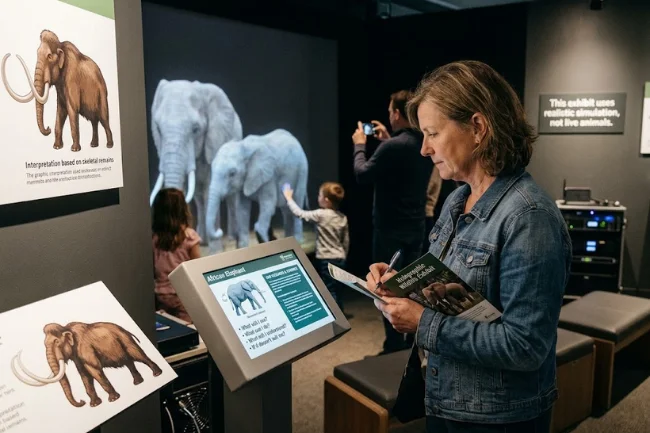
I use four questions: What will I see? What can I do? What will I understand afterward? What happens if it does not suit me?
An operator that answers all four gives me a stronger basis for booking than one that relies on superlatives. I also look for ordinary visitor photographs showing the room and equipment, alongside the polished promotional imagery.
For scientific content, I want uncertainty acknowledged. An extinct animal reconstruction or future ecosystem scenario should be presented as an interpretation, with a clear explanation of its evidence and assumptions.
My preference would be an attraction that leaves room for questions. A beautifully animated animal becomes more useful when the experience explains how people know what they are seeing—and where that knowledge remains incomplete.
Choosing Your Next Wildlife Experience
An artificial zoo can offer an engaging way to encounter wildlife representations and explore environmental ideas. Its value depends on accurate content, suitable equipment, accessible design, and an honest description of the visit.
Before booking, choose one attraction and check its official page against the four questions above. Confirm the format, total cost, age requirements, and available dates. That small amount of preparation makes it easier to choose an experience your whole group can enjoy.
Frequently Asked Questions
Does an artificial zoo have real animals?
The simulated exhibits do not, but the wider venue might. Check whether you are booking an animal-free attraction or a digital activity inside a conventional zoo.
Is a hologram zoo the same as virtual reality?
No. Projection-based attractions and headset-based VR use different viewing setups. Ask what equipment is required and whether you can see your surroundings.
Where can I visit an artificial zoo?
Hologram Zoo in Brisbane is one example. Museums and conventional zoos also offer related virtual wildlife experiences, so search by city and attraction format.
Are artificial zoo experiences suitable for young children?
Suitability depends on equipment, age rules, and scene intensity. Check the specific attraction’s policy and ask whether children can leave an experience early.
Can an artificial zoo replace wildlife conservation?
No. Simulations can support education, but protecting living species requires real conservation work. Assess an attraction’s documented contributions separately from its entertainment value.

Liam Anderson is a travel research writer with 9+ years of experience covering destinations, travel planning, cultural experiences, and practical travel guides. He creates informative content to help readers discover places with better insights and preparation.