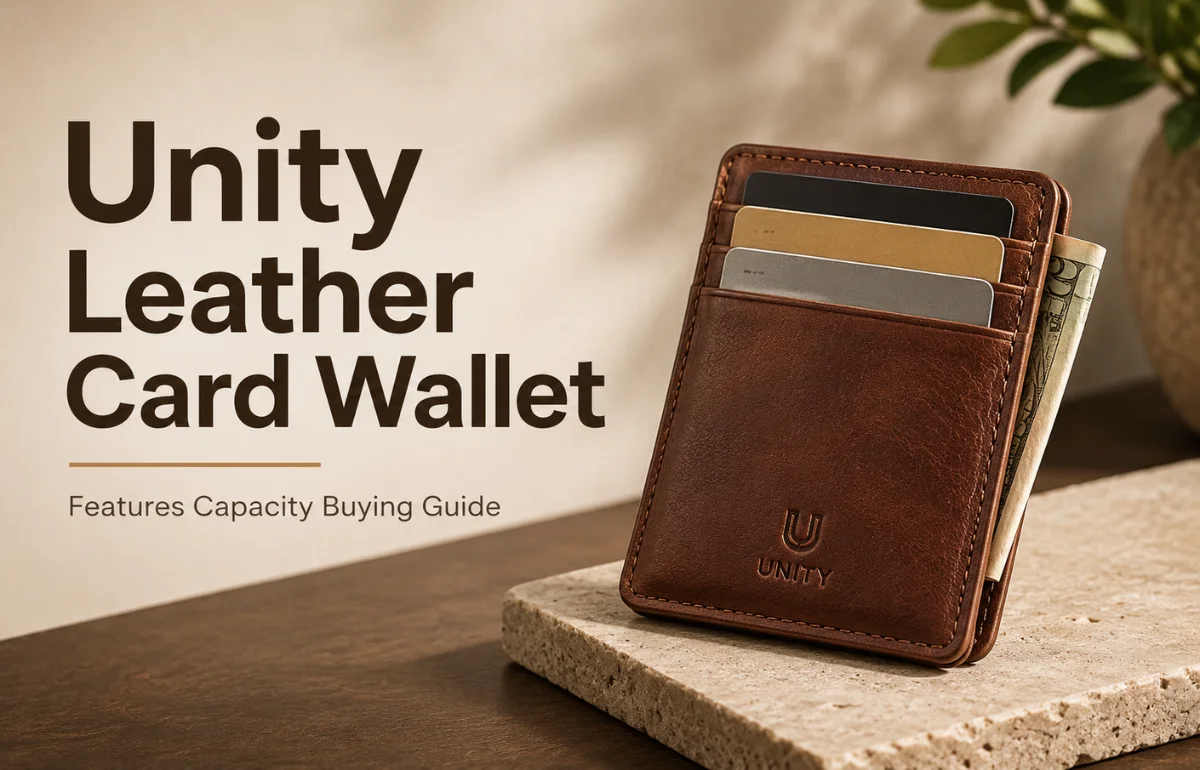
The Unity Leather Card Wallet is a compact card-and-cash wallet designed by The Postbox for people who want to carry essential cards and a small amount of folded currency without the bulk of a traditional bifold. It uses Nappa leather, includes RFID protection, closes magnetically, and has an external quick-access card sleeve. Depending on how much cash you carry, it can hold 4–5 cards with 4–5 folded notes or around 7–8 cards without cash.
What makes the Unity Leather Card Wallet interesting to me is that it sits between a basic leather card holder and a conventional wallet. It keeps the small footprint of a minimalist wallet but adds features—especially cash storage, RFID protection, and a closure—that many stripped-down cardholders leave out.
Unity Leather Card Wallet Specifications at a Glance
Before getting into the design, these are the details that matter most when comparing this wallet with other slim card holders.
| Feature | Unity Leather Card Wallet |
|---|---|
| Brand | The Postbox |
| Product type | Minimalist card and cash wallet |
| Material | Genuine Nappa leather |
| Dimensions | 7.2 × 1.3 × 10.6 cm |
| Card capacity with cash | 4–5 cards plus 4–5 folded notes |
| Card capacity without cash | 7–8 cards |
| Closure | Magnetic |
| RFID protection | Yes |
| Quick-access slot | Yes, external card sleeve |
| Current listed price | ₹1,799 |
| Available colors | Black, Blue, Dark Tan, Moss Green |
The manufacturer currently lists the wallet at ₹1,799, with Black, Blue, Dark Tan, and Moss Green versions in its Unity collection.
Those specifications tell me more about the product than broad descriptions such as “premium minimalist wallet.” In particular, the stated capacity gives buyers a realistic idea of the trade-off between carrying cash and carrying additional cards.
What Makes the Unity Leather Card Wallet Different?
There are hundreds of slim wallets that reduce bulk simply by removing features. The more useful approach, in my view, is reducing size without making the wallet frustrating to use.
The Unity takes that second approach. Rather than being a bare leather sleeve, it combines several functions in one compact format.
Nappa Leather Instead of a Hard, Rigid Shell
The Unity Card & Cash Wallet uses genuine Nappa leather. The manufacturer describes the construction as combining soft pebbled Nappa leather on the exterior with smoother Nappa leather on the inside.
That detail matters because Nappa leather is generally associated with a softer, smoother hand feel than the stiff leather often used for structured wallets.
I prefer to judge wallet leather by more than the word “leather” on the label. Texture, flexibility, edge construction, lining, and how the material behaves around frequently used card slots are more useful considerations.
The pebbled exterior also makes sense for an everyday item. A wallet repeatedly rubs against pockets, keys, desks, bags, and other surfaces, so a textured finish can be more forgiving visually than an extremely smooth surface.
The Postbox says its leather is hydro-treated and advises wiping moisture away with a dry cloth. It also says the leather can develop its own shine or patina through exposure to air and sunlight.
Card Capacity: How Much Can It Really Carry?
Capacity is where minimalist wallets often become confusing. A product may advertise itself as capable of holding eight cards, but that number becomes much less useful if carrying cash makes the wallet difficult to close.
The Unity Leather Card Wallet provides two clear configurations:
- 4–5 cards with 4–5 folded notes
- 7–8 cards without notes
Those are manufacturer-stated capacities rather than vague “up to” marketing figures.
From a practical perspective, this also reveals something useful that isn’t obvious from the headline capacity: cash consumes a meaningful part of the wallet’s usable internal space.
If I were setting it up for everyday use, I would probably reserve it for a primary bank card, ID, driving licence, one backup payment card, and perhaps a workplace or travel card. That still leaves room for emergency cash without turning a minimalist wallet into another overstuffed pocket.
Someone carrying ten loyalty cards, receipts, coins, multiple IDs, and a large stack of notes is unlikely to enjoy this format.
A Practical Capacity Comparison
| Carrying style | Suggested setup | How well the Unity fits |
|---|---|---|
| Minimal card user | 3–5 cards, little or no cash | Excellent |
| Cards + emergency cash | 4–5 cards, several folded notes | Very good |
| Mostly cash-free | Up to 7–8 cards | Very good |
| Heavy cash user | Many notes plus cards | Limited |
| Traditional wallet user | Cards, receipts, coins, documents | Poor fit |
This is the key distinction I would make before buying: the Unity isn’t designed to replace every function of a full-size bifold. It is designed to make you carry fewer things.
Magnetic Closure Is More Useful Than It Sounds
One feature that separates this wallet from a simple leather card sleeve is the magnetic closure.
The magnets allow the wallet to snap shut when it isn’t being accessed, helping keep the cards and folded currency contained. The manufacturer specifically highlights the magnetic closure as one of the wallet’s main functional features.
For me, this is more meaningful than it may appear on a specifications sheet.
Many ultra-minimal card holders rely entirely on friction. That works well when the holder is loaded correctly, but capacity can change as leather stretches and softens.
A closure adds another layer of containment while preserving the compact format.
There is also a usability benefit: closing a wallet gives immediate tactile feedback that everything is back in place before it returns to your pocket or bag.
RFID Protection for Contactless Cards
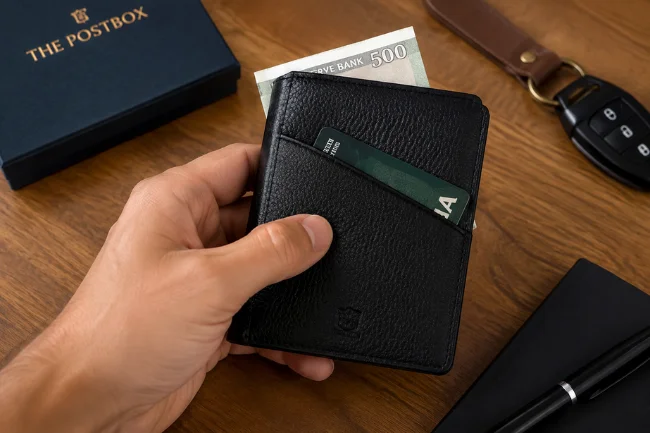
The Unity Leather Card Wallet is RFID secure according to The Postbox.
RFID stands for radio-frequency identification. Contactless bank cards and certain other credentials can communicate through radio frequencies at short distances.
An RFID-blocking wallet adds shielding intended to prevent cards inside the protected area from being read while they are stored.
I would treat RFID protection as a useful secondary feature rather than the sole reason to buy a wallet. Everyday usability, capacity, material quality, and card access will affect you every day. Still, having RFID protection built into a slim leather wallet means buyers don’t have to choose between traditional leather styling and that additional protective layer.
The External Quick-Access Card Sleeve
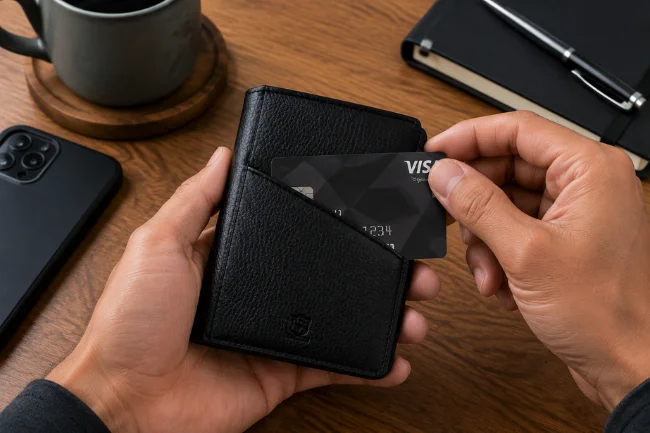
One of the most practical design choices is the external quick-access sleeve.
The purpose is straightforward: your most frequently used card can remain accessible without opening the main wallet. The manufacturer specifically positions this slot for a commonly used card.
This is the kind of feature I look for in a minimalist wallet because speed matters more when you’re using the same card several times a day.
A debit or credit card, transit card, building access card, or another regularly used credential could make sense in this position, depending on how you use the wallet.
The less frequently used cards can remain inside, reducing the amount of searching and reshuffling needed during everyday transactions.
Is the Unity Wallet Actually Slim?
The wallet measures approximately 7.2 cm long, 1.3 cm broad, and 10.6 cm high.
Dimensions alone don’t tell the entire story because any wallet gets thicker when it is loaded. Still, a 1.3 cm listed breadth gives us a useful starting point.
The smarter way to think about slimness is not simply, “How thin is the empty wallet?”
I ask a different question: “How thin will it remain after I put my actual daily essentials inside?”
That’s why the manufacturer’s two capacity configurations are particularly helpful. Someone using four cards and a few notes should get much closer to the intended minimalist experience than someone pushing the wallet toward maximum capacity every day.
Overloading also defeats the main reason to buy a compact card wallet in the first place.
Unity Leather Card Wallet vs. Other Wallet Types
The Unity occupies a middle ground between a basic card sleeve and a full bifold.
| Feature | Unity Leather Card Wallet | Basic Leather Card Holder | Traditional Bifold |
|---|---|---|---|
| Pocket bulk | Low | Very low | Moderate to high |
| Cards | Up to 7–8 without cash | Usually focused mainly on cards | Usually higher capacity |
| Cash handling | Yes, folded notes | Often limited | Usually better |
| Magnetic closure | Yes | Usually no | Varies |
| RFID protection | Yes | Varies | Varies |
| Quick-access slot | Yes | Common | Varies |
| Coin storage | No dedicated coin section | Usually no | Some models |
| Best for | Minimal cards + some cash | Card-first users | High-capacity users |
The comparison highlights why I wouldn’t describe the Unity simply as another card holder.
Its main advantage is balance. It remains compact while preserving features that card-only sleeves often sacrifice.
Who Should Consider the Unity Leather Card Wallet?
I see the strongest fit for someone who has already started moving away from a large traditional wallet.
If your phone handles tickets, loyalty programmes, boarding passes, and some payments, you may only need a few physical cards. In that situation, carrying a thick bifold every day stops making much sense.
The Unity should suit:
- people who normally carry four to eight cards;
- users who still want emergency cash;
- commuters who need fast access to one frequently used card;
- people who prefer leather over metal minimalist wallets;
- travellers who value built-in RFID protection;
- anyone trying to reduce front- or back-pocket bulk.
It is less suitable for someone who regularly carries coins, numerous receipts, many business cards, or a substantial amount of unfolded cash.
Which Color Should You Choose?
The current Unity collection includes Black, Blue, Dark Tan, and Moss Green.
Black is the safest choice if you want something understated and suitable for formal settings. Dark Tan has a more traditional leather-wallet appearance.
Blue offers more contrast, while Moss Green stands out without becoming overly bright. The Blue and Moss Green versions pair their main exterior color with Dark Tan Nappa leather details, while the Black version uses black pebbled and smooth Nappa leather.
Color is subjective, but I would think beyond how the wallet looks when new. Leather changes with handling, friction, oils from the hands, and normal exposure, so the appearance after months of use is part of its character.
How to Care for the Leather
A wallet receives far more handling than many other leather accessories, yet complicated maintenance isn’t necessary.
The manufacturer says its leather is hydro-treated and water-resistant, but it still recommends wiping the surface with a dry cloth after repeated exposure to water. It also advises wiping the wallet with a dry cloth when it isn’t being used and suggests a light wax polish if additional shine is desired.
I would also avoid stuffing the wallet beyond its intended capacity. Leather can adapt to what is regularly placed inside it, and consistently forcing too many cards into a slot may change its shape.
Keep it away from direct heat when wet, remove unnecessary receipts regularly, and give the wallet a quick clean rather than waiting until dirt has built up.
Is the Unity Leather Card Wallet Worth Buying?
At the time of checking, The Postbox lists the wallet at ₹1,799 including taxes.
Whether that represents good value depends on what you expect from it.
If all you need is the cheapest possible card sleeve, there are simpler options. The Unity makes more sense when you value the combination of Nappa leather, a compact card-and-cash layout, RFID protection, magnetic closure, and a dedicated quick-access sleeve.
What I like most about the design on paper is that each feature has a clear job. The wallet isn’t trying to become a miniature organiser filled with unnecessary compartments.
Its biggest limitation is equally clear: capacity.
That isn’t necessarily a flaw. Minimalist wallets work best when their limits encourage you to stop carrying things you rarely use.
Final Verdict
The Unity Leather Card Wallet is best understood as a compact everyday wallet rather than a downsized traditional bifold. Its Nappa leather construction, RFID protection, magnetic closure, external card sleeve, and flexible card-or-cash capacity give it more functionality than a basic leather card holder.
I would shortlist it for anyone who normally carries around four or five essential cards plus a few notes and wants a cleaner, slimmer setup. If you regularly carry more than eight cards, coins, receipts, or a thick stack of cash, a conventional bifold will probably suit your habits better.
Before buying, empty your current wallet and separate what you actually used during the past week from everything you carried “just in case.” If the essentials fit within the Unity’s stated capacity, the switch to a minimalist wallet should feel natural rather than restrictive.
Frequently Asked Questions
Is the Unity Leather Card Wallet made from real leather?
Yes. The Postbox currently specifies genuine Nappa leather, including soft pebbled leather externally and smoother Nappa leather internally.
How many cards can the Unity Leather Card Wallet hold?
It is designed for about 7–8 cards without cash, or 4–5 cards when carrying approximately 4–5 folded notes.
Does the Unity wallet have RFID protection?
Yes. The manufacturer lists the Unity Card & Cash Wallet as RFID secure.
What are the dimensions of the Unity Leather Card Wallet?
The listed dimensions are approximately 7.2 cm in length, 1.3 cm in breadth, and 10.6 cm in height.
Does the Unity wallet hold cash as well as cards?
Yes. It is specifically designed as a card-and-cash wallet and can carry around 4–5 folded notes alongside 4–5 cards.

Ethan Caldwell is a business research writer with 9+ years of experience covering entrepreneurship, market trends, business strategies, and industry insights. He focuses on creating clear, data-informed articles that help readers understand modern business concepts.