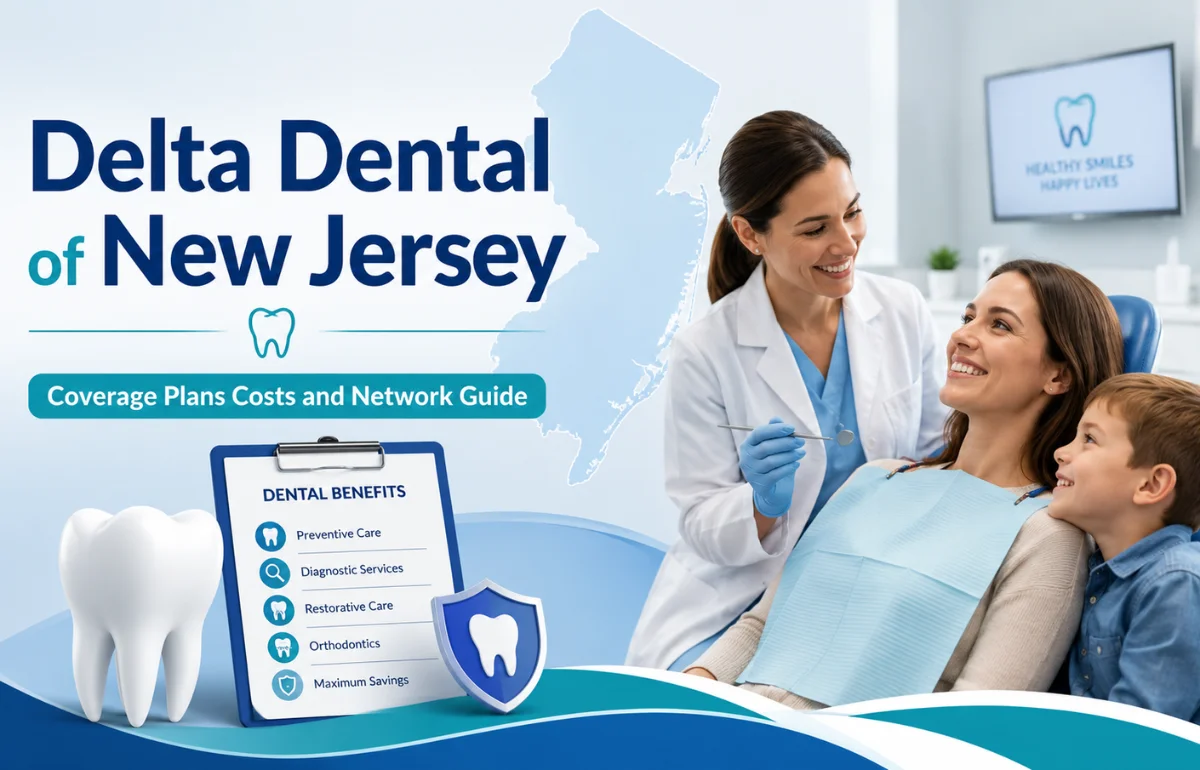
Delta Dental of New Jersey is a not-for-profit dental benefits organization that sells and administers dental coverage for individuals, families, employers, and other groups. It is not a dental office, and “Delta Dental” is not one identical national policy. Instead, the New Jersey company operates locally while participating in the broader Delta Dental Plans Association network. For members, that usually means access to contracted dentists, negotiated fees, claim processing, preventive-care benefits, and plan-specific help with procedures such as fillings, crowns, root canals, dentures, implants, or orthodontics.
I think the simplest way to understand Delta Dental of New Jersey is this: it helps pay for covered dental care, but the amount you save depends on the exact plan, the dentist’s network tier, and the timing and type of treatment. The company has offered dental benefits since 1969 and is regulated in New Jersey as a dental service corporation.
What Delta Dental of New Jersey Actually Does
Delta Dental of New Jersey creates or administers dental benefit programs, contracts with participating dentists, processes claims, and gives members tools to check coverage and treatment costs.
Its offerings include individual and family dental insurance, employer-sponsored benefits, PPO-style coverage, Premier network options, and the DeltaCare USA HMO-type program.
A 2026 company release states that it provides or administers coverage for more than 2.2 million people through group and individual contracts in New Jersey and Connecticut.
That local-versus-national structure matters. Your card may carry the familiar Delta Dental name, but eligibility, benefit percentages, annual limits, covered procedures, and customer-service rules come from your specific contract.
Two neighbors can both have Delta Dental and still have very different coverage.
Who Can Get Delta Dental Coverage in New Jersey?
Coverage may be available through an employer, union, association, public-sector benefits program, or a directly purchased individual or family plan.
Delta Dental of New Jersey also markets options for seniors and retirees, while employers may offer DeltaCare USA or customized PPO arrangements.
For people shopping independently, current plan pages show several designs rather than one standard policy. Examples include plans that increase benefits over the first three years, higher-maximum plans, fixed-copay plans, and options adding orthodontic or implant coverage.
Online rates are starting examples; actual premiums vary by plan, age, location, and household composition.
Understanding the Main Plan Types
The plan name matters less than the payment structure behind it. When I review dental benefit documents, I look first at network fees, deductibles, coinsurance, annual maximums, and non-covered charges.
| Plan or network structure | How it generally works | Best fit for | Main trade-off |
|---|---|---|---|
| Delta Dental PPO | Uses dentists who accept deeper negotiated discounts | Members focused on lower out-of-pocket costs | The PPO list may be narrower than Premier |
| PPO Plus Premier | Includes PPO and Premier participating dentists | People wanting savings plus broader choice | Premier care may cost more than PPO care |
| Delta Dental Premier | Broad contracted fee-for-service network | Members prioritizing provider access | Discounts may be smaller than PPO discounts |
| DeltaCare USA | HMO-type plan with a selected primary dentist and fixed copayments | People preferring predictable charges | Routine out-of-network care is generally not covered |
| Individual fixed-copay plan | Uses set member payments for covered services | Shoppers who dislike percentage-based uncertainty | The copay schedule and exclusions require close review |
Delta Dental of New Jersey says its PPO network provides the deeper discount, while Premier provides another contracted tier with broader access.
Under PPO Plus Premier, members can often use either tier but may save more with a PPO dentist.
DeltaCare USA works differently. Members choose a participating primary dentist, referrals are coordinated within the network, and the program generally uses fixed copayments without deductibles or annual maximums.
Out-of-network benefits are normally limited to dental emergencies.
What Dental Services May Be Covered?
A typical dental plan groups care into preventive, basic, and major services. Preventive care often includes exams, routine cleanings, and certain X-rays.
Basic services may include fillings and uncomplicated extractions. Major care can include crowns, dentures, bridges, root canals, or implants, depending on the contract.
Coverage is not guaranteed simply because a procedure fits a familiar category. Frequency limits, waiting periods, replacement rules, age restrictions, alternate-benefit provisions, and dental-necessity reviews can change what the plan pays.
Current individual plan examples show the variation. Some list preventive care at 100% and pay a percentage of fillings, crowns, and root canals.
One premium design lists implant coverage, while a higher-maximum design excludes implants and orthodontics. A fixed-copay design lists no annual maximum or deductible but applies scheduled copayments.
I would never choose a dental policy based only on “100% preventive” or a low monthly premium. Those details matter, but expensive treatment is where exclusions and limits become financially significant.
The Five Numbers I Check Before Comparing Premiums
Most shoppers start with the monthly price. I start with five other figures because they explain how the plan behaves when someone needs care.
Deductible
The deductible is the amount a member may pay before the plan begins sharing certain covered costs. Preventive services are sometimes exempt, depending on the plan.
Coinsurance or Copayment
Coinsurance is a percentage split, such as the plan paying 50% of an allowed fee for a crown. A copayment is a fixed amount for a covered procedure.
Annual Maximum
The annual maximum is the most the dental plan pays toward covered services during the plan year.
It is not the same as a medical out-of-pocket maximum. Once the dental maximum is reached, the member may owe the remaining cost.
Waiting Period
A waiting period delays coverage for selected services. Current materials warn that waiting periods may apply, although qualifying prior coverage may waive them in some cases.
Lifetime Orthodontic Maximum
When orthodontics is included, it may have a separate lifetime limit. The current Enhanced Plus Ortho example lists a $1,500 lifetime orthodontic maximum, but that figure does not apply to every plan.
Why the Dentist’s Network Status Changes the Bill
The network can change the allowed fee, discount, and whether the dentist may bill above the plan allowance.
| Dentist choice | Negotiated fee protection | Likely member cost | What to verify |
|---|---|---|---|
| PPO dentist | Strongest discount tier | Usually lowest | Participation in the exact PPO network |
| Premier dentist | Contracted with a generally smaller discount | Often higher than PPO | How the plan reimburses Premier care |
| Nonparticipating dentist | No Delta Dental contract controlling the full charge | Usually highest | Balance billing and claim submission |
| DeltaCare USA primary dentist | Fixed-copay arrangement | Predictable for covered services | Assignment and referral requirements |
New Jersey regulators explain that members using nonparticipating dentists may owe charges above the plan’s maximum allowance, commonly called balance billing.
Delta Dental’s PPO illustration likewise shows that a nonparticipating dentist can leave the patient responsible for the difference between the charge and plan allowance.
My practical advice is to verify the individual dentist and office location immediately before treatment.
“We accept Delta Dental” does not necessarily mean “we are in your lowest-cost Delta Dental network.”
A Better Comparison Method: The Benefit-Dollar Yield
Here is a calculation I rarely see explained clearly online. I call it the benefit-dollar yield:
Expected plan payments minus annual premiums, divided by annual premiums.
This is my comparison framework, not an insurer’s official metric. Estimate the care you reasonably expect, apply the deductible and coverage percentages, cap the insurer’s share at the annual maximum, and subtract your yearly premiums.
A higher-premium plan may offer better value when a crown, root canal, implant, or orthodontic treatment is already likely.
A low-premium preventive plan may be more economical for someone expecting only exams and cleanings. The best policy is not always the one with the highest maximum; it is the one whose covered benefits match the care you are likely to use.
How to Avoid Surprises Before Major Dental Work
For a costly procedure, I recommend asking the dental office to submit a pre-treatment estimate before care begins.
Delta Dental of New Jersey also offers a cost estimator for an immediate estimate based on benefits and dentist. A formal pre-treatment estimate uses the dentist’s treatment plan and the member’s current benefits.
Treat the estimate as a planning document, not a guarantee. Eligibility can change, other claims can use available benefits, and the final service may differ from the proposal.
I would also request procedure codes, confirm whether laboratory charges are included, ask about any alternative benefit, and check what happens if treatment crosses into a new plan year.
These questions reveal more than a general request for “the insurance price.”
Using MySmile, Claims, and Member Tools
The MySmile account allows members to view coverage, check claims, print ID cards, and review treatment history.
Delta Dental of New Jersey also provides online tools for dentists, employers, and brokers.
After a visit, compare the Explanation of Benefits with the dental bill. The EOB is not itself a bill, but it helps identify coding errors, duplicate charges, or a network mismatch.
Is Delta Dental of New Jersey a Good Choice?
It can be a strong choice for someone who has access to a suitable Delta Dental network and selects a plan matching expected treatment.
PPO Plus Premier offers broad participating-provider access, PPO dentists may deliver deeper discounts, and members can use digital claim and coverage tools.
The limitations are familiar across dental insurance: annual maximums may be modest compared with major treatment costs, exclusions vary, waiting periods may apply, and out-of-network billing can reduce the value of coverage.
Before enrolling, I would compare the full certificate or benefit booklet—not only the marketing summary—and verify whether your dentist is in the correct network, whether expected procedures are covered, and how much the plan can pay during the year.
Frequently Asked Questions
Is Delta Dental of New Jersey the same as Delta Dental nationwide?
No. It is a local Delta Dental member company participating in a national association and provider network while administering plan-specific benefits.
Does Delta Dental of New Jersey cover implants?
Some plans do, while others exclude implants or use fixed copayments. Check the benefit booklet and request a pre-treatment estimate.
Can I use Delta Dental of New Jersey out of state?
Many PPO and Premier plans use national networks, but coverage depends on your contract. Confirm the dentist’s network status first.
Does Delta Dental of New Jersey have a waiting period?
Some individual plans may apply waiting periods, and qualifying prior coverage may sometimes waive them. Employer plans can differ.
Do I need a Delta Dental ID card to see a dentist?
A physical card is often unnecessary when the office can verify your subscriber and plan information, though digital and printable cards are available.
My Final Take
Delta Dental of New Jersey is best viewed as a collection of dental benefit options, not one universal policy.
Match the network, annual maximum, waiting periods, and covered procedures to your dentist and likely treatment. Before enrolling or approving major work, verify benefits in writing and request a pre-treatment estimate so your decision is based on realistic costs rather than the monthly premium alone.

Daniel Reed is a dental health writer with 6 years of experience creating clear, research-informed content about oral hygiene, gum care, preventive habits, and everyday dental wellness. He focuses on making reliable information easy to understand while encouraging readers to seek professional dental care for diagnosis and treatment.