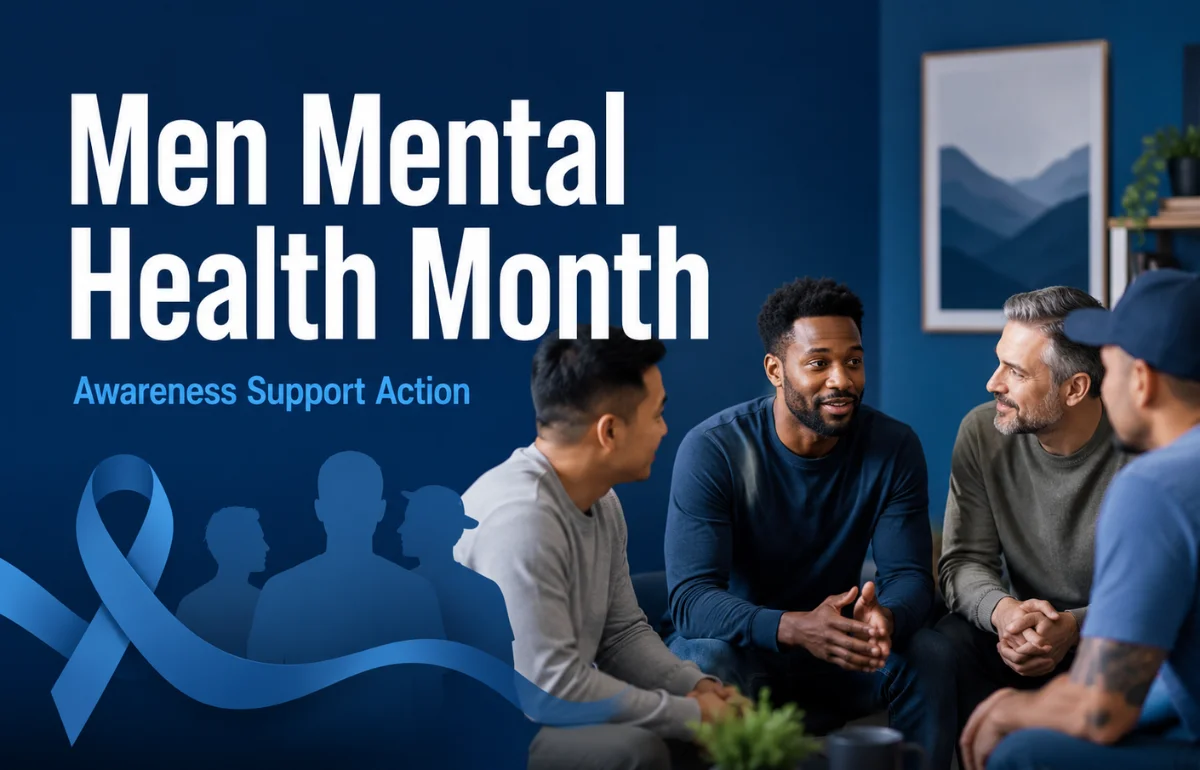
Men mental health month is a common search phrase for the annual period devoted to raising awareness of men’s emotional well-being, reducing stigma, recognizing warning signs, and connecting men with support. In the United States, this conversation is most often linked to June, which is widely observed as Men’s Health Month.
June covers physical and mental health, while many organizations give special attention to depression, anxiety, substance use, loneliness, trauma, and suicide prevention among men. November also receives major attention through Movember, a separate global campaign focused on men’s mental health, suicide prevention, prostate cancer, and testicular cancer.
Used well, the month creates a practical opening to replace “I’m fine” with a more honest conversation—and to turn that conversation into care.
When Is Men’s Mental Health Month?
For most U.S.-focused content, the clearest answer is June. Men’s Health Month is promoted throughout June, and National Men’s Health Week has a history of congressional recognition dating to 1994.
The broader observance includes preventive care, chronic disease, healthy relationships, and emotional well-being.
The wording can be confusing because “Men’s Mental Health Month” is not always used consistently across countries and organizations. Some people use it as a mental-health-focused name for June. Others associate men’s mental health awareness with November because of Movember.
Here is the simplest way to understand the calendar:
| Awareness period | When it happens | Main focus |
|---|---|---|
| Mental Health Awareness Month | May | Mental health education and support for the wider population |
| Men’s Health Month | June | Men’s physical health, mental health, prevention, early detection, and healthy living |
| Movember | November | Men’s mental health, suicide prevention, prostate cancer, and testicular cancer |
SAMHSA recognizes May as Mental Health Awareness Month, Men’s Health Network promotes June as Men’s Health Month, and Movember runs its best-known campaign in November.
These observances overlap in purpose, but they are not interchangeable.
For 2026, the Men’s Health Month campaign theme emphasizes “Partners in Care,” connection, education, advocacy, and support across the lifespan.
That theme matters because men’s mental health rarely improves through willpower alone. It improves when care becomes easier to discuss, access, and continue.
Why Men Mental Health Month Matters
Men experience many of the same mental health conditions as women, but the signs are not always recognized early. NIMH notes that men are less likely than women to have received mental health treatment in the previous year.
It also lists anger, irritability, aggression, substance misuse, sleep changes, high-risk behavior, physical complaints, hopelessness, and difficulty feeling positive emotions among possible signs of mental disorders in men.
That does not mean every angry, tired, or withdrawn man has a mental health condition. It means a change in behavior deserves curiosity rather than judgment—especially when it lasts, disrupts daily life, or appears alongside alcohol or drug misuse.
The consequences of missed warning signs can be severe. CDC data show that the U.S. age-adjusted suicide rate for males was 23 deaths per 100,000 people in 2022, considerably higher than the overall rate of 14.2.
Globally, the World Health Organization estimates that 727,000 people died by suicide in 2021.
Statistics explain the scale, but they do not fully explain the silence. Many men have learned to describe distress through work problems, exhaustion, anger, headaches, drinking, risk-taking, or relationship conflict rather than words such as anxiety, grief, or depression.
Mental distress does not always look like sadness
A man may still go to work, pay bills, make jokes, train at the gym, and appear dependable while struggling internally. High functioning is not the same as feeling well.
I think this is one of the most useful messages an awareness campaign can offer: do not wait for a dramatic breakdown before taking emotional pain seriously.
A pattern of poor sleep, emotional numbness, isolation, irritability, lost motivation, or heavier substance use may be the earlier signal.
Men face practical barriers as well as stigma
“Men need to talk more” is true but incomplete.
Talking is harder when a person cannot afford therapy, does not know where to begin, works inflexible hours, lacks privacy, has had a bad experience with care, or cannot find a professional who understands his culture or circumstances.
A strong campaign should therefore address both personal reluctance and system design. Emotional openness matters, but so do affordable services, evening appointments, telehealth, culturally responsive care, paid time off, peer support, and clear referral pathways.
Common Signs Worth Paying Attention To
Mental health symptoms vary by person and condition. The table below is not a diagnostic checklist. It is a conversation starter based on signs described by NIMH.
| Possible change | What it may look like in daily life | A useful first response |
|---|---|---|
| Irritability or anger | Frequent arguments, snapping, road rage, or unusual aggression | Ask what has felt harder lately rather than criticizing the attitude |
| Withdrawal | Ignoring messages, skipping hobbies, or avoiding family and friends | Offer a specific, low-pressure invitation |
| Sleep disruption | Insomnia, oversleeping, exhaustion, or irregular routines | Encourage a medical or mental health check if it persists |
| Substance misuse | Drinking more or using drugs to sleep, relax, or escape | Focus on safety and support, not shame |
| Loss of interest | No enjoyment in work, sex, exercise, parenting, or hobbies | Mention the change you have noticed and ask directly how he is doing |
| Physical complaints | Headaches, digestive trouble, pain, or tension without a clear cause | Suggest an appointment that considers both physical and mental health |
| Hopelessness or risky behavior | Saying nothing matters, driving recklessly, or giving possessions away | Treat the situation as urgent and seek crisis or emergency help |
One sign alone may have many explanations. The combination, intensity, duration, and effect on normal functioning matter more than any single behavior.
What the Month Should Actually Accomplish
Posting a graphic can raise visibility, but awareness without a next step fades quickly.
In my experience evaluating health communication, the strongest campaigns give people a clear action. I use a simple three-part standard for judging whether a men’s mental health campaign is useful.
1. Make distress easier to name
Use ordinary language.
“You seem worn down and unlike yourself” may work better than asking someone to identify a diagnosis. Men do not need perfect psychological vocabulary before they deserve support.
Questions can also focus on daily life:
- How have you been sleeping?
- Are you enjoying anything at the moment?
- Has work started to feel unmanageable?
- Are you drinking more than usual?
- Do you feel connected to anyone right now?
These questions give a person several ways to answer without forcing him to begin with a clinical label.
2. Make help easier to enter
Give one clear route rather than a long directory.
That route might be a primary care appointment, an employee assistance program, a licensed therapist, a community clinic, a veterans’ service, or a crisis counselor.
Too many options can become another obstacle when someone is already exhausted, anxious, or overwhelmed. A short list of two relevant services is often more usable than a page containing 30 links.
3. Make support easier to continue
A single conversation is rarely enough.
Follow-up is where concern becomes care: send a message the next day, offer a ride, help compare providers, watch the children during an appointment, or schedule another check-in.
This “name, enter, continue” model is my practical addition to the usual awareness advice. It shifts the goal from persuading men to disclose everything at once to reducing friction at each stage of help-seeking.
How Men Can Use the Month Personally
Start with an honest self-check.
Consider sleep, mood, energy, concentration, relationships, substance use, anger, physical symptoms, and whether life still contains enjoyment.
Then choose one action that is specific enough to complete. Book a primary care visit. Ask a therapist about availability. Tell a trusted person, “I have not felt like myself for the past few weeks.”
You could also reduce alcohol for a defined period and notice what changes, or reconnect with someone instead of waiting until you feel sociable.
I recommend avoiding the trap of turning self-care into another performance target.
Exercise, sleep, daylight, nutrition, and social connection can support mental health, but they are not moral tests. They also do not replace professional treatment when symptoms are persistent, severe, or dangerous.
Asking for help does not require reaching a breaking point. Preventive mental health care is still care.
How to Support a Man Who May Be Struggling
Begin with an observation, not an accusation.
Try saying, “You have seemed quieter and more exhausted lately. How are you really doing?”
Listen without rushing to correct, compare, or solve. A person may need several conversations before accepting help. Calm consistency is usually more useful than a single intense confrontation.
Offer a concrete next step:
“Would it help if I found two local therapists?”
“I can sit with you while you make the call.”
“Would you like me to come to the appointment?”
Specific help reduces the mental workload that often comes with depression, anxiety, grief, burnout, or trauma.
Ask directly about safety when there are warning signs. Research summarized by NIMH indicates that asking about suicide does not increase suicidal thoughts or behavior.
In the United States and its territories, people can call or text 988 at any time for free, confidential crisis support. A person does not have to be suicidal to contact the service.
Call emergency services when someone is in immediate danger.
How Workplaces and Communities Can Participate
A workplace campaign should offer more than a motivational email.
Employers can review mental health benefits, explain confidentiality, train managers to respond to distress, protect time for appointments, and publish a simple route to care.
Managers should not try to diagnose employees. Their role is to recognize concerning changes, listen respectfully, explain available support, and follow established safety procedures when necessary.
Community groups can host screenings, peer-support events, or sessions with licensed professionals.
Sports clubs, barbershops, faith communities, colleges, unions, and veterans’ organizations may reach men who would never attend an event labeled as therapy. Keep the invitation private, practical, and free of ridicule.
What to Avoid During Men’s Mental Health Awareness Campaigns
Avoid presenting men as emotionally defective or unwilling to help themselves. Shame is not an effective doorway to care.
Avoid turning the issue into a competition between genders. Men’s mental health deserves attention without minimizing the mental health needs of women, transgender people, or nonbinary people.
Avoid using suicide statistics as shock content without including support information. Numbers should lead readers toward prevention, not leave them with fear.
Also avoid suggesting that one lifestyle habit can cure a mental disorder.
A morning routine, gym membership, supplement, or social media break may help some people, but treatment may include psychotherapy, medication, medical evaluation, substance-use care, social support, or a combination tailored to the individual.
Making Men’s Mental Health a Year-Round Priority
June can open the door, and November can reopen it, but neither month is enough on its own.
The better goal is a culture where men can say they are anxious, lonely, grieving, burned out, traumatized, or depressed without losing dignity.
Families can normalize check-ins. Employers can remove practical barriers. Health professionals can ask about mood, sleep, substance use, safety, and social connection as naturally as they ask about blood pressure.
I would measure progress through ordinary outcomes: more honest conversations, earlier appointments, fewer missed follow-ups, better crisis plans, and more men who know exactly where they would turn on a difficult night.
Take the Next Step
Men mental health month is most useful when awareness becomes action.
Choose one person to check on, one reliable resource to save, or one appointment to make. A small, specific step taken today is more valuable than a month of supportive messages that never reach someone privately.
Frequently Asked Questions
Is men’s mental health month in June or November?
June is commonly associated with Men’s Health Month and its mental-health focus. November is Movember, a separate campaign that also supports men’s mental health and suicide prevention.
What is the purpose of men’s mental health month?
Its purpose is to reduce stigma, improve recognition of mental health symptoms, encourage earlier help-seeking, and connect men and their families with reliable support.
What color represents men’s mental health awareness?
Blue is most closely associated with Men’s Health Month through its Wear Blue campaigns, although individual organizations may use different branding.
How can I support men’s mental health month?
Check in privately, listen without judgment, share one clear support option, promote professional resources, and follow up after the first conversation.
Why are men less likely to seek mental health help?
Common barriers include stigma, pressure to appear self-reliant, difficulty naming symptoms, cost, limited access, privacy concerns, and previous negative experiences with care.

Sophia Bennett is a mental health writer with 8 years of experience creating thoughtful, research-informed content about emotional wellbeing, stress management, mindfulness, self-care, and healthy coping strategies. She focuses on making mental wellness topics easier to understand while encouraging readers to seek support from qualified mental health professionals when needed.