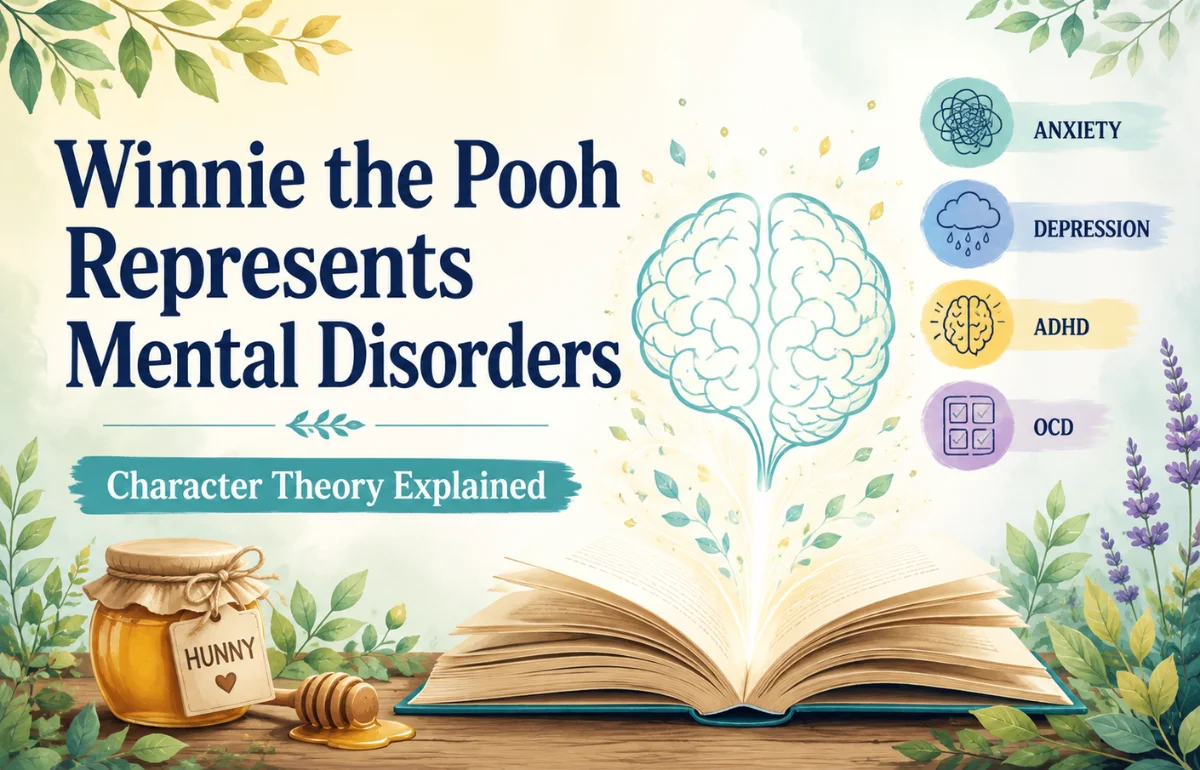
The phrase “Winnie the Pooh represents mental disorders” describes a popular interpretation that links characters in the Hundred Acre Wood with recognizable mental-health traits. Pooh is associated with inattention and compulsive eating, Piglet with anxiety, Eeyore with depression, and Tigger with hyperactivity and impulsivity. However, these are not official diagnoses, and there is no reliable evidence that A. A. Milne created the characters as a coded psychiatric guide. The theory grew mainly from a humorous medical article published in 2000, then spread online in simplified and sometimes inaccurate forms. I see it as a useful conversation starter about behavior, personality, neurodiversity, and emotional support—but not as a substitute for clinical assessment.
Where Did the Winnie the Pooh Mental Disorders Theory Come From?
The best-known source is “Pathology in the Hundred Acre Wood: a neurodevelopmental perspective on A. A. Milne,” published in the Canadian Medical Association Journal in December 2000. Its authors playfully applied DSM-IV terminology to Pooh and his friends. They associated Pooh with inattentive ADHD and provisional OCD, Piglet with generalized anxiety disorder, Eeyore with dysthymic disorder, Rabbit with narcissistic personality disorder, Owl with a reading disorder, and Tigger with hyperactive-impulsive ADHD.
That origin matters because viral charts often treat the paper as a serious psychological study. It was not based on interviews, developmental histories, standardized assessments, or observations across real-life settings. It was a humorous literary exercise using the diagnostic language available at the time.
A later academic thesis found no convincing evidence that the characters were intentionally designed to represent specific psychological disorders. It concluded that Milne’s stories were more likely imaginative, nostalgic children’s literature.
Which Mental Disorder Does Each Winnie the Pooh Character Represent?
The table below separates common online claims from a more responsible interpretation.
| Character | Common association | Traits readers notice | Responsible interpretation |
|---|---|---|---|
| Winnie the Pooh | ADHD, OCD, or disordered eating | Forgetfulness, distractibility, repetitive thoughts about honey | The stories do not establish distress, duration, loss of control, or impairment |
| Piglet | Generalized anxiety disorder | Worry, fear, hesitation, reassurance-seeking | Piglet illustrates anxious temperament, but nervousness alone is not a diagnosis |
| Eeyore | Depression or persistent depressive disorder | Low mood, pessimism, low energy, negative self-view | He resembles depressive traits, but readers lack a complete symptom history |
| Tigger | Hyperactive-impulsive ADHD | Constant movement, risk-taking, interrupting | His behavior may also be exaggerated personality-based characterization |
| Rabbit | OCD or narcissistic traits | Order, control, planning, need for recognition | Perfectionism is not automatically OCD; the original paper linked him with narcissistic traits |
| Owl | Dyslexia or narcissistic traits | Misspellings, long speeches, confidence | The original paper suggested a reading disorder; later posts frequently change the claim |
| Kanga and Roo | Social anxiety, autism, or attachment issues | Protective parenting, dependence, social differences | The viral diagnoses were not assigned in the original paper |
| Christopher Robin | Schizophrenia in many memes | Talking with imaginary animal friends | This confuses imaginative play with psychosis and is not supported by the original article |
Why People Believe Winnie the Pooh Represents Mental Disorders
Winnie the Pooh: Inattention, Repetition, and Honey
Pooh forgets plans, loses track of details, and follows immediate rewards. Those traits make the ADHD comparison easy to understand. Modern descriptions of ADHD involve persistent inattention, hyperactivity, or impulsivity that occurs frequently across multiple situations and interferes with daily functioning.
The original paper also proposed OCD because Pooh repeatedly counts and fixates on honey. That comparison is weaker than many websites suggest. OCD involves uncontrollable recurring thoughts, excessive repetitive behaviors, or both, usually with substantial distress or disruption. Enjoying honey or repeating a behavior is not enough.
I would describe Pooh more cautiously as a character with distractibility, reward-driven behavior, and comforting routines.
Piglet: A Familiar Picture of Anxiety
Piglet worries about danger before it arrives. He startles easily, predicts bad outcomes, and looks to friends for reassurance. This resembles generalized anxiety, which involves excessive, difficult-to-control worry and may include restlessness, tension, fatigue, or sleep problems.
Yet Piglet is also brave. He often acts while afraid, reminding readers that anxiety does not erase courage. For me, he is the clearest example of how this theory can create a compassionate discussion rather than a joke.
Eeyore: Depression, Dysthymia, or Temperament?
Eeyore’s gloomy voice, pessimism, low expectations, and negative self-appraisal make him the series’ most recognizable symbol of depression. The 2000 article used “dysthymic disorder,” a DSM-IV term. Current terminology uses persistent depressive disorder for a long-lasting depressed mood pattern; in adults, the duration is generally at least two years.
Still, Eeyore participates in activities, accepts affection, notices kindness, and shows dry humor. Fictional characters offer selective scenes, not complete clinical histories.
More valuable than his possible label is his friends’ response. They include him without demanding cheerfulness as the price of belonging.
Tigger: Energy and Impulsivity
Tigger bounces into situations, interrupts plans, overestimates his abilities, and rarely pauses to consider consequences. These traits resemble the hyperactive-impulsive presentation of ADHD described in the original article.
The comparison can reinforce the stereotype that ADHD simply means being loud or energetic. Clinical ADHD requires a persistent pattern across settings and meaningful difficulty in daily life.
I read Tigger as an exaggerated portrait of impulsive enthusiasm, showing both the charm and consequences of acting before thinking.
Rabbit: Why Perfectionism Is Not the Same as OCD
Rabbit likes schedules, tidy gardens, predictable plans, and authority. Online lists frequently label him as having OCD. The original satire, however, placed Rabbit under narcissistic personality disorder rather than OCD.
That discrepancy shows how internet retellings mutate. A neat character becomes “OCD,” a sad character becomes “depression,” and an imaginative child becomes “schizophrenic.”
OCD is not simply a love of order. It centers on obsessions and compulsions that are difficult to control, time-consuming, distressing, or disruptive. Using “OCD” as a synonym for neatness can minimize the real condition.
Owl, Kanga, Roo, and Christopher Robin
The original paper associated Owl with a reading disorder because his confidence and vocabulary did not always match his literacy performance. Later lists often recast him as narcissistic because he enjoys giving advice.
Viral posts also assign Kanga and Roo social anxiety, autism, or attachment-related conditions, although those diagnoses were not included in the original table.
Christopher Robin is frequently labeled as having schizophrenia because he talks to animals. That is especially misleading: imaginative childhood play is not, by itself, evidence of hallucinations or psychosis.
The original paper instead used an outdated provisional DSM-IV label related to gender identity. Current psychiatric guidance distinguishes identity from diagnosis and focuses on clinically significant distress when defining gender dysphoria.
Viral Claims Versus the Original Theory
| Viral claim | What the 2000 paper said | Better modern wording |
|---|---|---|
| Rabbit represents OCD | Rabbit was linked with narcissistic personality disorder | Rabbit displays control, rigidity, and perfectionistic behavior |
| Owl represents narcissism | Owl was linked with a reading disorder | Owl shows uneven literacy skills and strong confidence |
| Roo represents autism | No clinical disorder was assigned | Roo is young, energetic, dependent, and impressionable |
| Kanga represents social anxiety | No clinical disorder was assigned | Kanga is protective and cautious as a parent |
| Christopher Robin represents schizophrenia | Schizophrenia was not the paper’s diagnosis | His animal world is imaginative storytelling |
| Milne intentionally coded every character | No persuasive evidence supports the claim | The theory is a later interpretive framework |
Why Fictional Traits Cannot Confirm a Mental Disorder
A diagnosis is not a personality quiz. The DSM-5-TR is a professional classification system containing symptom descriptions and criteria that clinicians use alongside interviews, history, context, and judgment.
When I evaluate a fictional-character theory, I use a three-layer test.
1. Trait
Does the character show recognizable worry, impulsivity, sadness, rigidity, or another behavior?
2. Pattern and Context
Does it persist over time and appear in different situations, or is it mainly a storytelling device used for humor and contrast?
3. Distress or Impairment
Does it create significant distress, disrupt daily functioning, or produce sustained difficulty managing ordinary life?
Most online comparisons stop at the first layer. They identify one visible trait and jump directly to a disorder.
That missing middle—pattern, context, and impairment—is why the character charts should be treated as metaphors.
Is the Theory Helpful or Harmful?
The theory helps when it encourages empathy. Eeyore is not excluded for being gloomy. Piglet is valued despite his fear. Tigger remains part of the community even when his impulsiveness creates problems. Pooh receives patience rather than humiliation.
It becomes harmful when outdated labels are repeated as fact, disorders are reduced to jokes, or readers diagnose themselves and others from a few traits.
A healthier reading is strengths-based. Piglet brings loyalty, Eeyore honesty, Tigger energy, Rabbit organization, Kanga care, and Pooh warmth. Their difficulties coexist with qualities that matter to the group.
What the Hundred Acre Wood May Really Represent
The deeper lesson is not that every character equals one disorder. It is that a community can contain different minds, moods, energy levels, and coping styles without requiring everyone to behave the same way.
I read the Hundred Acre Wood as a model of imperfect belonging. Friends become frustrated, make mistakes, repair problems, and return. Their support is practical: visiting someone who is isolated, rebuilding a home, offering reassurance, sharing food, or simply staying nearby.
This adds something diagnosis charts miss. Mental health is not only about symptoms within an individual. It is also shaped by whether a community responds with patience, structure, dignity, and connection.
Final Thoughts
The claim that Winnie the Pooh represents mental disorders is best understood as a modern interpretation inspired by a humorous 2000 medical article—not a confirmed account of A. A. Milne’s intentions. The comparisons can open useful discussions about anxiety, depression, ADHD, OCD, personality, and neurodiversity when they are presented as metaphors rather than diagnoses.
Read the stories again and notice not only how each character struggles, but how the group makes room for difference. For personal mental-health concerns, speak with a qualified professional instead of relying on an online character test.
Frequently Asked Questions
What mental disorder does Winnie the Pooh represent?
Pooh is commonly associated with inattentive ADHD, OCD, and disordered eating, but these are unofficial literary interpretations.
Does Piglet represent anxiety?
Yes. Piglet is widely associated with generalized anxiety because of his persistent worry, fear, and reassurance-seeking.
Is Eeyore clinically depressed?
Eeyore displays depressive traits, but a fictional character cannot receive a valid diagnosis from selected scenes.
Was Winnie the Pooh written about mental illness?
There is no reliable evidence that A. A. Milne intentionally created each character to represent a mental disorder.
Which Winnie the Pooh character represents ADHD?
Tigger is commonly linked with hyperactive-impulsive ADHD, while Pooh was linked with inattentive ADHD in the original satire.

Sophia Bennett is a mental health writer with 8 years of experience creating thoughtful, research-informed content about emotional wellbeing, stress management, mindfulness, self-care, and healthy coping strategies. She focuses on making mental wellness topics easier to understand while encouraging readers to seek support from qualified mental health professionals when needed.