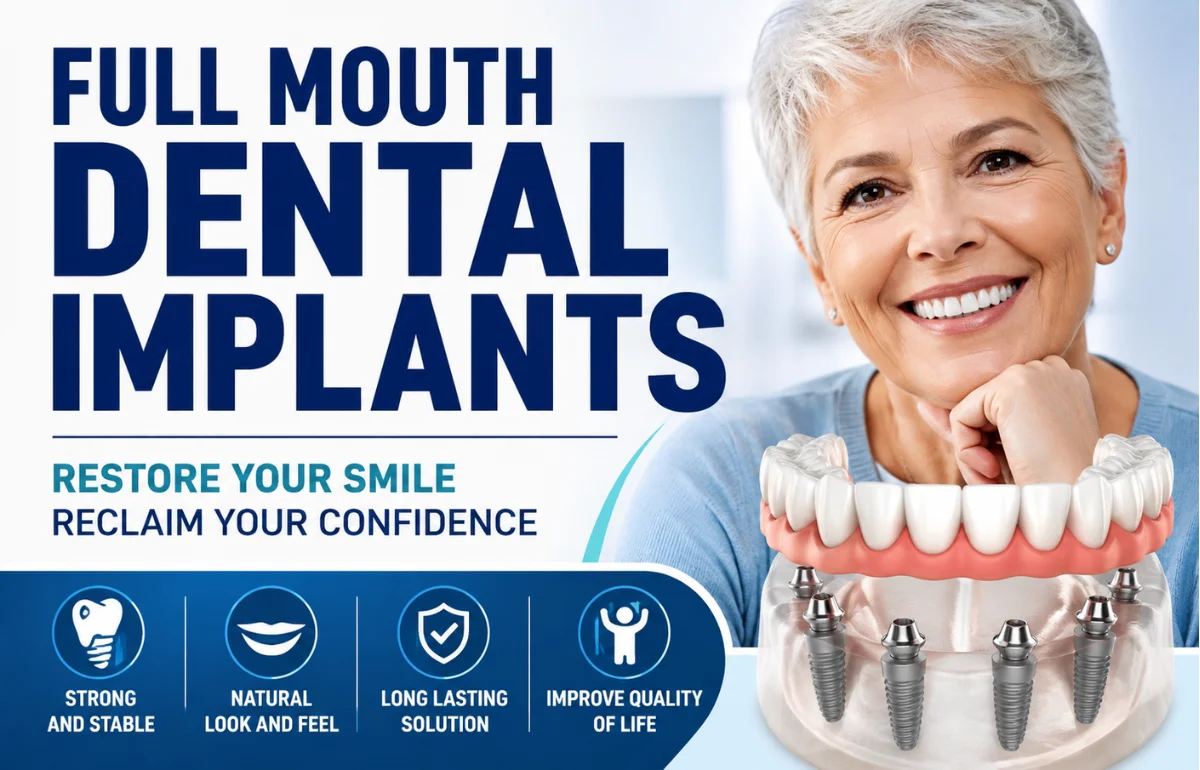
Full mouth dental implants are a tooth-replacement treatment for people who have lost, or are likely to lose, most or all of their teeth. Instead of placing one implant for every missing tooth, a dentist positions several implant posts in the jaw and uses them to support a complete set of replacement teeth. The final teeth may be fixed in place or removable, depending on the design.
I think of full mouth dental implants as a foundation-and-bridge system: the implants act like artificial tooth roots, while the full-arch restoration restores the visible teeth and bite. Treatment may involve one arch—the upper or lower jaw—or both. It can improve chewing, speech, stability, and confidence, but it still requires surgery, careful planning, daily cleaning, and professional maintenance.
What Does “Full Mouth” Actually Mean?
The term can be confusing because clinics do not always use it in the same way. Strictly speaking, full mouth treatment replaces teeth in both jaws. “Full-arch dental implants” usually refers to one complete upper or lower arch.
In marketing, however, full mouth dental implants may describe one arch, two arches, a fixed bridge, or an implant-retained removable denture. I recommend confirming exactly what is included before comparing plans or prices.
A complete proposal should state whether treatment covers one or both arches, how many implants are planned, whether the teeth are fixed or removable, and whether extractions, grafting, sedation, temporary teeth, final teeth, and follow-up care are included.
Types of Full Mouth Dental Implants
Fixed Full-Arch Implant Bridge
A fixed full-arch bridge is secured to implants and normally removed only by a dental professional. Patients often choose this design because it feels stable and does not move like a conventional removable denture.
You may hear terms such as All-on-4, All-on-6, or All-on-X. These labels generally describe a full-arch restoration supported by a selected number of implants. Four implants are common in published protocols, but the correct number and distribution depend on bone volume, arch shape, bite forces, restorative space, and the prosthetic plan—not on a slogan.
Implant-Supported Removable Denture
An implant-supported overdenture snaps or clips onto implants but can be removed for cleaning. It is usually more stable than a traditional denture and may require fewer implants than a fixed bridge.
Some patients prefer its lower cost and easier hygiene access. Others dislike removing their teeth. The right choice depends on anatomy, dexterity, budget, expectations, and the ability to maintain the restoration.
Conventional Dentures
Conventional dentures rest on the gums without implant support. They avoid implant surgery and generally cost less upfront, but they may move during chewing and require periodic adjustment or relining.
Fixed vs. Removable Full-Arch Teeth
| Feature | Fixed implant bridge | Implant-supported removable denture | Conventional denture |
|---|---|---|---|
| Stability | High | Moderate to high | Variable |
| Removed by patient | No | Yes | Yes |
| Cleaning access | Requires tools beneath bridge | Easier after removal | Cleaned outside the mouth |
| Surgery required | Yes | Yes | Usually no |
| Upfront cost | Usually highest | Usually moderate | Usually lowest |
| Maintenance | Professional service often needed | Attachments may wear | Relines are common |
Who May Be a Candidate?
A candidate needs more than missing teeth. The treatment team evaluates general health, gum health, bone anatomy, bite, medications, smoking history, oral hygiene, and expectations.
Adequate jawbone is needed to stabilize implants, although bone grafting or alternative strategies may help in selected cases. Active periodontal disease should be controlled first. The American Academy of Periodontology identifies poor plaque control, smoking, diabetes, and previous periodontal disease as risk factors for peri-implant disease.
Age alone is not usually the deciding issue. A healthy older adult may be a better candidate than a younger person with uncontrolled disease or heavy smoking.
Assessment commonly includes a medical and dental history, examination of the gums and bite, X-rays or three-dimensional imaging, digital scans, and an evaluation of bone volume and restorative space.
How the Treatment Process Works
Diagnosis and Restorative Planning
The process should begin with the desired final teeth, not simply with available bone. The team plans tooth position, lip support, smile line, speech, bite, and cleaning access before selecting implant locations.
This matters because an implant can integrate with bone yet still be poorly positioned for the final bridge. Recent periodontal consensus work has emphasized that implant position and prosthetic design can influence long-term peri-implant health.
Preparatory Treatment
Some patients need failing teeth removed, gum infection treated, or bone grafting. In other cases, extractions, implants, and a temporary restoration may be provided during the same visit.
A promise of “teeth in one day” usually means receiving temporary teeth quickly, not completing every stage of treatment in a single day.
Implant Placement
During surgery, implants are placed in planned positions in the jaw. Local anesthesia is standard, while sedation options vary according to patient needs and provider qualifications.
The FDA lists possible complications such as injury to surrounding tissues, sinus perforation, jaw fracture, an abnormal bite, loosening components, infection, and implant failure. These events are not inevitable, but they belong in an informed-consent discussion.
Temporary Teeth and Healing
When implants achieve suitable stability, a temporary fixed bridge may be attached soon after surgery. Immediate loading means connecting a functioning prosthesis within one week; early and conventional loading occur later.
Immediate teeth are not suitable for everyone. They must be protected while bone heals around the implants, a process called osseointegration. A soft-food diet may be necessary even when the smile looks complete.
The Final Restoration
After healing, the dentist checks the bite, tissue condition, implant stability, appearance, and fit. The temporary teeth are then replaced with the final bridge or overdenture.
Final restorations may use acrylic-based materials, composite, titanium frameworks, zirconia, or combinations of materials. The choice depends on restorative space, bite forces, appearance, repair strategy, weight, and cost.
How Long Does Treatment Take?
Treatment may take several months or longer than a year when complex grafting is required. A suitable immediate-load patient may receive temporary teeth on or near the day of surgery, but the final restoration normally comes after healing and refinement.
| Phase | Main purpose | What affects timing |
|---|---|---|
| Consultation and imaging | Diagnosis and design | Records and complexity |
| Extractions or grafting | Prepare implant sites | Infection and bone loss |
| Implant surgery | Place implant foundations | One or both arches |
| Temporary teeth | Restore appearance and limited function | Implant stability |
| Osseointegration | Allow bone-to-implant healing | Health and bone quality |
| Final teeth | Establish definitive fit and bite | Tissue and laboratory process |
I would be cautious with any provider who gives an exact timeline before reviewing scans and health history. Immediate-loading protocols can shorten the period without fixed teeth, but the appropriate schedule still depends on implant stability, bone quality, health, and the restorative plan.
Benefits and Limitations
Full mouth dental implants can provide strong stability, better chewing, a more natural-feeling smile, and freedom from a loose conventional denture. Implants also transfer forces into the jawbone, although they do not make a patient immune to future tissue problems.
The limitations deserve equal attention. Treatment can be expensive, surgery carries risk, healing takes time, and temporary teeth may restrict diet. The restoration can chip, wear, loosen, or need repair even when the implants remain healthy.
Long-term success should mean more than “the implants survived.” It should include comfortable function, healthy tissues, a cleanable restoration, a stable bite, acceptable appearance, and a realistic repair plan.
The Overlooked Issue: Cleanability and Serviceability
When I review full-arch treatment information, this is the detail I most often see reduced to one sentence: how will the patient clean beneath the teeth, and how will the dentist service them later?
A bridge should allow access to implant areas with brushes, flossing aids, or water irrigation recommended by the dental team. Limited hand dexterity, reduced vision, or dependence on a caregiver should influence the choice between fixed and removable teeth.
Serviceability matters too. Ask whether the restoration can be removed without damage, whether a fractured tooth can be repaired, how quickly emergency repairs are handled, and whether replacement components will remain available.
Professional maintenance should assess plaque, inflammation, bleeding, swelling, tissue changes, and mechanical problems. Peri-implant mucositis affects the soft tissue, while peri-implantitis includes supporting bone loss.
How Much Do Full Mouth Dental Implants Cost?
There is no single reliable price because “full mouth” may mean one arch or two, and treatment scope varies. Cost is influenced by implant number, extractions, grafting, anesthesia, temporary teeth, final material, laboratory work, clinician expertise, location, and follow-up care.
Request an itemized written plan. A low advertised price may exclude scans, sedation, preparatory procedures, the temporary restoration, the final bridge, or maintenance. Ask what happens financially if an implant does not integrate or the temporary teeth break.
Insurance may cover limited portions of care, but benefits vary. Compare the complete treatment rather than only the advertised monthly payment.
Questions to Ask at a Consultation
I would take these questions to any full-arch consultation:
- Is the plan fixed or removable, and why?
- Does the fee cover one arch or both?
- Which natural teeth can reasonably be saved?
- How many implants are planned?
- Will I need grafting?
- What will I wear during healing?
- How will I clean the restoration?
- What complications are most relevant to me?
- What repairs and maintenance should I expect?
- Is the final restoration included?
A strong consultation should leave you understanding both benefits and trade-offs. Pressure to commit before receiving a diagnosis, alternatives, and written scope is a reason to slow down.
Frequently Asked Questions
How many implants are needed for a full mouth?
The number varies by anatomy and restoration design. Many fixed plans use four or more implants per arch, but the choice must be individualized.
Are full mouth dental implants painful?
Anesthesia controls pain during surgery. Soreness, swelling, and bruising can occur afterward, and your dental team should provide a recovery plan.
Can I get full mouth dental implants in one day?
Some suitable patients can receive implants and temporary teeth in one visit, but healing and delivery of the final restoration take additional time.
How long do full mouth dental implants last?
They can function for many years, but longevity depends on health, hygiene, bite forces, smoking, maintenance, and management of mechanical problems.
Can I get implants if I have bone loss?
Possibly. Bone grafting, modified implant positions, or other approaches may be considered after three-dimensional imaging and specialist evaluation.
Your Next Step
Full mouth dental implants can be life-changing, but the best result comes from matching the restoration to the patient rather than forcing everyone into the same branded solution.
Schedule a comprehensive examination with an implant-experienced restorative dentist, periodontist, or oral and maxillofacial surgeon. Bring your medication list and request a written plan covering surgery, temporary teeth, final teeth, hygiene, risks, maintenance, and total fees.

Daniel Reed is a dental health writer with 6 years of experience creating clear, research-informed content about oral hygiene, gum care, preventive habits, and everyday dental wellness. He focuses on making reliable information easy to understand while encouraging readers to seek professional dental care for diagnosis and treatment.