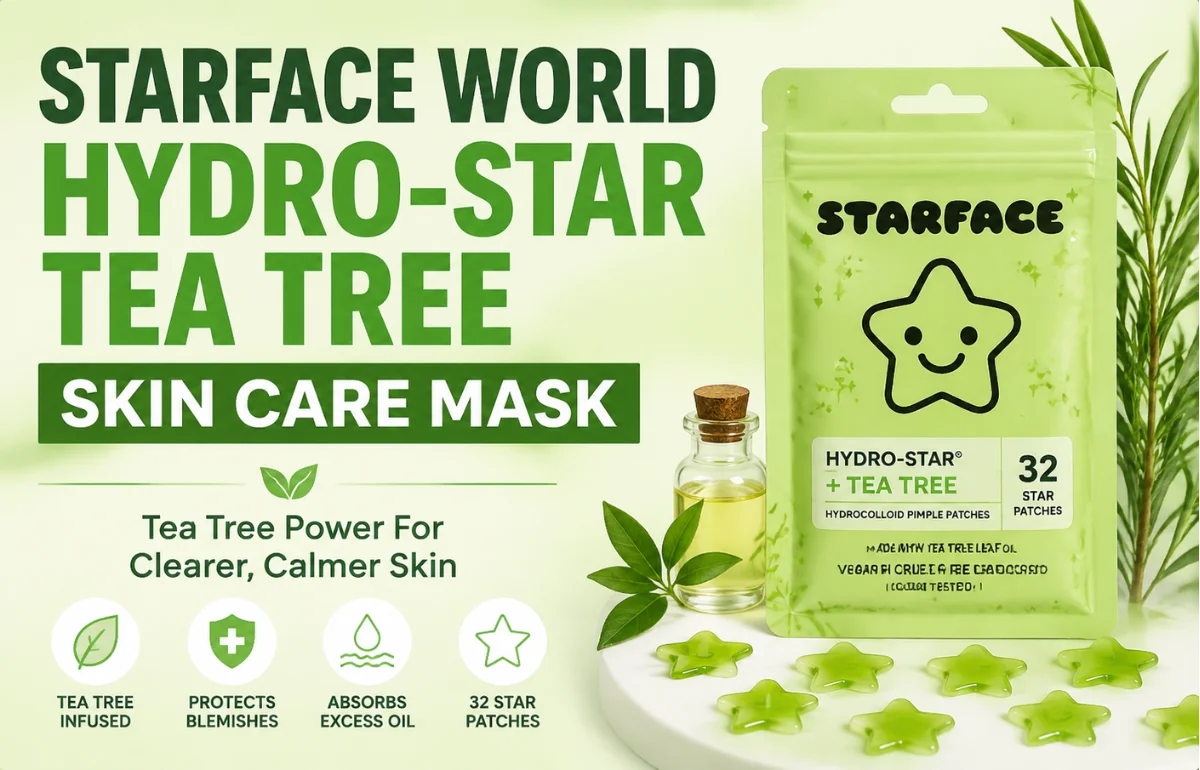
The Starface World Hydro-Star Tea Tree Skin Care Mask is a retail search name for Starface Hydro-Star + Tea Tree, a pack of 32 green, star-shaped pimple patches made with hydrocolloid and tea tree leaf oil. Despite the word “mask,” it is not a sheet mask, clay mask, or full-face treatment. Each small adhesive star is placed directly over an individual blemish, where the hydrocolloid layer absorbs surface fluid and creates a protective barrier, while tea tree oil is included to support oily, congested-looking spots. Starface recommends wearing each patch on clean, dry skin for at least six hours or overnight and limiting the tea tree version to one to three uses per week.
That distinction matters because shoppers searching this keyword may expect a face mask. What they are actually buying is a targeted acne patch designed mainly for surface-level pimples, whiteheads, and oily spots—not a treatment for the entire face.
Quick Product Overview
| Feature | What to Know |
|---|---|
| Product type | Targeted hydrocolloid pimple patches, not a full-face mask |
| Pack size | 32 green star-shaped patches |
| Main materials | Hydrocolloid-forming materials and tea tree leaf oil |
| Best suited to | Oily spots, visible whiteheads, and surface-level blemishes |
| Wear time | Six or more hours, often overnight |
| Suggested frequency | One to three times per week |
| Finish | Bright green and intentionally visible |
| Brand claims | Vegan, cruelty-free, and dermatologist-tested |
The current official listing also describes an updated star design that is claimed to be twice as sticky, 50% more absorbent, and easier to apply because of perforated backing sheets.
Those are manufacturer comparisons rather than independent head-to-head test results, but they are useful details for anyone who remembers older Starface patches slipping or folding during application.
How the Hydro-Star + Tea Tree Patch Works
I judge pimple patches by three practical questions: Can they absorb fluid, can they stay in place, and can they stop me from touching the spot? Hydro-Star + Tea Tree is built to address all three.
Hydrocolloid Absorbs Fluid From a Surface Blemish
Hydrocolloid is a moisture-absorbing material with roots in wound care. On a pimple that has reached the surface, it can take up fluid and form a soft, whitish gel beneath the patch.
The whitish gel visible after wear is absorbed moisture and fluid—not the entire pimple being pulled from the pore. A surface whitehead may look flatter, but the patch does not remove the deeper causes of acne.
The American Academy of Dermatology says pimple patches can draw fluid and reduce picking, but they do not work well on deep acne.
The Patch Creates a Physical Shield
The barrier function may be just as valuable as absorption. Covering a blemish reduces casual touching, scratching, squeezing, and friction from clothing or a pillowcase.
For people who pick without noticing, the bright star also acts as a reminder to leave the area alone.
Tea Tree Oil Adds a Targeted Botanical Ingredient
Tea tree oil, listed as Melaleuca alternifolia leaf oil, is the distinguishing ingredient in this version. Research on topical tea tree preparations suggests possible benefits for mild to moderate acne, including a randomized trial involving a 5% tea tree oil gel.
One limitation is often overlooked: Starface does not publish the tea tree oil percentage. Results from a 5% gel cannot automatically be transferred to an adhesive patch with an undisclosed concentration.
I therefore view tea tree as a supporting feature rather than a proven acne-treatment dose.
Is It Really a “Skin Care Mask”?
Some marketplace listings categorize the Starface World Hydro-Star Tea Tree Skin Care Mask under facial masks or even wash-off masks.
One Walmart Canada listing, for example, places it in the facial-mask category while also identifying the product form as a patch. The manufacturer’s own page consistently calls it a pimple patch.
This appears to be a retail taxonomy issue rather than a separate Starface mask product.
A traditional mask covers a broad area. Hydro-Star + Tea Tree covers one blemish at a time and is peeled off rather than rinsed away.
“Skin care mask” is the retailer’s category; “tea tree hydrocolloid pimple patches” is the accurate product description.
Which Pimples Respond Best?
Hydro-Star + Tea Tree makes the most sense when a blemish is visible, raised, and close to the surface.
Starface positions this version for oily spots and clogged-looking pores, while its standard hydrocolloid stars are aimed at surface pimples and whiteheads.
I would consider it for a visible whitehead, a small pimple that has opened naturally, an oily surface spot, or any blemish I am tempted to touch.
I would not expect much from it on a hard, painful bump below the skin. Cystic and nodular acne develop too deeply for a standard hydrocolloid patch.
Blackheads are also a poor match because the star does not function like a pore strip.
Tea Tree vs. Classic and Salicylic Acid Hydro-Stars
| Starface option | Main feature | Best use case | Main caution |
|---|---|---|---|
| Hydro-Star + Tea Tree | Hydrocolloid plus tea tree oil | Oily spots and blemishes needing a soothing, protective patch | Tea tree oil may irritate reactive skin |
| Classic Hydro-Star | 100% hydrocolloid | Surface-level pimples and visible whiteheads | Less targeted for congestion before a whitehead forms |
| Hydro-Star + Salicylic Acid | Hydrocolloid plus salicylic acid | Persistent-looking spots and clogged pores | Can be drying or irritating if overused |
Starface recommends limiting both the tea tree and salicylic acid versions to one to three uses weekly. Classic hydrocolloid patches can be a simpler option when someone wants frequent spot coverage without an added active ingredient.
My choice would depend on the blemish, not the color: plain hydrocolloid for a visible whitehead, tea tree for an oily surface spot, and salicylic acid for more persistent congestion.
How to Use Starface Hydro-Star + Tea Tree Correctly
Cleanse and Dry the Area Completely
Wash the skin gently, then pat it fully dry. Moisture, moisturizer, sunscreen, facial oil, and makeup can weaken adhesion.
Apply the patch before the rest of your skincare routine. The official instructions recommend completely clean, dry skin and at least six hours of wear.
Place the Center Over the Blemish
Tear the perforated backing, center the star over the spot, and smooth its points outward.
Using the perforation instead of prying at the star with a fingernail reduces folding and keeps the adhesive side cleaner.
Leave It on for Six Hours or Overnight
Do not lift the patch repeatedly to check the pimple. Every lift can weaken the adhesive and introduce more contact.
After six or more hours, peel it away gently. Stop using it if the area feels hot, itchy, unusually red, or sore.
Do Not Place It Over Damaged Skin
The retailer warning advises against using the patch on damaged or broken skin and recommends stopping if a rash or irritation develops.
A squeezed, scraped, or bleeding spot needs gentler care because adhesive and tea tree oil may irritate compromised skin.
Ingredients Explained Without Marketing Language
The ingredient list includes cellulose gum, polyisobutene, petroleum resins, a styrene/butadiene copolymer, mineral oil, polyurethane, tea tree leaf oil, and an antioxidant stabilizer.
In plain terms, most ingredients create the absorbent layer, flexible backing, and adhesive. Tea tree oil is the recognizable skincare ingredient, but this is still a manufactured dressing containing polymers, resins, and mineral oil.
“Plant-powered” describes the tea tree component, not every material in the patch.
This distinction may matter to shoppers who assume a tea tree patch is made entirely from natural materials. Reading the full ingredient list gives a more realistic picture of what is being placed on the skin.
Possible Side Effects and Skin-Safety Considerations
Tea tree oil can cause redness, irritation, or allergic contact dermatitis in some people. The risk deserves extra attention if you have eczema, a known essential-oil sensitivity, or an already damaged skin barrier.
A small patch test is sensible before placing several stars on the face. Adhesives can also cause temporary redness, so peel slowly and close to the skin rather than pulling upward.
Anyone with frequent painful breakouts, scarring, widespread acne, or acne that is not improving should treat the patch as a cosmetic support product—not a substitute for a dermatologist-guided plan.
The AAD specifically notes that deep acne requires a different approach.
Benefits of Starface Hydro-Star + Tea Tree
It Helps Protect Pimples From Picking
The patch creates a physical boundary between your fingers and the blemish. This is especially useful when touching or squeezing spots has become an automatic habit.
Even when absorption is limited, the protection alone may make the patch worthwhile.
It Can Make a Surface Whitehead Look Flatter
When fluid is available near the surface, hydrocolloid can absorb some of it during wear. The spot may look less raised after the patch is removed.
Results will vary according to the type and stage of the blemish. A patch placed over a dry bump with no accessible fluid may show little visible change.
The Visible Design Reduces Acne Stigma
Starface does not try to hide the fact that someone has a blemish. The bright green stars turn a spot treatment into a visible accessory.
That will not appeal to everyone, but it can help make acne care feel less embarrassing or clinical, particularly for teenagers and younger adults.
The Updated Backing May Improve Application
Small pimple patches are easy to fold, stretch, or contaminate with a fingernail. The current perforated sheet allows the backing to separate around the star.
This is a minor packaging change, but practical packaging often determines whether a patch reaches the skin flat and clean.
Where Expectations Need to Stay Realistic
The patch is intentionally visible. It will not prevent future acne, clear every clogged pore, or flatten a deep cyst overnight.
Tea tree oil is not automatically better for sensitive skin. Plain hydrocolloid may be the safer starting point, especially alongside retinoids, benzoyl peroxide, or exfoliating acids.
Value also depends on frequency. Someone using several stars per night will empty a 32-count pack quickly, while a person with occasional blemishes may keep the pack for months.
The product is therefore better viewed as a targeted tool within an acne routine, not as the routine itself.
Who Should Buy It?
The Starface World Hydro-Star Tea Tree Skin Care Mask is a good match for someone who gets occasional oily, surface-level blemishes and likes visible, playful skincare.
It may also suit teenagers or adults who habitually touch pimples, provided they tolerate tea tree oil.
I would skip it for cystic acne, widespread inflammatory acne, nose blackheads, or post-acne dark marks. Those concerns require different ingredients and, in some cases, professional advice.
For highly reactive skin, I would start with plain hydrocolloid so there is no added botanical ingredient to complicate a reaction.
Is Starface Hydro-Star + Tea Tree Worth Buying?
It can be worth buying when the product matches both your blemish type and your skincare preferences.
The main value comes from the combination of hydrocolloid absorption, physical protection, and a visible design that discourages picking. Tea tree oil may offer an extra benefit for oily spots, but its undisclosed concentration makes it difficult to assess separately.
Someone seeking the strongest possible acne treatment may find the product too limited. Someone seeking a gentle-looking patch for occasional surface blemishes may find it convenient and enjoyable to wear.
I would base the decision on the type of acne rather than the popularity of the star shape. Correctly matching the patch to the spot is more likely to produce a satisfying result.
FAQs
Is Starface Hydro-Star Tea Tree a face mask?
No. It is a pack of 32 individual hydrocolloid pimple patches, although some retailers list it within the facial-mask category.
How long should I leave Hydro-Star + Tea Tree on?
Starface recommends leaving each patch on for at least six hours or overnight, applied to completely clean and dry skin.
Can I use Starface Tea Tree patches every day?
The brand recommends limiting this tea tree version to one to three times per week. Plain hydrocolloid patches may be better for more frequent use.
Do Starface Tea Tree patches work on cystic acne?
They are unlikely to flatten deep cystic acne because hydrocolloid works best when fluid is close to the skin’s surface.
Can sensitive skin use Hydro-Star + Tea Tree?
Possibly, but tea tree oil and adhesives can irritate reactive skin. Patch test first and stop use if redness, itching, or a rash appears.
Final Verdict
Starface Hydro-Star + Tea Tree is best understood as a playful, targeted blemish patch—not a conventional skin care mask.
Its strongest practical benefits are fluid absorption, physical protection, and reduced picking. Tea tree oil adds a potentially useful but not fully quantified supporting ingredient.
Choose it for occasional oily surface spots, follow the six-hour wear guidance, and keep expectations focused on visible blemish care rather than complete acne treatment.
Before buying, compare it with plain hydrocolloid and salicylic acid patches so the ingredient matches the type of spot you actually have.

Mia Anderson is a skincare writer with 8 years of experience creating practical, research-informed content about skincare routines, skin health, ingredients, and everyday self-care habits. She focuses on helping readers understand skincare choices through simple explanations and realistic routines while encouraging professional advice for specific skin concerns.