

Boneless couches are sofas that get their shape and support mainly from foam rather than a traditional wood or metal frame. Many arrive vacuum-compressed in boxes and expand after unpacking, making them appealing for apartments, narrow stairways, and rooms where moving a conventional sofa is difficult. Some consist of a single sculpted piece; others have separate sections you can rearrange. Despite the name, not every model is identical: some use layered polyurethane or memory foam, while others add spring components for support. The result is usually a low-profile, generously cushioned seat designed more for relaxed lounging than formal, upright sitting.
I can see why these sofas attract attention. They promise the comfort of a giant cushion without the delivery headaches of bulky furniture. But their simple appearance hides a few important buying decisions, particularly around foam quality, seat height, cleaning, and returns.
How Does a Boneless Couch Work?
A conventional sofa normally relies on a rigid frame to hold its shape. Its cushions rest on springs, webbing, or another support system. A genuinely frameless sofa does things differently: substantial foam blocks provide both the structure and the seating surface.
Manufacturers may combine firmer base foam with a softer top layer. That construction keeps the sofa from feeling like one enormous, squishy pillow. Memory foam, when included, contours under pressure, while more resilient foam tends to spring back faster. Neither material automatically guarantees a better couch; how the layers work together matters.
Some products advertised as boneless include internal springs or reinforcing elements. I would check the construction description rather than assume that every item bearing the label is made entirely of foam.
Why Do They Arrive in Small Boxes?
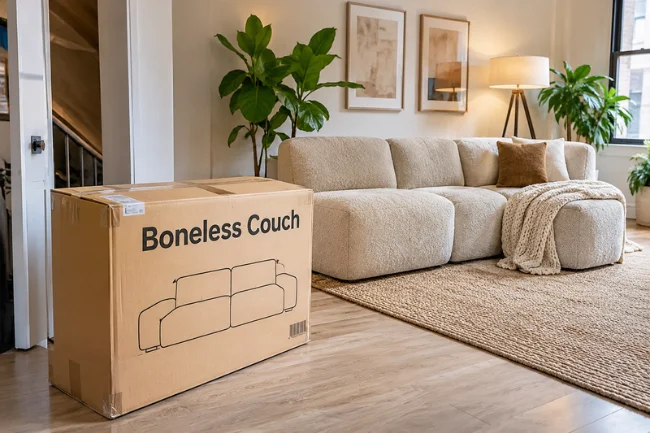
Flexible foam can often be compressed for shipping. Once you remove the packaging, it gradually recovers its shape. The process is not inflation: you do not need a pump, and the couch does not contain a balloon-like air chamber.
Many compressed sofas need roughly 24–72 hours for substantial recovery, although the manufacturer’s instructions should take priority. Some regain height quickly but need additional time to smooth out wrinkles and reach their intended dimensions.
Why Are Boneless Couches So Popular?
Easier Delivery and Moving
A boxed sofa is generally simpler to carry through a tight doorway than one full-size, rigid couch. This is especially useful in walk-up apartments and homes with sharp hallway turns. Modular pieces can also be moved separately when you rearrange a room.
There is a catch: easy delivery does not necessarily mean easy returns. Once expanded, the foam may not fit back into the original carton. That is worth investigating before ordering.
A Relaxed, Cloud-Like Appearance
The rounded edges, deep seats, and soft upholstery suit casual interiors. Corduroy, bouclé-style fabrics, and textured chenille often emphasize that inviting look. A boneless sofa can act as the main statement piece without needing an elaborate room design.
Still, “cloud-like” describes an impression, not a standardized comfort rating. One model may feel supportive and buoyant; another may let you sink close to the floor.
Flexible Layouts
A modular boneless sectional can work as a straight sofa, a corner arrangement, or separate loungers, provided its pieces are designed for those configurations. That flexibility appeals to renters, growing households, and anyone who changes their living-room layout often.
Check whether modules connect securely. Unattached sections can shift apart during everyday use, especially on smooth floors.
Boneless Couch vs. Traditional Sofa
Neither design wins in every home. I would compare them by how they are used, not simply by appearance.
| Feature | Boneless Couch | Traditional Framed Sofa |
|---|---|---|
| Main structure | Foam-dominant; some models include springs | Wood or metal frame with a separate support system |
| Delivery | Often compressed into cartons | Usually larger assembled or partly assembled pieces |
| Seat feel | Frequently deep, low, and lounge-oriented | Wider range of upright and lounge-oriented designs |
| Layout | Some models are rearrangeable modules | Fixed and modular options both exist |
| Repairs | Foam or cover replacement may be model-specific | Some cushions, legs, and parts may be replaceable |
| Returns | Expanded foam can complicate repacking | Bulky pickup and shipping can also be difficult |
A framed sofa often makes more sense if you regularly sit upright, want clearly defined arm support, or need a higher seat. A boneless design is compelling when relaxed seating, soft edges, and manageable delivery are your priorities.
Types of Boneless Couches Worth Knowing
One-Piece Foam Sofas
These have a unified shape, usually without separate sections to move around. They suit smaller rooms and buyers who want a clean silhouette. Before choosing one, check whether it can be rotated or carried through the intended doorway after expansion.
Modular Boneless Sectionals
Individual pieces create L-shaped, U-shaped, or straight layouts. They are practical when several people share the living room, but the joints between pieces deserve attention. Look for connectors, non-slip bases, and consistent cushion heights.
Convertible Sofa Beds and Floor Loungers
Some models fold or unfold into a larger, flatter surface for occasional guests. I would treat the sleeping function as a bonus unless the manufacturer explicitly designs it for nightly sleep. Seams, uneven foam thickness, and limited edge support can affect comfort overnight.
Curved and Sculptural Designs
Rounded sofas make a strong visual impression and can soften boxy rooms. Their unusual shapes can reduce usable seating compared with a rectangular couch of similar overall width. Measure the actual seating area, not just the outside dimensions.
How to Choose a Boneless Couch That Lasts
Look Beyond the Phrase “High-Density Foam”
Foam density and firmness are different properties. Density describes the amount of material in a given volume and is one factor linked to durability. Firmness describes how much force is needed to compress the foam. A dense foam can feel soft, and a firmer-feeling foam is not necessarily longer-lasting.
The Polyurethane Foam Association explains this distinction in its guidance on foam performance. If a seller publishes only a vague “premium foam” claim, I would ask for the layer construction, density, and firmness information. Not every manufacturer discloses those specifications, and missing data should make you more cautious about durability promises.
Check Seat Height Before Softness
Low seating is part of the appeal, but it can become irritating when you stand up dozens of times a day. An extra-deep seat may also leave shorter adults without enough back support unless they add pillows.
I suggest comparing three dimensions with a couch you already find comfortable: floor-to-seat height, usable seat depth, and backrest height above the seat. Those measurements reveal more about everyday usability than the overall width alone.
If rising from low furniture is difficult for you, favor a higher, firmer seat or test the couch in person before buying. Softness alone does not equal ergonomic support.
Choose Upholstery for Your Actual Household
Corduroy offers a cozy, textured finish but its ridges can hold crumbs. Chenille is soft and inviting, although its care requirements vary by construction. Smooth woven fabrics may be easier to brush off, while light upholstery tends to show marks more quickly.
For homes with pets or children, I would prioritize an explicitly washable removable cover, durable stitching, and the ability to clean individual sections. “Removable” does not always mean “machine washable,” so read the care label rather than relying on product photos.
Investigate Support, Not Just Seating Capacity
A listing that says “seats six” does not explain how six adults will actually fit. Check usable width per person, weight guidance where provided, and whether the back cushions remain upright when leaned against.
Also look closely at owner photos for sagging, gaps between modules, flattening edges, or covers that bunch after use. Reviews written after several months are particularly informative, though individual experiences are not controlled durability tests.
Read the Return Policy Before Checkout
This is the easiest detail to overlook. Verify when the return window starts, whether opened or expanded products qualify, who pays return freight, and whether the company supplies suitable repacking materials.
I would also confirm warranty coverage for permanent foam impressions, seam failures, and manufacturing defects. A generous-sounding warranty may exclude ordinary softening or require photos and measurements to support a claim.
The Three-Measurement Room Test I Recommend
Before shopping by color, I recommend a simple paper-and-tape exercise to separate a pretty sofa from one that will actually work in a room.
First, mark the proposed couch’s full footprint on the floor with painter’s tape. Include any chaise or ottoman in its usual position. Walk around the outline and check the path to doors, storage, and nearby furniture.
Next, compare the advertised seat height with a chair at home. Sit down and stand up a few times from a similar height if possible. This quickly reveals whether the low silhouette is practical for daily use.
Finally, measure the route from the delivery point to the room: door widths, stair turns, elevator depth, and tight corners. Compare that route with the package dimensions, not merely the expanded sofa’s measurements.
I call this the footprint, sit, and delivery test. It costs nothing and catches three of the most common ways furniture can disappoint: poor fit, awkward comfort, and access problems.
What Should You Expect to Pay?
Boneless couch prices vary widely by size, fabric, foam construction, brand, and whether you are buying a single seat or a sectional.
As a rough guide to the U.S. market, compact models can cost around $250–$500, while larger modular sectionals may range from $500 to $1,500 or more. These are indicative prices, not fixed retail quotes.
Instead of comparing sticker prices alone, I calculate the total delivered cost and consider how much usable seating it provides. Shipping charges, taxes, optional connectors, protection plans, and potential return fees all belong in that calculation.
A cheap six-piece set is not necessarily a bargain if the pieces are unusually shallow or the seller will not disclose foam specifications. Likewise, a premium-looking photograph does not prove that a costly sofa will retain its shape longer.
The better question is: what am I paying for in measurable comfort, construction, service, and usable space?
Unboxing and Caring for a Boneless Sofa
When your couch arrives, open the cartons carefully so a blade does not cut the fabric. Remove the compression wrapping according to the manufacturer’s instructions and arrange the pieces in a clean, ventilated room with enough space to recover.
Avoid judging the final shape immediately. Foam recovery can be gradual, and creases may ease as the material expands. If a section remains misshapen after the specified recovery period, photograph it and contact the seller while the return window remains open.
For regular care, vacuum with an upholstery attachment, remove crumbs from seams, and address spills promptly. Blot rather than aggressively rub a fresh mark. Use only cleaning methods approved for the fabric; soaking foam can make thorough drying difficult.
I would keep a copy of the care instructions and the order confirmation. Those two documents are surprisingly useful if you later need replacement covers or warranty assistance.
Will a Boneless Couch Sag Over Time?
Any foam seating can change with use. Compression, body weight, how often the same spot is occupied, foam composition, and cushion design all affect the result. A new couch feeling soft is not the same thing as an older couch developing a permanent depression.
Watch for three signs: a seat that no longer rebounds evenly, a noticeable low spot in a favorite position, and back cushions that stop supporting you. If the design allows it, rotating modules or changing favorite seating positions can help distribute wear, but it cannot repair degraded foam.
I would be skeptical of promises that a foam sofa will never sag. More useful evidence includes disclosed construction, relevant durability testing, clear warranty terms, and detailed owner feedback collected over time.
Are Boneless Couches Safe and Healthy?
Foam composition and ventilation are legitimate buying considerations, but marketing language often goes too far. CertiPUR-US certification applies to qualifying flexible polyurethane foam tested for specified content, emissions, and durability criteria; it does not automatically certify the entire finished sofa or make it “chemical-free.” You can check the program’s official directory if a seller claims certification.
For furniture sold in the United States, applicable upholstered seating must also meet federal flammability requirements under 16 CFR Part 1640. Compliance is not the same thing as a guarantee that the product contains no flame-retardant chemicals.
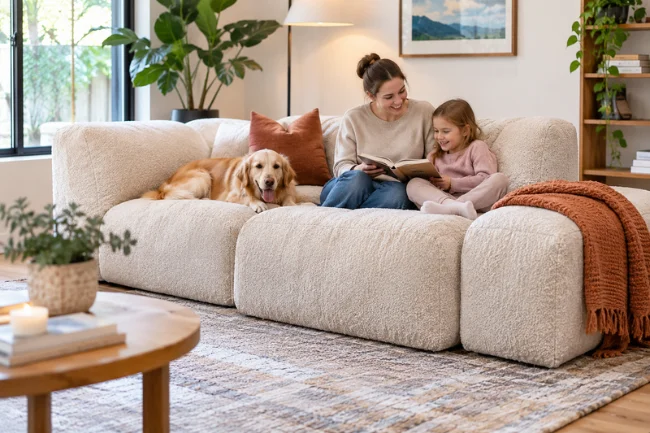
A noticeable odor after unpacking does not, by itself, establish whether a product is hazardous. Ventilate as instructed, and contact the retailer if the smell is strong, persistent, or accompanied by a product defect. For family use, also check manufacturer guidance on intended age, use, and placement; a soft lounge sofa should not be mistaken for an infant sleep surface.
Which Boneless Couch Fits Your Lifestyle?
| Your Priority | Features I Would Prioritize | Main Trade-Off to Check |
|---|---|---|
| Small apartment | Compact footprint, boxed delivery | Seat depth and doorway clearance |
| Family living room | Modular sections, washable covers | Sections shifting apart |
| Movie nights | Deep seating, supportive base foam | Very low seat height |
| Occasional guests | Convertible flat surface | Seams and sleeping comfort |
| Long-term daily use | Disclosed foam specs, warranty | Permanent impressions and repair options |
| Pet-friendly home | Cleanable fabric, sturdy seams | Hair trapped in textured upholstery |
My final filter is simple: if I cannot verify the dimensions, cleaning instructions, and opened-product return conditions, I keep looking. Those details matter long after the excitement of unboxing wears off.
Frequently Asked Questions
Are Boneless Couches Comfortable for Everyday Use?
They can be, especially for lounging, but daily comfort depends on seat height, firmness, back support, and foam quality. Try a comparable seat before committing.
How Long Do Boneless Couches Take to Expand?
Many compressed models recover substantially within 24–72 hours. Follow the specific manufacturer’s instructions because full recovery times differ.
Do Boneless Couches Need Assembly?
Many need little more than unpacking and positioning, but modular models may require connectors or additional setup. Check the listing before delivery.
Can You Wash Boneless Couch Covers?
Only if the manufacturer identifies them as washable. A removable cover may require spot cleaning or professional cleaning instead.
Are Boneless Couches Worth Buying?
Yes, for buyers who value lounge comfort, flexible layouts, and boxed delivery. They are less ideal if you need very upright, high, or rigidly supported seating.
Final Thoughts
Boneless couches can be a smart fit for relaxed homes, but I would never choose one on appearance alone. Compare the foam construction, seat height, usable dimensions, cleaning rules, and returns before placing an order. Start by measuring your room and your favorite current seat; those two reference points will make the shopping decision much clearer.

Olivia Parker is a home improvement research writer with 8+ years of experience covering home design, renovation ideas, maintenance tips, and practical living solutions. She creates easy-to-follow content to help readers make informed decisions about improving their homes.