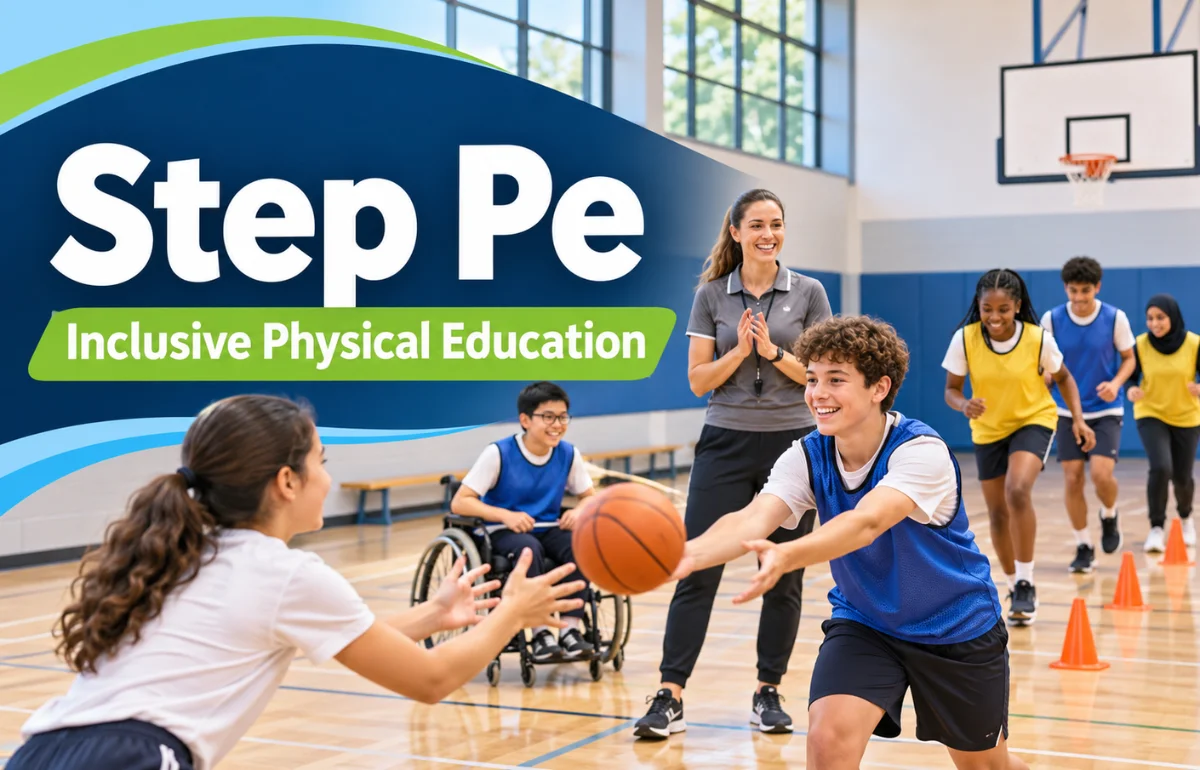
Step PE is a simple framework for adapting physical education activities so more students can participate, learn, and feel appropriately challenged. STEP stands for Space, Task, Equipment, and People—the four parts of an activity a teacher or coach can change. A smaller playing area, a different rule, a softer ball, or a new team arrangement may remove a barrier without changing the lesson’s main goal.
The approach is widely used in PE and sports coaching, including inclusive lessons involving disabled and non-disabled learners. I think its greatest strength is its simplicity: rather than replacing an entire lesson when something isn’t working, you can identify one obstacle and make a purposeful adjustment.
What Does STEP Stand for in Physical Education?
The STEP model gives teachers four questions: Where is the activity happening? What are students being asked to do? What are they using? Who are they working or playing with?
It isn’t a separate sport, fitness test, or prescribed curriculum. It’s a planning and teaching tool. Activity Alliance identifies STEP with Youth Sport Trust copyright dating to 2002, and organizations including UK Coaching use the model to explain personalized activity design.
| STEP element | What you can change | Simple PE example |
|---|---|---|
| Space | Area, distance, shape, surface, zones | Move passing partners closer together |
| Task | Rules, instructions, pace, objective | Allow a ball to bounce twice before return |
| Equipment | Size, weight, texture, height, type | Replace a hard ball with a soft foam ball |
| People | Team numbers, partners, opponents, roles | Try three attackers against two defenders |
Sometimes one adjustment is enough; sometimes several work together.
How the Four Elements of Step Pe Work
Space: Change the Environment
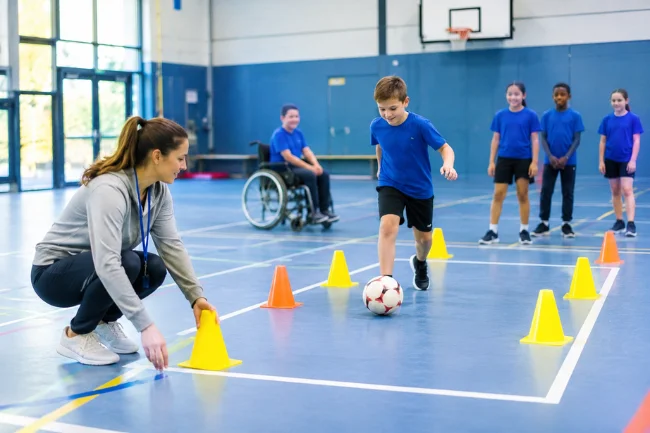
Space includes the size, shape, layout, and accessibility of the activity area. Moving cones closer can reduce the distance a learner travels. Widening a court may create more time to receive a pass. Marking a no-contact zone may help students take part with greater confidence.
Smaller doesn’t always mean easier. Less space can demand faster decisions in football but shorten the distance in a passing drill. I recommend choosing the learning objective before adjusting the boundaries.
Also look beyond the painted lines. Is there an accessible route into the hall? Is the surface suitable for mobility equipment? Can students move safely between stations? A clever game rule cannot solve a physical access barrier.
Task: Adjust What Students Must Do
Task refers to the rules, instructions, sequence, and expected action. A learner might practise catching from a gentle underarm throw before catching during a moving game. In tennis, permitting two bounces can create extra reaction time. In football, a temporary no-tackling rule can support a passing objective.
I prefer to preserve the skill being taught while changing how students reach it. If the goal is accurate passing, requiring every student to dribble through three defenders first may distract from that goal.
Teachers can offer two versions of the same challenge, demonstrate instructions visually, or give students a choice of how to complete a movement. The aim is meaningful progress, not simply making the task effortless.
Equipment: Match Tools to the Learner
Equipment may include balls, bats, rackets, targets, nets, markers, and assistive devices. A larger or slower-moving ball can give some learners more time to react. A lower target can support throwing practice. High-contrast markers may improve visibility in an appropriate setting.
Changes should suit the learner and objective. Ask whether the equipment improves control, access, feedback, or safety.
Foam balls, balloons, cones, and floor markers can provide inexpensive options. Specialist equipment should be selected with relevant guidance when a learner needs it.
People: Rethink Teams and Roles
People covers group size, partnerships, opposition, positions, and participation roles. Two-versus-one passing practice gives attackers more options than two-versus-two. Changing partners may improve communication or create an appropriate level of challenge.
But inclusion means more than placing a student on a team. Does that learner receive the ball? Are they making decisions? Do teammates listen to them? I would rather see a smaller game with genuine involvement than a full-sized match where several children barely participate.
Invite students to express preferences about partners and roles, while avoiding permanent labels such as “weak group.” Rotate leadership and responsibilities without assuming that a disabled learner should only keep score.
Why the STEP Framework Matters in Schools
PE groups rarely contain students with identical confidence, movement experience, stamina, communication preferences, or support needs. A fixed activity may suit a few learners while leaving others frustrated or inactive.
Step Pe gives teachers a practical way to differentiate teaching without designing an entirely separate lesson for every child. It can support access, increase opportunities to practise, and offer suitable challenges for students who are ready to progress.
Success can be personal: three controlled passes may signal real progress for a learner who previously avoided the ball.
Still, a framework by itself doesn’t guarantee inclusion. Teacher observation, student choice, safeguarding, and sensible adjustments matter just as much as the acronym. Progress should be judged against the intended learning goal and the learner’s starting point.
Practical STEP PE Examples Across Five Activities
These examples are adaptable starting points, not universal prescriptions. The best adjustment depends on the class, the individual, and the skill being assessed.
| Activity | Barrier or learning goal | Possible STEP adjustment | What to observe |
|---|---|---|---|
| Football | Learner rarely receives a pass | People: use smaller teams and a neutral supporting player | Number of purposeful touches and passes |
| Basketball | Standard basket is out of reach | Equipment: introduce an appropriate lower target | Controlled shooting attempts and technique |
| Tennis | Ball arrives before learner can respond | Task: allow a second bounce | Successful returns and positioning |
| Athletics | One fixed course prevents full participation | Space: offer suitable distances and accessible routes | Movement quality and personal progress |
| Relay games | Long waiting lines reduce activity | People: create more small teams | Active turns and time spent waiting |
Football: Teach Passing Before Full Competition
Imagine a class playing a large match in which two confident students control the ball. Instead of telling everyone else to “join in,” reduce team sizes, introduce a neutral player who supports the team in possession, and score a point for completing several passes.
This creates more decisions and ball contacts while students develop confidence. Once participation improves, the teacher can remove the supporting player or add a defender.
Basketball: Adapt the Target Without Losing the Skill
If students are practising shooting form, an adjustable lower hoop may let them focus on body position, controlled release, and aiming instead of struggling to reach the regulation height.
A larger target or closer shooting station offers another starting point. Observe the technique rather than comparing only the total baskets scored.
Tennis, Athletics, and Movement Games
For tennis, a softer, slower ball and a two-bounce rule can extend rallies. For athletics, provide accessible lanes or distance options while keeping an equivalent movement objective. For movement games, introduce clear zones, visual demonstrations, or shorter activity bursts where useful.
Let students try options, notice what helps, and adjust again. The framework works best as a conversation rather than a fixed set of disability-based rules.
How to Use STEP When Planning a PE Lesson
Start With One Measurable Learning Objective
Write down what students should practise: controlled throwing, safe landing, keeping possession, responding to rhythm, or communicating with teammates.
For a passing lesson, a clearer objective might be: “Students select and complete an appropriate pass to a moving partner.” That statement gives the teacher something observable.
Identify the Barrier, Not Just the Student
Watch what happens before changing the activity. Is the passing distance too long? Are the rules confusing? Is the ball difficult to grip? Are teams uneven? Ask the learner what they think would help.
I find this barrier-first question especially useful because it prevents assumptions. A student who avoids catching might need a slower throw or clearer instructions, not a different team.
Make the Smallest Useful Change
Try one adjustment, observe the response, and keep or revise it. Altering boundaries, rules, equipment, and teams simultaneously can make it difficult to tell what worked.
A quick decision loop is: identify the goal, notice the barrier, choose a STEP change, observe participation, and review the result. It isn’t an official additional STEP component; it’s a practical planning routine to make the framework easier to apply.
Ask Whether the Challenge Is Still Right
Watch for two opposite problems: frustration because the task is inaccessible and disengagement because it has become too easy. Students should have opportunities to choose a suitable challenge and progress when ready.
Ask three questions: Is it accessible? Is the intended skill being practised? Is there meaningful choice? Revisit any weak point.
Two Ready-to-Use STEP PE Lesson Plans
Lesson One: Inclusive Passing and Receiving (30 Minutes)
Suitable for: Primary-age learners, adjusted to local curriculum requirements and individual needs.
Objective: Choose an appropriate pass and receive a ball with increasing control.
Equipment: Soft balls of different sizes, cones, floor markers, and optional target hoops.
Begin with five minutes of partner rolls or passes at a comfortable distance. Spend eight minutes on a moving-partner activity, allowing pairs to select distances and ball types. Next, run a twelve-minute small-sided possession game, using small teams and optional safe zones. Reserve five minutes for feedback and reflection.
Use Space to vary passing distance, Task to permit a bounce before receiving, Equipment to offer slower or easier-to-grip balls, and People to adjust partner or defender numbers. Students can work toward increased accuracy, more successful receptions, or better decisions.
Record whether each learner attempted passes, received feedback, and made a purposeful improvement. Check surface safety, collision risk, and individual support arrangements before the session.
Lesson Two: Secondary-School Possession Game (35 Minutes)
Suitable for: Older learners developing tactical awareness in invasion games.
Objective: Create and use passing options while maintaining possession.
Start with five minutes of movement and passing warm-ups. Follow with ten minutes of three-versus-two possession practice, rotating defenders. Use fifteen minutes for small-sided games with multiple scoring options. End with five minutes of student-led discussion.
Students needing more processing time might play in a larger area or with a neutral teammate. Those ready for extra challenge could face an additional defender or a touch limit. None of these changes should become a permanent ability label.
Assessment is straightforward: Did students move into space? Did they identify an available teammate? Did they keep possession more effectively after feedback?
Making STEP PE Inclusive for Different Support Needs
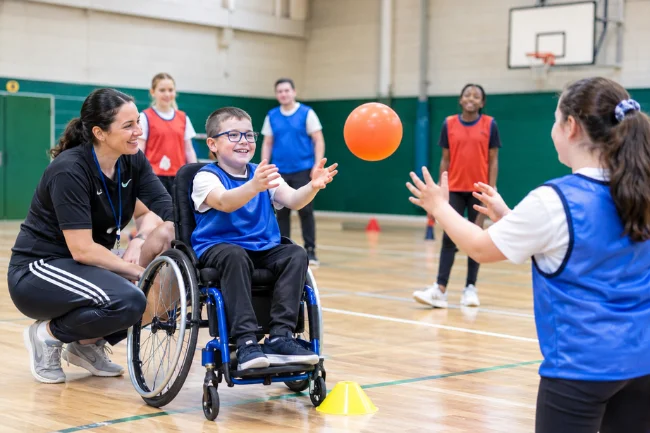
Inclusive planning starts with the individual, not a diagnosis. Two students with the same disability may prefer completely different adjustments. Speak with the learner, consider relevant school support plans, and consult specialists where needed.
For mobility-related needs, check accessible surfaces, movement routes, turning space, and suitable equipment. For visual access, consider contrast, clear verbal information, and appropriate audible equipment after individual assessment. For hearing access, pair spoken instructions with visual cues and position demonstrations where they can be seen.
For students who benefit from predictable routines or simpler communication, use short instructions, demonstrations, and clear transitions. Offer choices without overwhelming learners with too many rules at once.
Never assume a seated or non-playing role is the best accommodation. Meaningful participation can involve an adapted version of the main skill. Any physical adjustments must remain consistent with safeguarding, equipment guidance, and individual safety requirements.
How STEP Relates to the Inclusion Spectrum
The Inclusion Spectrum, sometimes presented through the Activity Inclusion Model, considers different ways to organize inclusive activity. Dorset Council describes open activities, modified activities, parallel activities, and specific activities. Each offers a different participation format.
STEP answers a narrower question: What exactly should change within the chosen format? For example, a teacher might run a modified group game and use Equipment to offer an alternative ball, or organize parallel activities and use Space to change distances.
The distinction is useful because neither model should turn into a rigid checklist. First choose a participation approach that respects the learner’s goals; then use STEP to tune the experience. Activity Alliance offers inclusive PE activity cards that show such adaptations across different game types.
Benefits, Limits, and Mistakes to Avoid
STEP can make lesson planning more flexible, help teachers notice barriers sooner, and give students more appropriate practice opportunities. It also supports progression: the same framework can increase difficulty when a learner is ready.
Yet four letters cannot replace staff training, specialist advice, accessible facilities, or honest student feedback. Modifying a game also doesn’t prove that learning has improved; teachers still need to assess outcomes.
I would watch for three common mistakes. First, treating every adaptation as a reduction in difficulty can leave learners underchallenged. Second, changing too many elements at once can hide which change helped. Third, equating inclusion with attendance can overlook students who spend the whole lesson waiting or watching.
A simple participation audit helps: Who has meaningful turns? Who gets feedback? Who makes decisions? Who is improving? The answers should influence the next lesson.
A Quick STEP Checklist for Teachers and Coaches
Before the lesson, identify the intended skill, available space, suitable equipment, and student preferences. During the activity, notice barriers and choose one practical adjustment. Afterward, record whether participation and skill performance improved.
I suggest keeping three short notes: “barrier observed,” “change made,” and “result noticed.” Over several lessons, that record becomes more useful than an elaborate plan that nobody revisits. Keep notes appropriately confidential and aligned with school procedures.
For further guidance, see Activity Alliance’s STEP resources, UK Coaching’s STEP model explanation, and the inclusive PE activity cards.
Frequently Asked Questions About STEP PE
What does STEP stand for in PE?
STEP means Space, Task, Equipment, and People. These are four areas teachers can modify to make activities more accessible or appropriately challenging.
Is STEP PE only for students with disabilities?
No. STEP can support all learners, including beginners, confident athletes, and students who need individualized adaptations.
Can STEP make PE activities harder as well as easier?
Yes. Changing rules, equipment, space, or team numbers can increase challenge when that supports the lesson objective.
What is a simple example of STEP in PE?
In a catching lesson, a teacher might shorten the throwing distance, allow one bounce, or use a softer ball.
How do teachers know whether a STEP adjustment worked?
Compare participation and skill performance before and after the change, and ask students whether the activity feels accessible and challenging.
Final Thoughts
Step PE is most useful when it shapes real teaching decisions, not just lesson-plan terminology. Start with one activity you already teach, ask what prevents some students from taking part fully, and test one Space, Task, Equipment, or People adjustment. Keep what helps, change what doesn’t, and use student feedback to guide your next lesson.

Lauren Mitchell is a fitness and exercise specialist with 11+ years of experience helping people build strength, improve mobility, and maintain healthier lifestyles. She provides evidence-based fitness guidance focused on effective workouts, injury prevention, and sustainable exercise habits.