Commission Conjunction is a search variation of Commission Junction, the former name of CJ, an affiliate marketing network that connects brands with publishers and creators. The official platform is called CJ, and it helps businesses reward partners when their promotional links lead to qualifying sales, leads, or other agreed actions.
In simple terms, a blogger recommends a product, a reader follows a tracked link, and the blogger may earn a commission if the reader completes an eligible action. The advertiser sets the program rules, while CJ supplies the technology and reporting that help manage the relationship.
If you arrived here searching for “Commission Conjunction,” you are almost certainly looking for Commission Junction or CJ Affiliate—not a separate company or a type of English conjunction.
The name matters: outdated tutorials and suspicious sign-up pages can mislead beginners. I prefer to focus on the business model and what a publisher can control.
Commission Conjunction vs. Commission Junction: Clearing Up the Name
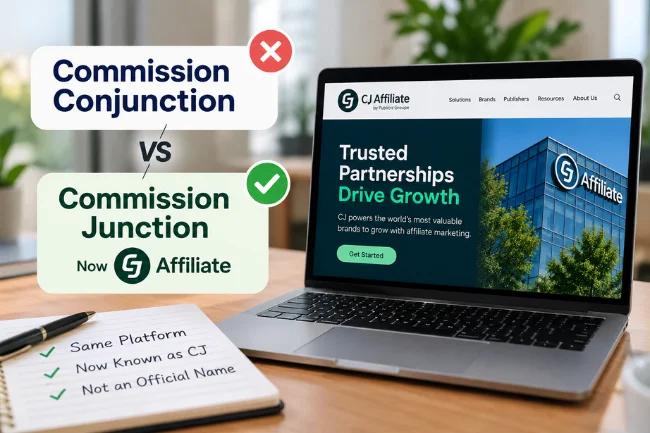
Commission Junction began in Santa Barbara, California, in 1998. Later known as CJ Affiliate, it now primarily uses CJ. Its parent group is Publicis Groupe. CJ’s company overview confirms its history and current identity.
“Commission Conjunction” is not an official CJ product or membership level. It is a mistaken search phrase for the same affiliate platform.
I would use the official CJ website for account registration, support, and program information. A website that promises guaranteed commissions merely for creating an account deserves immediate skepticism.
How Does CJ Affiliate Actually Work?
CJ acts as the connection between two main groups: advertisers that want customers and publishers that can introduce those customers.
A publisher might run a blog, comparison website, shopping publication, or qualifying creator channel. An advertiser might sell software, hotel bookings, clothing, or another product or service.
The journey looks like this:
- An advertiser joins CJ and sets the terms for its affiliate program.
- A publisher creates an account and applies to relevant advertiser programs.
- After approval, the publisher obtains tracking links for eligible offers.
- A reader clicks a link and visits the advertiser’s website.
- If an eligible action occurs and is attributed to that publisher, CJ records the transaction.
- The transaction is reviewed, finalized, and paid according to the applicable terms.
Joining the network does not grant access to every brand. Each advertiser can assess audience, region, and promotional methods separately.
What Does CJ Provide—and What Is Still Your Job?
CJ provides a marketplace for partnerships, tracking tools, reporting, and payment infrastructure.
It also offers methods for making product-level links, including a Deep Link Generator for supported advertiser programs. Its publisher information explains these capabilities.
What CJ does not provide is a trusting audience.
Content quality, useful recommendations, and relevant traffic still determine whether an account becomes a business. A tracked click alone never guarantees a commission.
Who Can Use Commission Junction?

CJ serves publishers and creators, although eligibility varies by account type and advertiser.
Its support guidance says standard publisher applicants need an active website and that creating an account is free.
For a blogger, a strong application clearly explains the site’s audience, traffic sources, and promotional approach.
Before Applying, I Would Check These Basics
- Publish genuinely useful articles that are accessible to visitors.
- Make your audience and editorial focus obvious.
- Include contact, privacy, and disclosure pages.
- Check that your website loads properly on mobile devices.
- Describe traffic sources accurately instead of exaggerating figures.
- Verify current requirements for your location.
A focused hiking blog may suit an outdoor advertiser better than a larger, unfocused website. Approval remains the advertiser’s decision.
How to Get Started With CJ Affiliate
Start at CJ’s official sign-up page. The publisher account is free, although application screens may change.
1. Create an Accurate Publisher Profile
Verify your email, provide accurate details, and select categories matching your active website.
2. Search for Relevant Advertisers
Check whether the advertiser serves your readers’ countries, accepts your methods, and sells something your audience wants.
An impressive rate on an irrelevant product has little value.
3. Read the Program Terms Before Applying
Review eligible actions, exclusions, referral windows, coupon policies, and restrictions on search or social promotion.
4. Build Links Only After Approval
After approval, create authorized links.
Deep links can send readers to products rather than homepages, but CJ’s tool depends on advertiser support.
5. Measure Outcomes, Not Just Clicks
Track purchase-intent articles, clicks, and confirmed commissions.
I treat early results as learning data, not a final verdict.
CJ Commission Rates, Cookies, and Payment Rules
There is no universal Commission Conjunction commission rate.
Each advertiser determines the actions it will reward and the conditions attached to payment.
One program may offer a percentage of an eligible sale; another may pay a fixed amount for a verified lead or subscription.
| Payment model | How it works | Illustrative example |
|---|---|---|
| Percentage of sale | Publisher earns a share of the eligible order value | 8% of a $120 eligible purchase = $9.60 |
| Fixed payment per sale | A completed qualifying purchase earns a set amount | $15 for an approved order |
| Qualified lead | Payment follows an accepted registration or inquiry | $6 for a verified lead |
| Subscription or recurring arrangement | Rewards depend on the advertiser’s specific contract | Payment after a paid plan begins |
These are hypothetical examples, not CJ-wide rates. Actual programs may exclude products or apply different rates.
The Referral Window Is Not a Guarantee
A referral window, sometimes called cookie duration, indicates how long a referral may remain eligible.
A 30-day window does not guarantee that every purchase within 30 days belongs to the first publisher.
Later clicks, consent, device changes, and program rules can affect credit.
I would read the attribution terms instead of trusting a headline duration.
Why a Recorded Commission May Not Be Payable Yet
Transactions may be reversed or locked during validation. Refunds, cancellations, and ineligible actions can change recorded earnings.
CJ’s payment-cycle explanation describes payment periods around the 20th and, for eligible currencies, around the 28th.
It also explains that the closed commission balance must reach the account’s configured minimum and that available advertiser funding matters.
Check the current settings in your account rather than treating those dates as a personal payment guarantee.
How Much Can You Realistically Earn?
An affiliate dashboard is not a salary slip.
Earnings depend on several moving parts: suitable traffic, click-through rate, conversion rate, average eligible order value, commission percentage, and the share of transactions that remain approved.
I find it useful to estimate revenue per 1,000 article visits rather than focus on a flashy commission percentage.
Suppose a review page receives 1,000 visits in a month:
- 120 visitors click an affiliate link, a 12% click-through rate.
- 5% of those clicks become eligible orders: 6 orders.
- The average commission on each order is $12.
- One order is later reversed, leaving 5 approved commissions.
The result is $60 in confirmed commission from 1,000 visits, or $60 per thousand visits before operating costs and taxes.
Change the conversion rate, average payout, or reversal count and the result changes immediately.
Effective traffic value matters more than raw volume. A focused answer to a buyer’s question can outperform a popular but noncommercial post.
Look at Effective Earnings, Not the Advertised Rate
When comparing programs, I would calculate:
Expected commission per 100 qualified clicks = 100 × conversion rate × average eligible commission × approval rate.
For example, Program A might pay $20 per order but convert only 1% of qualified clicks, producing about $20 per 100 clicks before reversals.
Program B might pay $8 per order and convert 4%, producing about $32.
The smaller headline commission can therefore deliver better results.
This is a planning estimate, not an earnings prediction. Replace assumptions with actual reports.
How to Choose an Advertiser That Fits Your Audience
I would evaluate relevance, pricing, availability, landing-page quality, customer support, and program rules—not only the highest listed rate.
| Evaluation factor | Stronger signal | Reason for caution |
|---|---|---|
| Audience match | Product solves a problem your readers discuss | Offer is unrelated to your website’s purpose |
| Commission terms | Clear eligible actions and exclusions | Vague or frequently changing conditions |
| Buying experience | Accurate pages, transparent pricing, smooth checkout | Broken links or surprising extra charges |
| Tracking and attribution | Understandable referral rules and reporting | Unclear credit for conversions |
| Brand credibility | Verifiable company details and fair customer policies | Repeated unresolved customer complaints |
| Editorial independence | You can recommend alternatives and mention drawbacks | Pressure to publish misleading praise |
My Two-Question Fit Test
Before placing a link, I would ask two questions:
Would this recommendation remain useful if it paid nothing?
And can I explain exactly why this product is suitable for this particular reader?
If either answer is no, the commission is driving the content instead of supporting it.
Content Strategies That Work Better Than Random Affiliate Links

Affiliate links work best at genuine decision points.
A suitcase guide, for example, should explain size limits and durability before recommending products.
I would organize a monetized blog around three kinds of content:
Comparison and Alternative Pages
Explain differences, trade-offs, intended users, and the basis of your judgment.
Never invent hands-on testing.
Problem-Solving Guides
Explain the problem before recommending products. A home-office article might cover desk height before suggesting equipment.
Updates to Existing Popular Articles
Update broken links, discontinued products, and outdated comparisons.
I would refresh popular pages before publishing more thin content.
A practical decision rule—who should buy and who should skip a product—adds more value than repeating a feature list.
Common Mistakes That Can Cost Publishers Money
Editorial mistakes can be as costly as technical ones.
- Applying everywhere: Begin with a few relevant brands.
- Ignoring program restrictions: Some advertisers limit coupons, search ads, social promotion, or other traffic methods. Read their policies first.
- Linking only to homepages: A direct product page may reduce friction when the advertiser permits deep linking.
- Confusing tracked with approved commissions: Wait for validation before counting revenue as final.
- Forgetting link maintenance: A broken or unavailable offer can quietly waste valuable search traffic.
- Chasing payouts: Inflated claims undermine credibility.
I recommend a monthly “link-to-promise” review: open popular articles and confirm each destination still matches the recommendation.
Analytics cannot tell you when a linked product page quietly changes.
Transparency, Trust, and Affiliate Disclosures
Readers should know when a recommendation can earn you money.
A clear disclosure near commercial recommendations might say:
“I may earn a commission if you buy through links in this article, at no additional cost to you.”
Use only wording that accurately describes your arrangement.
The US Federal Trade Commission’s endorsement guidance emphasizes making material relationships clear and noticeable.
Requirements also differ by country, platform, and advertiser, so publishers should check the rules that apply to their audience and activities.
Disclosure is necessary, but it is not a substitute for honest reviews.
I would distinguish first-hand testing from desk research, cite reliable specifications, disclose significant limitations, and avoid presenting an affiliate offer as the only reasonable choice.
For search visibility, usefulness comes before keyword repetition.
Use descriptive headings, answer the actual question, show how claims were checked, and keep pages updated.
Someone searching “Commission Conjunction” needs a correct explanation of CJ, not twenty awkward repetitions of the mistaken phrase.
Is CJ Affiliate Worth Using in 2026?

For a publisher with a focused audience, CJ can be a sensible way to work with multiple brands through one established network.
Its appeal includes advertiser discovery, link creation, performance reporting, and international payment options.
CJ’s current publisher page says it supports payments in many currencies, including options through Payoneer, subject to availability and account requirements.
The trade-offs are real.
Individual advertisers still decide approvals and commissions. Payments are not instantaneous.
Attribution and reversals complicate forecasts. And a new blog cannot rely on the network to produce traffic.
I would consider CJ a strong candidate when the website already helps readers make purchasing decisions and suitable advertisers are available.
If the site has little useful content or no clear audience yet, I would develop that foundation before optimizing affiliate revenue.
Final Thoughts
Commission Conjunction is best understood as a mistaken name for Commission Junction, now CJ.
The platform can connect a useful publication with brands willing to pay for qualifying results, but sustainable earnings come from relevance, accurate information, and reader trust.
My suggested next move is practical: visit CJ’s official site, check publisher eligibility, and identify three advertisers that genuinely serve your audience.
Compare their terms before adding a single link. A thoughtful first partnership is worth more than a long list of unsuitable offers.
Frequently Asked Questions
Is Commission Conjunction the same as Commission Junction?
Yes, in affiliate marketing searches, it generally refers to Commission Junction, the former name of CJ. “Commission Conjunction” is not the platform’s official name.
Is CJ Affiliate free for publishers?
CJ says creating a standard publisher account is free. Individual advertiser programs have their own approval requirements.
Do I need a website to join CJ Affiliate?
CJ’s standard publisher support guidance specifies an active website for applications. Creators should check the current requirements for their account type.
How does CJ Affiliate pay commissions?
CJ pays eligible, finalized commissions after account thresholds and applicable payment conditions are met. Timing and available methods depend on your account and currency.
Can beginners make money with Commission Junction?
Yes, but earnings are not guaranteed. Beginners need relevant content, genuine visitors, advertiser approval, and qualifying conversions before commissions become payable.

Ethan Caldwell is a business research writer with 9+ years of experience covering entrepreneurship, market trends, business strategies, and industry insights. He focuses on creating clear, data-informed articles that help readers understand modern business concepts.