
incabizgrowth.com is a business-focused information website that publishes articles about entrepreneurship, finance, technology, professional skills, and wellbeing. It also provides four free calculators for measuring business growth, customer value, cash runway, and conversion rates. In other words, it is mainly a publishing platform with a small collection of practical tools, not a dedicated business-management application or a personalized consulting service.
I reviewed its public homepage, tools, About page, contact information, and published policies in October 2026. The site offers useful starting points for business research, but several unfinished policy details make its editorial and privacy claims harder to verify. Here’s what I found, what the calculators can realistically tell you, and where I would exercise caution.
What Is incabizgrowth.com, and Who Is It For?

The website uses the name Inca Biz Growth and presents itself as a resource for founders, marketers, small-business owners, and professionals. Its main offering is educational content. You can read articles without building a company profile, entering revenue data, or purchasing a subscription.
The domain sounds like it might belong to a growth agency or software product. Instead, I found articles, search, a newsletter signup, and calculators. I did not find evidence of individual consulting or customer account management.
Its About Us page describes an editorial team of writers, marketers, and industry researchers. That’s how the publisher presents itself; the page does not independently establish the qualifications or identities of every contributor.
For a reader, the practical question is simple: do you need an introduction to a topic, a quick business calculation, or advice specific enough to drive a major decision? The first two are closer to the website’s visible strengths. The third calls for additional research.
What Topics Does the Website Cover?
I found five main categories in the current navigation. They are more business-oriented than the wide assortment of subjects found in some older articles, although the archive still contains material that stretches beyond those labels.
Business and Entrepreneurship
The Business section covers starting and running a company, marketing choices, leadership, and day-to-day operations. Examples visible on the homepage include an article comparing PPC and SEO, a LinkedIn brand-awareness piece for B2B companies, and guidance for new Amazon sellers.
Someone choosing between search advertising and organic traffic needs to weigh budget, timing, competition, and measurement. An introductory article can frame that decision, but it is not a tailored marketing plan.
Finance and Business Numbers
The Finance category includes money management, investing, and financial services. Its archive also contains older personal-finance and insurance-related content. Publication dates matter here: an explanation of budgeting may remain useful for years, while an investment or regulatory claim can become outdated quickly.
I would check the source and date of any figures before using them in a budget, investment decision, or client presentation. The site’s own general-information disclaimer is a reminder that reading an article is not the same as obtaining professional financial advice.
Technology, Skills, and Wellbeing
Technology articles range from digital tools to consumer-oriented subjects. The Skills & Education area is positioned around learning and career development, while Health & Wellbeing addresses concerns relevant to working people and business teams.
The mix is broad. The homepage, for example, displays material about artificial intelligence and screen time alongside business marketing topics. That variety can be convenient for browsing, but a publication that covers several disciplines still needs topic-specific sources and qualified reviewers when claims affect health or money.
The Four Free Growth Calculators Explained
The most useful feature I found outside the article archive is the Free Growth Tools collection. The site advertises four calculators with no signup requirement. I inspected their displayed inputs and explanations; I did not conduct an independent software or privacy audit.
| Calculator | Information you enter | What it helps estimate |
|---|---|---|
| CAGR & Growth | Starting value, ending value, years | Average annual compounded growth |
| Customer Lifetime Value & CAC | Order value, purchase frequency, gross margin, customer lifespan, acquisition cost | Customer economics and LTV-to-CAC comparison |
| Startup Runway | Cash balance, monthly expenses, monthly revenue | Months of cash remaining at the assumed burn rate |
| Conversion Rate & Funnel | Visitors, conversions, optional ad spend and conversion value | Conversion percentage, acquisition efficiency, and potential uplift |
CAGR: Understanding Growth Over Time
The CAGR calculator uses the starting value, ending value, and number of years to estimate a compound annual growth rate. The underlying formula is straightforward: divide the final value by the initial value, take the result to the power of one divided by the number of years, and subtract one.
Suppose a company’s annual revenue increases from $100,000 to $144,000 over two years. Its CAGR is 20%. That does not mean revenue rose by exactly 20% in each individual year; it describes the smooth annual rate that would produce the same overall change.
I find that distinction more useful than the headline percentage. A business might grow sharply in year one and struggle in year two. CAGR compresses that uneven journey into one number, so it works best alongside the actual year-by-year figures.
Customer Lifetime Value and Acquisition Cost
The LTV and CAC calculator asks for average order value, annual purchase frequency, gross margin, expected customer lifespan, and the cost of winning a customer.
Imagine customers spend $50 per order, buy four times a year, stay for three years, and generate a 40% gross margin. The estimated gross-margin-based lifetime value is $240. If acquiring one customer costs $80, the LTV-to-CAC ratio is 3:1.
That’s useful context, but the ratio is not a universal pass-or-fail test. The estimate depends on realistic retention assumptions, consistent cost definitions, and whether the business can afford the time between acquisition spending and customer payments. It also does not replace a full cash-flow analysis.
Startup Runway: How Long Can Cash Last?
The runway calculator considers cash in the bank, monthly expenses, and monthly revenue. If a startup has $60,000 in cash, spends $12,000 monthly, and brings in $7,000, the net monthly burn is $5,000. At that rate, the calculated runway is 12 months.
Real businesses rarely keep their expenses and income perfectly flat. Hiring, tax payments, seasonal sales, debt obligations, and unexpected costs can change the picture. I would use the result as a snapshot, update it regularly, and model a less optimistic scenario before making hiring or fundraising commitments.
Conversion Rate and Funnel Performance
The conversion calculator takes visitor and conversion counts, with optional advertising spend and average conversion value. For example, 120 sales from 6,000 visitors produce a 2% conversion rate.
Define conversions consistently: newsletter signups, qualified leads, and purchases are different outcomes. Mixing them can make a marketing channel appear more effective than it is.
The tool also describes a hypothetical improvement with the same traffic. Treat that as scenario planning, not a forecast. Better conversion rates require changes in traffic quality, messaging, pricing, experience, or some combination of those factors.
How Easy Is It to Use incabizgrowth.com?

The homepage places a search field near the top and highlights business, finance, technology, skills, and wellbeing categories. It also separates featured and recent articles from the free tools. A reader looking for a broad topic should be able to begin with either the search field or the relevant section.
The site includes a weekly newsletter invitation. As with any newsletter, I would read the privacy terms before subscribing and avoid assuming that a signup promise guarantees a particular delivery schedule or editorial standard.
One useful detail is that the homepage displays dates and reading-time estimates on article previews. That helps readers distinguish a recent piece about digital marketing from an older technical article. It does not, by itself, tell you whether the content was reviewed or corrected after publication.
Is incabizgrowth.com Legitimate and Trustworthy?

I can confirm that the website exposes readable public pages, an article archive, calculators, contact routes, and policy documents. Those are observable features of an operating publication. They do not prove that every article is accurate, every tool is secure, or the publisher’s legal ownership has been independently verified.
My review uncovered several specific transparency issues. They are more informative than giving the entire domain an unsupported numerical trust score.
| Public evidence I checked | What I observed | What it means for readers |
|---|---|---|
| About Us | The site describes a team of business writers, marketers, and researchers | A stated team identity is not independent verification of credentials or ownership |
| Editorial Policy | Its research section contains an unfinished instruction about describing research and testing | The public research process is not fully documented |
| Contact Us | A message form appears, but one email reference remains a placeholder; an address is also shown in the footer | Contact information is present but inconsistently completed |
| Privacy Policy | The update date, newsletter provider, analytics services, and deletion-contact wording contain unfilled fields | Readers lack complete details about the stated data practices |
What the Editorial Policy Reveals
The policy states positions on editorial independence, content updates, and sponsored posts. Those are useful subjects for a publisher to address. But its research section still contains template-style wording rather than a description of how writers verify claims or evaluate sources.
I see this as a documentation problem, not proof that individual articles are false. To assess a specific business article, I would still look for a named writer, relevant sources, a clear date, and an explanation of any calculations or recommendations.
What the Contact and Privacy Pages Reveal
The contact page offers a form and the footer displays an email address. However, the body of the contact page includes unfinished email wording. The privacy policy similarly leaves several fields incomplete, including the newsletter service and technologies used for analytics or advertising.
Those gaps matter because readers need to know who handles submitted information and whom to contact about a correction or privacy request. They do not establish that information is being misused. They establish that the public explanation is incomplete at the time I checked it.
Are the Free Calculators Safe for Business Data?
The website says its calculators operate in the visitor’s browser and that numbers entered into them are not sent to its servers. This is a useful privacy claim, especially for small-business owners who may be entering sales figures, cash reserves, or acquisition costs.
I cannot independently certify that claim without examining the live code, network requests, and applicable third-party scripts under controlled conditions. The presence of HTTPS or a privacy policy would not settle that question either.
For ordinary exploration, hypothetical or rounded figures can show how a formula works. For confidential budgets, payroll-related data, customer records, or investment models, I would avoid entering sensitive details until the tool’s handling of data has been independently verified or approved by the business’s security team.
The same principle applies to the site’s financial and health articles. Use them to learn terminology or find questions worth investigating, but verify consequential advice with authoritative sources and qualified professionals.
Domain History and Similarly Named Websites
Some online discussions cite a 2017 creation date for the domain. A registration date, even when confirmed, would establish when a domain record began, not whether the same owners, editorial team, or business model operated continuously from that year onward.
For a stronger historical check, I would consult an official ICANN registration lookup and compare publicly available snapshots using the Internet Archive. Changes in categories, branding, and content should be dated separately rather than folded into one uninterrupted origin story.
There is also a similarly named domain, incabizgrowth.site, associated in publicly indexed material with product-review rewards. The different extension matters. A shared-looking brand does not establish that the two websites have a common owner, payment system, or purpose.
Check the complete address before signing up for rewards, submitting personal details, or following a payment offer. I would not transfer a trust judgment about one domain to another simply because their names resemble each other.
Strengths, Limitations, and Who May Benefit
The website’s strengths are accessibility and range. You can encounter small-business topics, learn basic financial vocabulary, and open simple calculators without working through a complicated product setup. The growth tools offer more tangible utility than a typical collection of opinion articles.
Its limitations are just as clear. The archive covers subjects requiring different kinds of expertise, some content is years old, and publicly displayed editorial and privacy documentation is unfinished. I also found no basis for treating the calculators as independently certified financial software.
For a founder comparing marketing metrics, a student learning business formulas, or a professional scanning new topics, incabizgrowth.com may be a reasonable first stop. Someone making investment decisions, handling sensitive business figures, or seeking individualized medical or financial guidance should move beyond it.
My rule is to separate an explanation that helps me understand a concept from evidence strong enough to support a decision. The second requires primary records, current data, and decision-specific context.
My Verdict on incabizgrowth.com
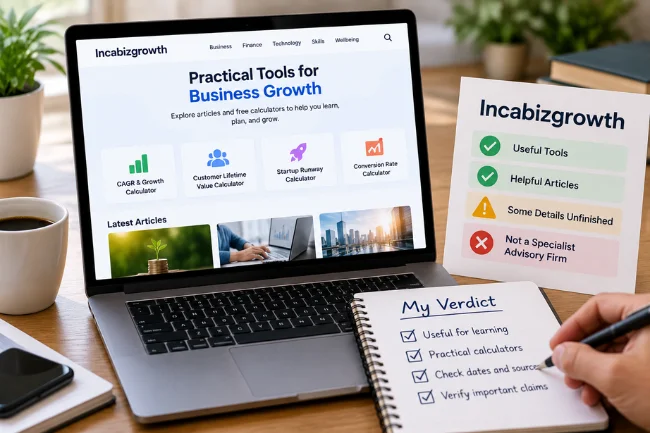
I would describe incabizgrowth.com as an accessible business-oriented publication with four practical growth calculators, rather than a specialist advisory firm. Its tools and introductory articles can be useful for learning, provided you understand their assumptions.
The unfinished editorial, contact, and privacy details prevent me from offering a blanket endorsement of its reliability or data practices. Start with a non-sensitive example calculation, check the date and sources of any article you read, and verify important claims elsewhere before acting on them.
Frequently Asked Questions
What is incabizgrowth.com used for?
It publishes articles on business, finance, technology, skills, and wellbeing, and offers free calculators for business growth, customer value, runway, and conversions.
Is incabizgrowth.com a legitimate website?
It is an accessible publication with identifiable content and tools, but its ownership credentials and several policy details remain insufficiently verified for a blanket trust verdict.
Are the incabizgrowth.com calculators free?
Yes. The site advertises four free calculators without required signup, although their technical accuracy and privacy implementation have not been independently audited here.
Does incabizgrowth.com offer business consulting?
Its publicly visible offering centers on articles and calculators; I did not find evidence of a personalized consulting service during this review.
Is incabizgrowth.com the same as incabizgrowth.site?
No. They are different domain addresses, and similar branding alone does not establish shared ownership or identical services. Check the exact URL before sharing information.

Ethan Caldwell is a business research writer with 9+ years of experience covering entrepreneurship, market trends, business strategies, and industry insights. He focuses on creating clear, data-informed articles that help readers understand modern business concepts.