OCCU is a member-owned, not-for-profit credit union based in Oregon, United States. Its name refers to Oregon Community Credit Union, a financial cooperative that offers checking and savings accounts, certificates, loans, credit cards, and digital banking services. Unlike a traditional shareholder-owned bank, OCCU is owned by its members, who can use its financial services and participate in its cooperative governance.
I think the easiest way to understand OCCU is to see it as an alternative to a bank, not an entirely different way of managing money. You can deposit a paycheck, pay bills, build savings, and borrow for major purchases. The differences lie in who owns the institution, who can join, and how its accounts are structured.
What Does OCCU Stand For?
OCCU is the preferred public name of Oregon Community Credit Union. The organization began in Eugene in 1956 and now serves eligible communities across Oregon and Washington, alongside members who qualify through family or organizational connections.
There is one naming detail worth clearing up. Our Community Credit Union, a separate Washington institution, previously used the abbreviation OCCU before shifting its branding to OURCU. If you are comparing accounts, confirm the institution’s full name and website rather than trusting an acronym on its own.
How Does the Credit Union Model Work?
Members deposit money into accounts, and the credit union uses funds, within regulatory and liquidity requirements, to support lending and other operations. Members are customers and owners, although ownership does not mean an individual can withdraw a share of the institution’s overall assets.
A member-elected governance structure gives members a voice. Because the organization is not built around paying outside shareholders, it can direct earnings toward operations, reserves, services, rates, and community programs. That does not mean every OCCU product is automatically cheaper than every bank product. I would still compare the numbers.
A Brief History of OCCU
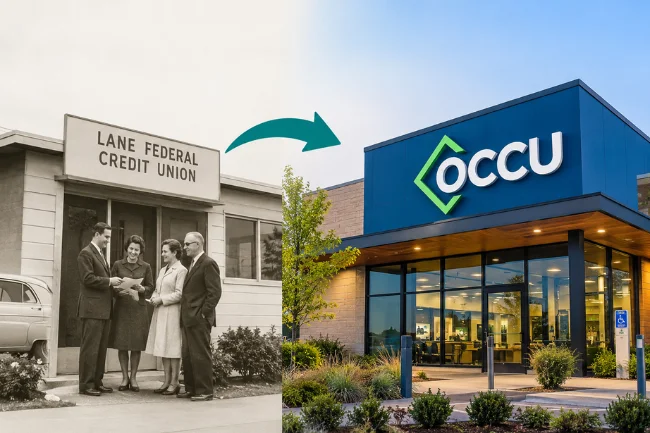
OCCU started as Lane Federal Credit Union when a small group of Oregon state employees pooled money to help one another. Over time, its membership and geographic reach expanded.
Its historical milestones tell a useful story: it adopted the Oregon Community Credit Union name in 2003, began using OCCU as its public name in 2016, and expanded eligibility across Washington in 2019. Those changes explain why a credit union rooted in Eugene can serve people well beyond the city today.
Who Can Join OCCU?
Membership is not automatically open to everyone in the United States. OCCU has a defined field of membership, and applicants must qualify under its current rules.
Its membership page includes residents of specified Oregon counties and people throughout Washington, as well as qualifying family members and people connected with certain organizations or employers, including the University of Oregon, Bi-Mart, and the State of Oregon.
I would check the live eligibility list before applying, particularly if I lived outside Oregon or Washington. Published descriptions of county counts have varied over time, so the current application criteria matter more than an old number repeated elsewhere.
What Does Membership Cost?
OCCU says its primary savings account comes with membership and requires a $5 balance to maintain the membership share. That amount is not the same thing as a monthly service charge. It is money held in an account, subject to the membership agreement.
Applicants normally provide identifying details such as their legal name, address, date of birth, and identification documents. Credit or account-history checks may apply depending on the product. Meeting membership requirements does not guarantee approval for a loan.
OCCU Checking Accounts: Rewards Versus Simplicity
Activate Rewards Checking
Activate Rewards Checking combines interest on eligible checking balances with potential debit card cash back. Under OCCU’s published terms effective April 16, 2026, members who satisfy monthly requirements can earn 2.00% APY on the first $20,000, with a blended rate for larger balances.
To qualify for the advertised interest, a member must enroll in electronic statements, complete one qualifying automated transaction or direct deposit, and make 12 settled debit card transactions per month. A $2,500 average daily balance is additionally required for the 1% debit purchase cash-back benefit, which is capped at $30 per month.
The account has no monthly service fee, but missing the activity requirements changes the earnings. OCCU lists a 0.05% APY when qualifications are not met. I see this as a strong reminder that a headline APY is not a promise of what a passive account will earn. Read the account disclosures before relying on any rate.
Kickstart Cashback
Kickstart Cashback is aimed at younger members, generally ages 16 through 25. Instead of interest, its feature is potential cash back on eligible debit purchases. OCCU lists a 1% cash-back opportunity, capped at $25 monthly, when users meet its separate activity rules.
Those rules include electronic statements, a monthly online banking login, 10 qualifying debit purchases, and a direct deposit or automatic payment. I would choose between these accounts based on actual spending patterns, not whichever name sounds more rewarding.
OCCU Savings Accounts and Certificates

OCCU’s savings choices cover different purposes: maintaining membership, building an emergency cushion, or setting money aside for longer-term goals.
Primary Savings and Ignite Savings
The primary savings account establishes membership. Ignite Savings is a separate, tiered product that advertises a higher rate on smaller balances. Under terms published April 16, 2026, its 5.25% APY applies to the first $500; the blended yield falls as balances move into additional tiers.
This distinction matters. A 5.25% rate on the first $500 does not mean $20,000 earns 5.25%. For someone starting an emergency fund, that first tier might still be useful. For larger savings, I would calculate the total dollar return across every tier.
Qualifying members can also receive a published 0.25-percentage-point APY boost on Ignite Savings when they meet requirements tied to an OCCU checking account. See the official savings information for current thresholds and terms.
Money Market Accounts and Certificates
OCCU also offers money market savings for balances that need access without a fixed commitment. Certificates, similar to certificates of deposit at banks, generally reward keeping money deposited for an agreed period.
Before opening a certificate, I would check its term, annual percentage yield, minimum deposit, renewal process, and early-withdrawal penalties. A higher advertised rate loses its appeal if the money is needed unexpectedly and withdrawing it triggers a substantial charge.
Borrowing From OCCU: Loans and Credit Cards
OCCU is not limited to deposit accounts. Its lending products include auto loans, mortgages, home equity borrowing, personal loans, lines of credit, and credit cards. Availability and terms depend on underwriting, product rules, and individual circumstances.
A personal installment loan, for example, provides funds in a lump sum and a repayment schedule. A personal line of credit is revolving, so approved funds can be borrowed again as the balance is repaid, subject to the agreement.
When I compare financing offers, I prioritize APR over an advertised interest rate alone. APR can better reflect the total borrowing cost where applicable, but I also examine origination fees, variable-rate terms, late charges, loan length, and whether the payment remains affordable.
Consider a vehicle loan: the lowest monthly payment may come from extending repayment over more years, yet that can increase total interest. The same principle applies whether a lender is a community credit union, a major bank, or an online lender. OCCU’s personal lending page provides product disclosures and current rate ranges.
OCCU Account Comparison at a Glance
| Account | Main purpose | What I would check |
|---|---|---|
| Primary Savings | Maintain credit union membership | Required membership balance and withdrawal rules |
| Activate Rewards Checking | Everyday spending with potential interest and cash back | Monthly transaction requirements, balance tiers, reward caps |
| Kickstart Cashback | Debit-purchase rewards for eligible younger members | Age eligibility, spending rules, monthly cash-back cap |
| Ignite Savings | Grow a smaller savings balance | Tiered APYs and whether a checking-linked boost applies |
| Money Market | Hold accessible savings, often larger amounts | Minimum balance, full-balance yield, withdrawal conditions |
| Certificate | Save for a fixed time horizon | Term, APY, maturity instructions, early-withdrawal penalty |
How OCCU Online and Mobile Banking Works
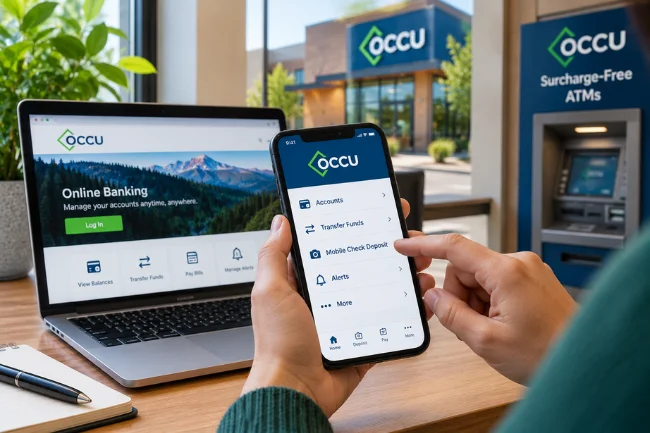
Through MyOCCU Online & Mobile, members can review balances, transfer funds, manage accounts, and use mobile check deposit where eligible. OCCU also describes alerts for balances, deposits, withdrawals, insufficient funds, and security events.
The institution reports access to more than 30,000 surcharge-free ATMs through the CO-OP network. It also operates physical branches and video teller locations in Oregon. Those channels complement one another, but an ATM is not interchangeable with a full-service branch for every transaction.
I recommend checking the branch and ATM locator for the specific service needed. Someone in Washington may qualify for membership yet still find that the nearest OCCU-operated branch is across a state line.
Digital Banking Safety Habits
I would enable transaction notifications, use a unique password, turn on available multifactor authentication, and avoid signing in through unsolicited text-message links. Financial fraud often begins with a convincing message rather than a weakness in the account itself.
Is OCCU Safe? Understanding Deposit Insurance
OCCU says its qualifying deposit accounts are federally insured by the National Credit Union Administration, or NCUA. The basic coverage is generally $250,000 per depositor, per insured credit union, per ownership category, subject to applicable rules.
This is comparable in purpose to FDIC insurance at insured banks, but the agencies are different. Crucially, several checking, savings, and certificate accounts held under one ownership category are not each given a separate $250,000 limit.
Joint, retirement, and trust arrangements may qualify for additional coverage under specific conditions. The NCUA insurance guide explains how to calculate that protection. Investments such as mutual funds and annuities are not NCUA-insured simply because they are offered through a credit union.
OCCU Fees and Rates: What Deserves Attention?
A no-monthly-fee checking account can still have charges connected with overdrafts, outgoing transfers, replacement services, or other circumstances. The full schedule matters as much as the headline claim.
APY and APR should also be kept separate. APY describes deposit earnings and reflects compounding; APR is commonly used for the annual cost of borrowing. Neither tells the whole story without the conditions attached to the specific product.
OCCU vs. a Traditional Bank
| Feature | OCCU | Traditional shareholder-owned bank |
|---|---|---|
| Ownership | Member-owned financial cooperative | Owned by shareholders |
| Joining | Requires membership eligibility | Usually no credit union-style field of membership |
| Deposit insurance | NCUA for eligible insured deposits | FDIC for eligible insured deposits |
| Branch access | Regional OCCU branches plus digital and network ATM access | Varies from local networks to nationwide footprints |
| Rates and fees | Depend on the account and qualifications | Depend on the bank and account |
| Governance | Members elect the board under credit union rules | Shareholders elect directors under corporate rules |
The ownership distinction is meaningful, but I would not use it as a shortcut for judging customer service or product value. A national bank might offer broader branch coverage; OCCU might provide a better match for a person’s checking habits or regional preferences.
Advantages and Limitations I Would Weigh
One advantage is variety: checking rewards, savings options, consumer lending, digital banking, and local service exist under one institution. Another is the member-owned structure, which may appeal to people who want a cooperative financial relationship.
There are trade-offs. Eligibility limits who can join, some attractive rewards require repeated monthly activity, and physical branches are concentrated in Oregon. Rates advertised for an initial savings tier may not represent the effective yield on a large deposit.
My Four-Part Test Before Choosing OCCU
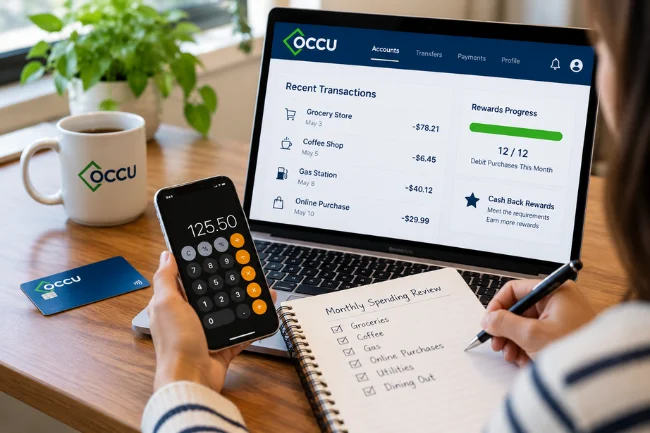
1. Calculate Rewards From Real Habits
I would look back at three ordinary months of transactions. Did I make 12 debit purchases each month without changing my behavior? Would I naturally maintain the checking balance needed for cash back? If not, I would value the account at its lower, nonqualifying return.
2. Compare Total Annual Dollars
A slightly lower APY can sometimes be outweighed by fewer fees or stronger cash-back rewards. I would estimate annual interest, add realistic rewards, then subtract expected costs. For tiered savings, I would calculate each balance slice separately rather than multiplying the entire balance by the top rate.
3. Test Access Before Moving My Paycheck
I would verify the closest usable ATM, check cash-deposit options, inspect mobile deposit policies, and identify how to reach support. A good rate is less valuable if basic financial tasks become frustrating.
4. Plan a Low-Risk Transition
I would open the new account, test a small transfer, and move direct deposits only after confirming the new details. I would keep the old account funded until recurring bills and pending transactions were accounted for. This avoids an easily overlooked problem: a missed payment caused by changing banks too quickly.
OCCU’s Role in the Community
OCCU’s cooperative identity extends beyond banking products. Through OCCU Foundation, established in 2018, it supports nonprofit projects connected with financial health, physical well-being, and community needs.
The foundation says it has granted more than $5 million to local nonprofit organizations since its creation. That is relevant context for readers who value community investment, though I would evaluate financial products on their own merits as well. The foundation website outlines its priorities.
How to Get Started With OCCU
First, review eligibility on the official OCCU website and identify the account that meets your needs. Next, examine the latest rate and fee schedule, membership agreement, and any qualifying activity requirements. Gather the identification needed for an application.
Once approved, fund the required membership share, activate online banking, and configure alerts. If changing institutions, move payroll deposits and automatic payments carefully rather than closing the previous account immediately.
Final Thoughts
OCCU brings traditional financial services into a member-owned, regional credit union model. Its rewards checking, tiered savings, lending options, and digital tools make it worth considering for eligible people, but each product has conditions that deserve a close reading.
My advice is to verify membership eligibility, calculate your likely annual benefit, and read current disclosures before applying. Visit OCCU’s official website to compare accounts and decide whether the fit is right for you.
Frequently Asked Questions About OCCU
What Does OCCU Stand For?
OCCU is the official short name used by Oregon Community Credit Union, a member-owned financial institution founded in Oregon.
Is OCCU a Bank or a Credit Union?
OCCU is a credit union, not a commercial bank. Its members own the cooperative and can access deposit and lending services.
Is OCCU Federally Insured?
Yes. Eligible OCCU deposits have NCUA insurance, generally up to $250,000 per depositor, per ownership category, at the credit union.
Can I Join OCCU if I Live in Washington?
OCCU lists statewide Washington eligibility, alongside qualifying Oregon communities and other membership paths. Check its current membership terms before applying.
Does OCCU Have Online and Mobile Banking?
Yes. MyOCCU Online & Mobile supports everyday account management, transfers, alerts, and eligible mobile deposits.
Disclaimer
This article is for informational and educational purposes only and does not constitute financial advice. We are not affiliated with OCCU or Oregon Community Credit Union. Interest rates, fees, membership requirements, and account features may change without notice. Always verify the latest information on OCCU’s official website before making financial decisions.

Ethan Caldwell is a business research writer with 9+ years of experience covering entrepreneurship, market trends, business strategies, and industry insights. He focuses on creating clear, data-informed articles that help readers understand modern business concepts.