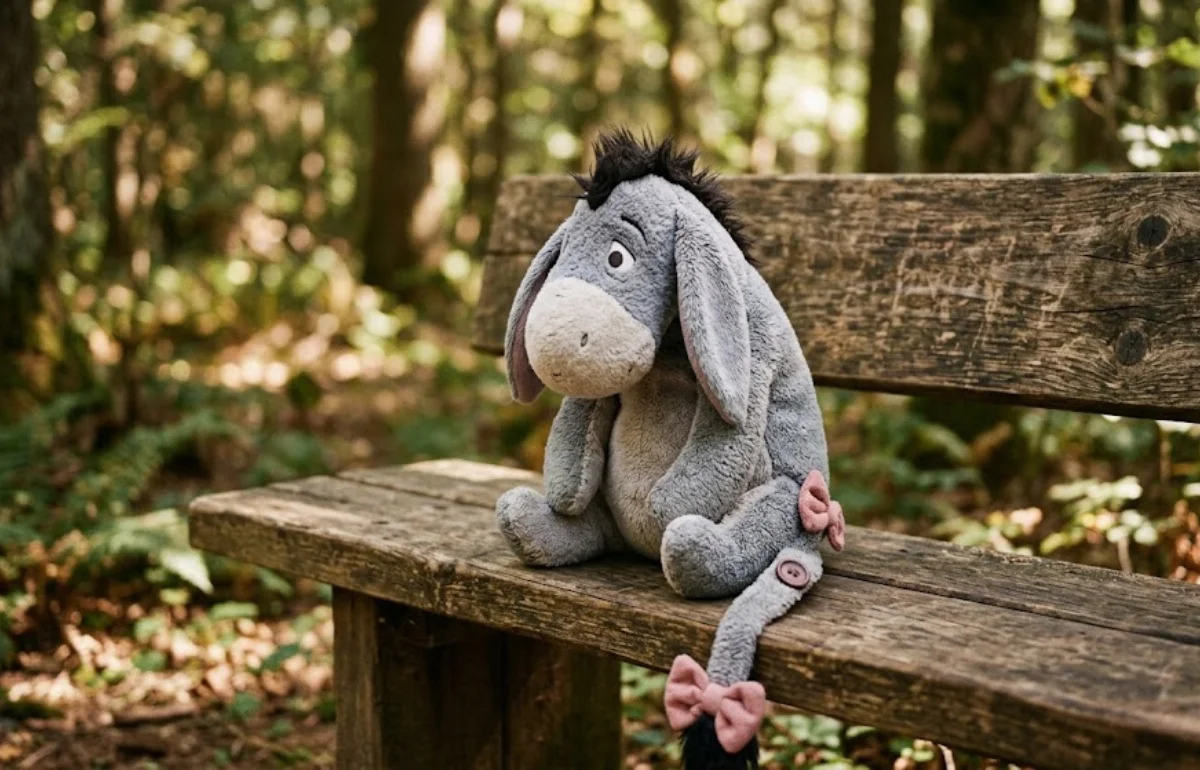
Γκαρής is the Greek name commonly used for Eeyore, the gentle, gloomy donkey from A. A. Milne’s Winnie-the-Pooh stories and Disney adaptations. He lives among Winnie the Pooh, Piglet, Tigger, and their friends in the Hundred Acre Wood, known in Greek adaptations as the Δάσος των Γαλάζιων Ονείρων. Recognizable by his drooping ears, slow speech, and frequently misplaced tail, he tends to expect disappointment but remains a loyal member of the group.
The name appears on Disney’s official Greek-language pages, so it is not simply an informal fan translation.
What makes Γκαρής memorable is not sadness alone: he gives children and adults a way to think about friendship, belonging, and the fact that people do not all express happiness in the same way.
Γκαρής at a Glance
| Detail | What to know |
|---|---|
| English character name | Eeyore |
| Greek character name | Γκαρής |
| Original creator | A. A. Milne; illustrated by E. H. Shepard |
| First book appearance | Winnie-the-Pooh (1926) |
| Animal | Donkey |
| Home | The Hundred Acre Wood |
| Recognizable features | Drooping ears, understated voice, detachable tail |
| Defining qualities | Pessimism, dry humor, sensitivity, loyalty |
Where Did Γκαρής Come From?
A character born in children’s literature
Eeyore began as a literary character, not a Disney invention. British author A. A. Milne introduced him in Winnie-the-Pooh, published in 1926, with illustrations by E. H. Shepard. His stories grew out of a child’s imaginative world and a collection of actual stuffed toys belonging to Milne’s son, Christopher Robin.
The sequel, The House at Pooh Corner, followed in 1928. These books established the setting and relationships that later films would bring to television and cinema audiences.
Their appeal comes partly from the way ordinary problems—losing something, feeling overlooked, or wanting company—become meaningful adventures.
The year 2026 marks a century since the first Winnie-the-Pooh book, a milestone that underscores the donkey’s enduring appeal.
The real toy behind the character
There really was an Eeyore toy. Alongside the original Pooh, Piglet, Tigger, and Kanga toys, it belongs to the collection of the New York Public Library.
The library explains that these toys reached the United States in 1947 and were donated to the institution in 1987.
I love how an ordinary toy became a character with weaknesses, humor, and friends, rather than starting as a commercial mascot.
Why is he called Eeyore?
The English name imitates the braying sound of a donkey. That makes it an example of onomatopoeia: a word shaped by the noise it represents.
Greek readers encounter Γκαρής instead, a localized name that feels natural beside Greek-language versions of the other characters.
The name changes in translation, but the personality stays recognizable.
What Does Γκαρής Look and Act Like?
The design most people recognize
Milne describes an old gray donkey, and Shepard’s original drawings give him an understated, slightly weary appearance.
In familiar Disney animation, he is typically grayish blue, with long ears, a dark mane, a pale muzzle, and a tail decorated with a pink bow.
His often-missing tail becomes a recurring plot device, allowing friends to show affection through practical help.
His slow, measured movements also contrast with Tigger’s bouncing energy and Pooh’s wandering enthusiasm. Even in a crowded scene, viewers can usually recognize him by how he moves and speaks.
A gloomy outlook with a generous heart
It is easy to describe Γκαρής as the sad character and stop there. I think that misses his best qualities.
He is observant, frequently funny in a dry way, and deeply aware of the possibility of being ignored. Yet he continues to belong to a community and can appreciate gestures of care.
He does not always say what everyone wants to hear. His doubts puncture exaggerated optimism and add a different rhythm to the stories.
His humor often comes from understatement rather than jokes, which is one reason adults may appreciate him differently from young children.
Most importantly, he is not a villain or a problem that the others must fix. The stories generally treat him as a friend whose temperament differs from theirs.
The Stories That Explain His Personality Best
The missing tail
One of the clearest introductions appears in Chapter Four of the 1926 book. Pooh notices that Eeyore’s tail has disappeared and goes looking for it.
The search leads to Owl, who has been using the lost tail as a bell-pull without understanding what it is.
The humor is gentle, but the lesson is concrete: somebody notices a friend’s problem, takes it seriously, and does something about it.
For me, this is a better summary of the series’ emotional appeal than any slogan about staying positive.
The lost-tail story continued to matter in adaptations. Disney’s 2011 Winnie the Pooh film again makes the search for Eeyore’s tail an important part of the group’s adventure.
An unusual birthday celebration
In another early story, Eeyore believes everyone has forgotten his birthday.
Pooh brings him a honey pot that ends up empty, while Piglet’s balloon becomes damaged on the way. What looks like a failed celebration turns into a small surprise when the two imperfect gifts work together.
This episode matters because the presents are not impressive. Attention is the real gift.
The friends get things wrong, but their wish to include him still makes the day meaningful.
A house and a sense of belonging
The House at Pooh Corner opens with Pooh and Piglet building a home for Eeyore.
As often happens in the Wood, their well-meant plan creates complications, but its starting point is kindness.
A home is more than a shelter in these stories. It suggests that Γκαρής has a place in the group even when he is quiet, doubtful, or unwilling to join the general excitement.
How Γκαρής Fits Among Pooh’s Friends
The Hundred Acre Wood works because its inhabitants have contrasting personalities.
I would not call one character the correct way to be. Each brings a different strength and a different difficulty to the same friendships.
| Character | Typical outlook | What their relationship with Eeyore reveals |
|---|---|---|
| Winnie the Pooh | Warm, curious, sometimes forgetful | Small acts of kindness can be enough |
| Piglet | Cautious and sensitive | Caring does not require confidence or perfection |
| Tigger | Energetic and exuberant | Friends can have very different social rhythms |
| Rabbit | Organized and practical | Helping is not always the same as controlling |
| Christopher Robin | Reassuring and attentive | Being noticed can restore a sense of belonging |
| Eeyore / Γκαρής | Doubtful, restrained, observant | Loyalty need not look cheerful |
The contrast with Tigger is particularly revealing. Where Tigger rushes toward experiences, Eeyore hesitates.
Neither personality automatically cancels the value of the other. The story becomes richer because both are present.
There is also a distinction between being alone and being abandoned. Γκαρής sometimes appears comfortable with solitude, but he still benefits when his friends remember him.
That tension feels remarkably familiar outside fiction.
Γκαρής in Disney Movies and Television
For many viewers in Greece, the character is familiar through the Greek-language Disney universe rather than through the English novels.
Disney+’s Greek listing for the 1988–1991 Winnie the Pooh series explicitly includes Γκαρής among Christopher Robin’s friends.
Across animated appearances, the donkey’s restrained voice and subdued reactions give the stories an emotional counterweight.
He can stand in the middle of a cheerful celebration and still sound unconvinced. The comic timing works precisely because other characters respond differently.
Disney’s 2011 animated Winnie the Pooh uses his missing tail to bring the friends together.
In Christopher Robin (2018), the familiar toys enter the life of an adult Christopher Robin, giving their long-standing friendships a more reflective setting.
These adaptations differ in style, but the essential character remains recognizable.
Book version versus screen version
In the original books, Shepard’s restrained illustrations and Milne’s dialogue leave much to the reader’s imagination.
Disney’s rounded designs, voice acting, music, and movements make those same moods audible and visible.
I would start with the books, then watch an adaptation to appreciate what a pause or lowered ear can communicate.
Is Γκαρής Supposed to Have Depression?
This is a common interpretation, especially in online discussions that assign psychological labels to fictional characters.
Eeyore is consistently gloomy and pessimistic, so the comparison is understandable. But it is not accurate to present him as a clinically diagnosed person or to suggest that sadness alone equals depression.
A fictional personality trait is not a medical assessment.
Clinical depression involves a broader pattern of symptoms, duration, and effects on daily functioning that cannot be established from isolated scenes in a children’s story.
What I find valuable about Γκαρής is something more practical: he makes space for a character who cannot simply switch to happiness because everyone else is having fun.
His friends may misunderstand him, yet they keep inviting him into their lives.
That is a humane way to discuss emotions with children. Rather than asking, “Why is he always negative?” I would ask, “What makes him feel included?”
The second question encourages attention and empathy without turning the character into a diagnosis.
I would also avoid treating him as proof that pessimism is wise or that permanent sadness is inevitable.
His role is literary, not a psychological model. Readers can appreciate his humor while still recognizing that real people experiencing persistent low mood may need meaningful support.
What Greek Readers Should Know About the Name
The spelling matters. Disney’s Greek-language material uses Γκαρής for Eeyore, but other similar-looking names appear in Greek publishing.
For example, Ο Γκάρης, with a different accent, is the title of a separate children’s book by Tasoula Eptakili, published by Patakis in 2019.
That book features a hardworking donkey who gains extraordinary abilities to help other animals; it is not a retelling of Milne’s Eeyore.
The related form Γκάρης is also recorded as a Greek surname.
Search results can therefore mix a Disney character, other fictional donkeys, and real names. I suggest checking the accompanying terms before assuming every result concerns Winnie the Pooh.
For English-language searches, combine the Greek spelling with “Eeyore” or “Winnie the Pooh.”
For Greek-language material, try “Γκαρής Γουίνι το Αρκουδάκι” or “Γκαρής Disney.” These combinations narrow the topic without assuming that every similarly named book or person has the same identity.
What Children and Adults Can Learn From Γκαρής
Friendship does not require identical moods
The most useful message I take from these stories is that companionship is not a reward for being entertaining.
Pooh’s group makes room for a friend who rarely matches its enthusiasm. That feels especially relevant in a world where sociability is sometimes confused with constant positivity.
A friend can be quiet, skeptical, tired, or funny in an unexpected way. None of these characteristics makes friendship less worthwhile.
In the stories, remembering Γκαρής and showing up for him often matters more than persuading him to smile.
The best help is often specific
Notice what works in the tail episode: Pooh identifies something missing and looks for it.
He does not deliver a lengthy lecture about gratitude. This offers a practical distinction between offering encouragement and paying attention to an actual need.
For parents or teachers reading aloud, I would use questions grounded in the action: “What did Pooh notice?” “Did his friend ask for a big present?” “How could someone help without making a fuss?”
Such questions turn a familiar story into an accessible conversation about empathy.
Imperfect gestures can still matter
The birthday story is particularly good for explaining intention and outcome.
A broken balloon and an empty pot sound like terrible gifts, yet the episode allows children to see how care can survive mistakes.
That does not mean effort excuses every hurtful action. It means relationships are often built from repairs, understanding, and moments of recognition rather than flawless performances.
I think that is a more honest lesson than telling children every problem disappears with a positive attitude.
Quiet characters deserve a voice
When I compare Eeyore with Tigger, I notice how much attention energetic characters naturally attract.
The donkey asks for a different kind of listening. His dry remarks, silences, and disappointment reveal information that other characters might miss.
A useful reading activity is to retell one scene from his point of view.
Ask what he expected, what actually happened, and which action changed his experience. It encourages perspective-taking without insisting that children adopt his pessimism.
Why the Character Still Resonates in 2026
A century after Milne’s first book, Γκαρής still expresses a familiar feeling: the suspicion that everyone else finds social life easier.
His understated responses can be funny without inviting readers to mock him.
I suspect that balance explains his cross-generational appeal. Children remember the floppy ears and lost tail; adults may notice how gently Milne portrays loneliness and the need to feel seen.
Final Thoughts
Γκαρής is more than the gloomy donkey in Winnie the Pooh.
He is a memorable reminder that friendship can include silence, skepticism, imperfect gifts, and patient acts of care.
His stories are accessible to children, but their emotional detail rewards an adult rereading too.
If you want to understand him beyond the familiar cartoons, read Milne’s original missing-tail and birthday chapters, then revisit a Greek Disney adaptation.
Seeing both versions makes it easier to appreciate why this modest character has stayed with readers for a hundred years.
Frequently Asked Questions About Γκαρής
What is Γκαρής in English?
Γκαρής is the Greek name for Eeyore, the gray donkey who appears in Winnie-the-Pooh books and Disney stories.
Is Γκαρής a Disney character?
Yes. He appears in Disney adaptations, although A. A. Milne created the original literary character before Disney’s versions.
Why is Γκαρής always sad?
His pessimistic, subdued temperament is a defining storytelling trait, but he also shows loyalty, dry humor, and appreciation for kindness.
Why does Γκαρής keep losing his tail?
The detachable tail creates a recurring story problem and gives his friends opportunities to show care through practical help.
Is Γκαρής the same as Ο Γκάρης from Patakis?
No. The 2019 Greek book Ο Γκάρης tells a separate donkey story; its title resembles the Disney character’s Greek name but refers to another work.

Elena Whitmore is a parenting writer with 7 years of experience covering child development, family wellbeing, and everyday parenting. She translates research into practical guidance to help parents strengthen family relationships and support their children’s emotional and physical development.