
Roadrunner Financial is a U.S. financing company that helps eligible buyers pay for motorcycles, ATVs, side-by-sides, personal watercraft, and other recreational vehicles through installment loans. Rather than paying the entire purchase price upfront, a borrower finances an approved vehicle and repays the balance over time, typically through monthly payments that include interest.
The company operates within the Octane family of businesses and works with participating dealerships. Its online prequalification process lets shoppers review potential loan offers without affecting their credit scores, although final loan approval involves further checks.
For someone comparing powersports financing options, the real question is not simply whether Roadrunner can approve a loan. I think the more useful question is whether its total borrowing cost, repayment schedule, and customer support fit the purchase.
Here is what buyers should understand before signing.
What Is Roadrunner Financial, and Who Owns It?
Roadrunner Financial is a specialized sales finance company, not a general-purpose bank or a provider of everyday personal loans. It began in 2016 as part of Octane’s effort to bring digital financing to dealerships selling recreational vehicles and outdoor equipment.
The distinction between the two names matters. Roadrunner Financial is the lender, Octane provides the financing technology, and Roadrunner Account Services handles existing customer accounts.
The company’s official disclosures identify Roadrunner Financial under NMLS ID 1525116 and its servicing subsidiary under NMLS ID 1758660.
Its business model connects an online credit application with a purchase from a dealer. You can browse financing options before visiting a showroom, but the actual loan depends on the eligible vehicle, participating dealership, and final underwriting decision.
What Types of Vehicles Can You Finance?
The company focuses on powersports and certain outdoor equipment rather than conventional passenger-car financing.
Its advertised categories include motorcycles, dirt bikes, sport bikes, scooters, ATVs, utility terrain vehicles, snowmobiles, personal watercraft, golf carts, zero-turn mowers, and some trailers and pontoons.
That range is useful because financing a recreational vehicle is not always as straightforward as financing a standard car. Some banks may have restrictions concerning vehicle age, engine size, or whether an item is street legal.
Roadrunner says its platform covers more than 25,000 vehicle options and works with over 3,300 dealers.
Those are company-reported figures, not guarantees that every model or dealership will qualify. Its site discusses both new and used vehicles, while certain online prequalification offers are specifically labeled for new vehicles.
My advice is to confirm the exact make, model, year, dealer, and intended use before treating any advertised financing option as available.
The company’s published terms exclude vehicles purchased for commercial or business purposes.
How Does Roadrunner Financial Work?
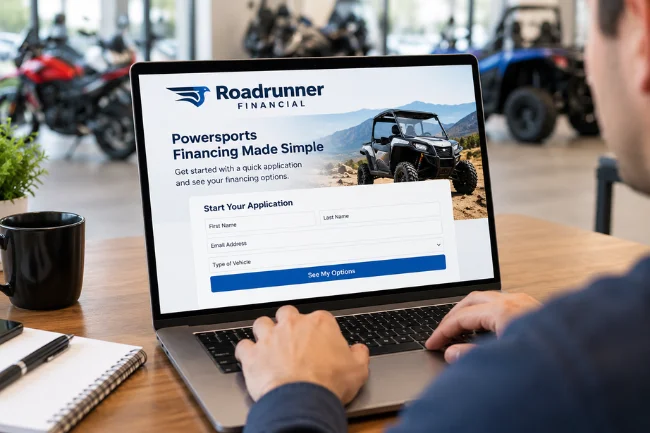
1. Check Financing Options Online
A buyer begins through the Roadrunner Financial website by checking potential rates and entering the requested application details.
The lender describes the process as quick and says prequalification uses a soft credit inquiry.
A soft inquiry lets the lender assess eligibility without lowering the applicant’s credit score. However, a prequalified result is not a binding promise that money will be lent.
2. Review the Personalized Offer
If eligible, a shopper may see potential interest rates, loan durations, and estimated monthly payments. Roadrunner advertises prequalified rate offers that remain valid for 30 days, subject to its program conditions.
I would save the offer details and compare them against a quote from another lender. A lower monthly payment can look attractive while hiding a much longer repayment period.
3. Choose an Eligible Dealership and Vehicle
The buyer then selects a qualifying vehicle at a participating dealer.
Roadrunner’s disclosure says funding normally requires a signed agreement with the dealership, and the dealer may initially originate the financing before assigning it to Roadrunner.
An outside-network dealer may sometimes be possible, but approval and closing procedures can differ. A casual private-party purchase should not be assumed eligible.
4. Complete Final Approval and Signing
Before contracts are generated, Roadrunner can obtain a full credit report, producing a hard inquiry that may affect the buyer’s credit score.
Identity, application details, vehicle eligibility, and other underwriting information may also be verified.
Only after the final terms are accepted and documents are signed does the transaction move toward funding and vehicle delivery.
I would not treat an initial approval screen as permission to skip reading the retail installment contract.
Credit Score Requirements and Eligibility
Roadrunner promotes financing access across prime and non-prime credit profiles.
On its ATV financing page, it says certain programs can consider applicants with FICO scores starting at 550 and that prime programs generally cover scores of 660 and above.
Those figures describe particular programs, not a universal eligibility rule. A score of 550 does not guarantee acceptance, and applicants with higher scores can still be declined for other reasons.
Loan decisions may also reflect income, existing debt, credit history, the vehicle being financed, loan length, down payment, and possibly a co-signer.
Even where no large down payment is advertised, financing the full purchase is never automatic.
If my credit profile were marginal, I would first decide on a maximum affordable payment rather than chasing the largest amount offered.
Qualifying for a loan and comfortably repaying it are different things.
Roadrunner Financial Interest Rates and Loan Terms

There is no single interest rate that applies to every borrower.
Roadrunner’s loan calculators display a starting illustration of 6.99%, but the company says actual rates vary by borrower, vehicle, co-signer, program, and selected loan term. A displayed example is not a guaranteed APR.
The annual percentage rate, or APR, is especially useful when comparing financing offers because it accounts for certain borrowing fees as well as interest.
I would compare APR with APR, not one lender’s advertised interest rate with another lender’s APR.
Loan lengths also matter. Roadrunner describes 36 to 72 months as commonly used ATV financing terms, with 60 months a popular example.
Available terms may differ across products and borrowers.
What a Longer Loan Can Actually Cost
Consider a hypothetical $12,000 loan at a fixed 12% annual interest rate, with equal monthly payments and no additional fees.
This is my illustration, not a Roadrunner quote.
| Loan term | Approximate monthly payment | Approximate total interest |
|---|---|---|
| 36 months | $398.57 | $2,349 |
| 60 months | $266.93 | $4,016 |
| 72 months | $234.60 | $4,891 |
Extending the term from three years to six cuts the payment by about $164 a month, but adds roughly $2,543 in interest.
That trade-off matters for machines that may lose value quickly or need expensive maintenance as they age.
The Consumer Financial Protection Bureau similarly recommends comparing total loan cost, APR, amount financed, and duration rather than monthly payment alone.
Roadrunner Financial vs. Other Financing Options
Specialized lending is convenient, but convenience does not necessarily mean the lowest cost.
Before choosing a lender, I would get at least one comparable quote from a credit union, bank, or manufacturer-backed promotion if those options are available.
| Financing option | Potential advantage | What to check |
|---|---|---|
| Roadrunner Financial | Powersports focus, digital prequalification, dealer integration | Personalized APR, eligible dealers, contract fees |
| Credit union or bank | Opportunity to compare independently before shopping | Vehicle restrictions, membership rules, approval time |
| Manufacturer promotional financing | Possible special pricing on eligible models | Promotion expiration, qualifications, post-promotion terms |
| Dealer-arranged alternative lender | Multiple offers during one dealership visit | Dealer add-ons, total financed amount, APR |
These are general differences, not promises about which lender will approve you or offer the best rate.
Request quotes for the same vehicle price, down payment, and repayment period to make the comparison meaningful.
Payments, Fees, and Paying Off a Loan Early
After financing, borrowers manage their loans through the Roadrunner servicing system.
This part of the relationship deserves as much attention as the application itself.
Ways to Make a Payment
According to the official payments FAQ, borrowers can use the Octane customer portal, enroll in autopay, submit an online payment, call the automated payment line, or mail a payment.
The portal also provides access to loan details and account management.
The company’s portal-fee guidance says ACH payments from a bank account have no portal transaction fee, while debit card payments incur a $4.25 fee.
Credit card payments are not currently accepted. These are payment-method fees, not a complete list of possible charges under an individual loan agreement.
Extra Payments and Early Payoff
Roadrunner’s published FAQ says there is no penalty for paying off a loan early.
Still, I would review the signed contract and obtain an official payoff amount before sending a final payment.
Extra money does not necessarily bypass accrued interest. The company’s guidance explains that payments cover interest due, with additional amounts reducing principal.
Its payoff instructions also warn that some payment methods may delay release of the vehicle title or lien.
What if a Payment Becomes Difficult?
Roadrunner provides a way to request a hardship extension through the account portal, where the request receives a decision.
It also describes a possible one-time due-date change of up to 19 calendar days, subject to conditions.
Neither option should be treated as automatic relief.
If cash flow becomes tight, I would contact customer service before the due date and ask how any approved change affects accrued interest and the remaining schedule.
Advantages and Drawbacks of Roadrunner Financial
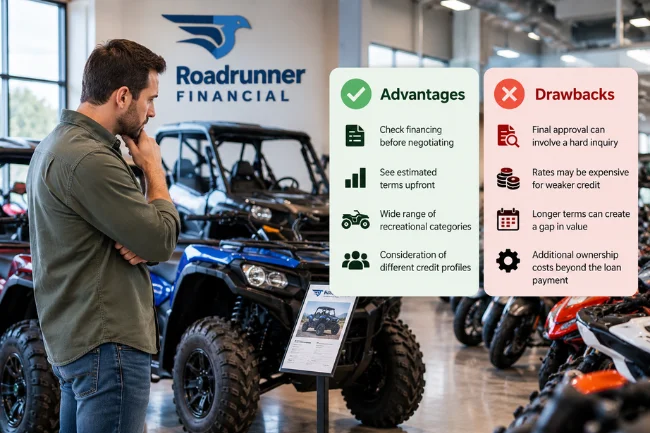
The most appealing feature is the ability to investigate financing before negotiating at a dealership.
Seeing estimated terms upfront can help a buyer focus on vehicles within budget rather than relying entirely on a salesperson’s suggested monthly payment.
The lender’s specialization is another strength. Its wide range of recreational categories and consideration of different credit profiles may be useful when a traditional lender has limited powersports coverage.
There are genuine trade-offs.
Financing remains tied to vehicle and dealer eligibility; final approval can involve a hard inquiry, and rates may be expensive for borrowers with weaker credit.
Longer terms can also create a gap between the amount owed and the vehicle’s resale value.
I also would not confuse an easy digital application with a low-risk purchase.
Insurance, registration, maintenance, riding gear, storage, fuel, and repairs can make the true monthly ownership expense considerably higher than the loan payment.
Roadrunner Financial Reviews: What Do Customers Say?
Independent review platforms show mixed individual experiences but notably low aggregate scores.
As of October 2026, Trustpilot displayed a rating of about 1.5 out of 5 across approximately 201 reviews, while the Better Business Bureau showed approximately 1.2 out of 5 from 41 reviews and listed the company as not BBB accredited.
Recurring complaints include payment processing, communication, loan costs, and account servicing.
These are customer allegations, not independently established findings about every account. Voluntary reviews also tend to attract people with unusually positive or negative experiences.
I would read recent reviews for patterns, pay attention to how disputes are addressed, and ask the lender direct questions about payment posting, fees, title release, and hardship support.
A company’s advertising tells you how borrowing starts; servicing policies tell you what living with the loan may be like.
Is Roadrunner Financial Legitimate and Safe?
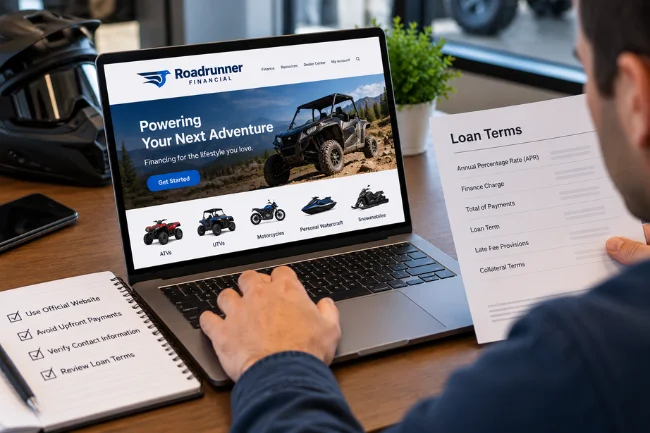
Roadrunner Financial is an identifiable U.S. sales finance company with a published corporate relationship, licensing information, consumer disclosures, and account-servicing channels.
Those factors distinguish it from an anonymous loan website, but legitimacy does not mean every loan is affordable or that every customer will be satisfied.
Use the official Roadrunner website or its linked Octane portal instead of links from unsolicited messages.
Never send a stranger an upfront payment to “release” loan funds, and verify requests for personal information through independently located customer-service contact details.
For any loan, examine the written APR, finance charge, total of payments, late-fee provisions, and collateral terms before agreeing.
That is a stronger safety check than relying on either glowing marketing or a single angry review.
My Checklist Before Accepting a Powersports Loan
I use a simple ownership-cost test to judge whether recreational financing makes financial sense.
First, calculate the out-the-door price, not merely the advertised vehicle price. Include taxes, dealer charges, accessories, warranties, and any optional products you actually choose.
Next, estimate the cost of owning the machine during a low-use month.
A snowmobile or personal watercraft may sit unused for part of the year, but the monthly loan obligation continues. If payments depend on using the vehicle frequently, the budget may be too optimistic.
Then compare the loan term with how long you realistically expect to keep the vehicle.
A six-year commitment on equipment you expect to replace in three years deserves extra scrutiny, particularly if depreciation could leave you owing more than its resale price.
Finally, request a written breakdown of the amount financed and test a smaller loan.
Even a modest down payment can reduce the balance that accrues interest. I would also keep an emergency repair reserve separate from the cash needed for monthly payments.
Frequently Asked Questions
Is Roadrunner Financial a legitimate finance company?
Yes. It is a U.S. sales finance company within the Octane group, though customers should still review loan terms and servicing feedback before borrowing.
What credit score do I need for Roadrunner Financial?
Some ATV programs consider FICO scores from 550, but approval standards vary, and no particular score guarantees a loan.
Does Roadrunner Financial do a hard credit check?
Prequalification uses a soft inquiry; a hard inquiry may occur during final underwriting before the financing contract is generated.
How do I make a Roadrunner Financial payment?
You can pay through the linked Octane customer portal, arrange autopay, use its phone payment system, or mail a payment.
Can I pay off a Roadrunner Financial loan early?
Yes. Roadrunner says it does not charge an early-payoff penalty; obtain the current payoff figure and confirm title-release instructions first.
Final Thoughts
Roadrunner Financial can be a practical option for buyers seeking motorcycle, ATV, UTV, or other powersports financing through a dealership.
Its quick prequalification and specialized vehicle coverage are worth considering, but the final decision should rest on your APR, total repayment cost, and confidence in the servicing process.
Before committing, compare at least two written offers, budget for ownership beyond the loan, and check the final contract against the terms you expected.
Start with Roadrunner’s official rate-check page only when you know what payment and total cost you can comfortably afford.

Ethan Caldwell is a business research writer with 9+ years of experience covering entrepreneurship, market trends, business strategies, and industry insights. He focuses on creating clear, data-informed articles that help readers understand modern business concepts.