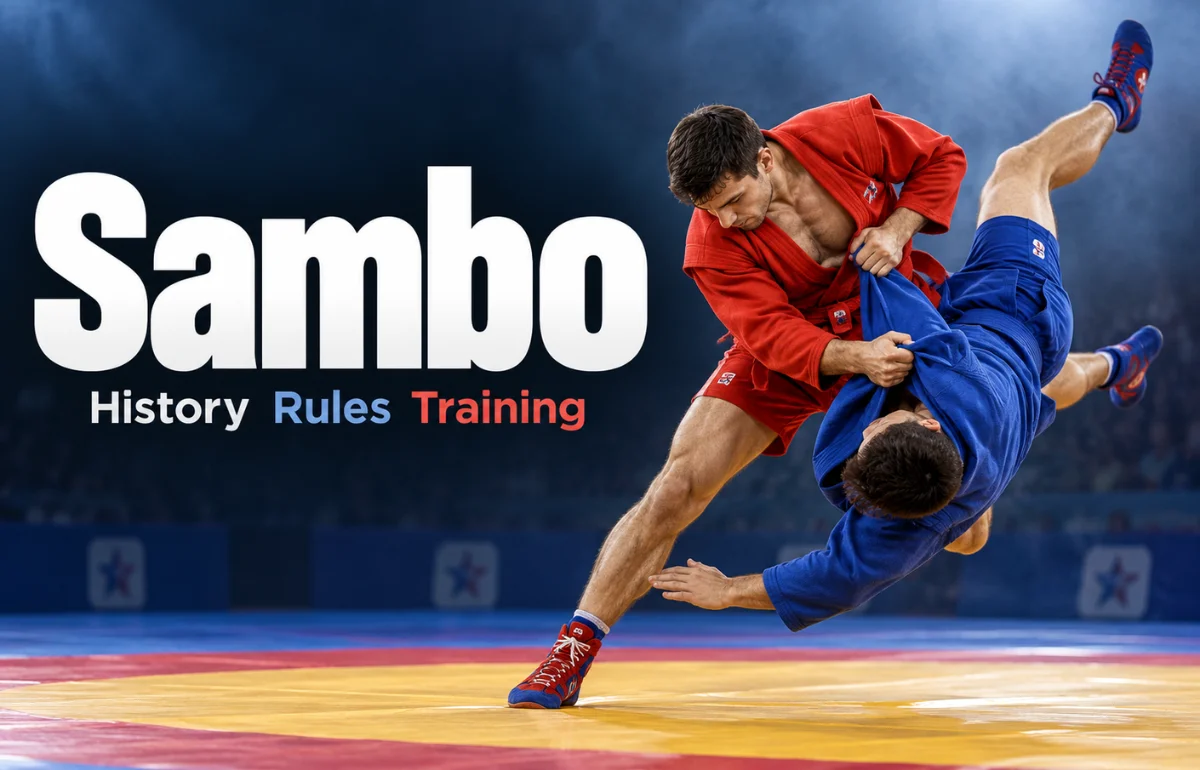
Sambo is a martial art and combat sport developed in the Soviet Union that combines wrestling, throws, joint locks, and practical self-defense. Its name comes from a Russian phrase meaning “self-defense without weapons.” Unlike a style built around one technique, Sambo teaches practitioners to control balance, take opponents to the ground, and respond quickly when a situation changes. Sport Sambo emphasizes grappling without strikes, while Combat Sambo adds punches, kicks, and other permitted attacks. There is also a beach format focused on standing throws.
I think Sambo makes the most sense as a chain of decisions: a grip creates an imbalance, a takedown creates control, and control may open a submission. That connection explains much of its appeal.
What Does Sambo Mean, and Where Did It Come From?
The name is an abbreviation of samozashchita bez oruzhiya, Russian for “self-defense without weapons.” Sambo took shape during the 1920s and 1930s, when Soviet instructors were looking for effective ways to combine existing fighting systems.
Three figures are particularly associated with its development: Viktor Spiridonov, Vasili Oshchepkov, and Anatoly Kharlampiev. Spiridonov worked on practical self-defense methods, Oshchepkov brought knowledge of Japanese judo, and Kharlampiev helped develop and popularize the emerging sport. I would avoid crediting a single inventor; the history is more collaborative than that.
November 16, 1938, is recognized as Sambo’s official birth date. On that day, a Soviet sports authority issued an order supporting the development of the wrestling system from which the modern sport emerged.
Why Sambo Has So Many Influences
Its founders studied more than judo. Regional wrestling traditions from across the Soviet Union, together with other combat disciplines, contributed grips, trips, throws, and approaches to controlling an opponent.
That mixed heritage shows on the mat: jacket grips, wrestling-style attacks, and grappling submissions often appear in the same exchange. Adaptability matters more than loyalty to one method.
How It Became an International Sport
Sambo expanded beyond the Soviet Union through international tournaments and exchanges. Its first world championship took place in Tehran in 1973, and the International Sambo Federation (FIAS) was established in 1984.
FIAS received full recognition from the International Olympic Committee in 2021. That recognition does not mean Sambo is on the Olympic Games program; it remains a separate question whether the sport will be included in a future edition.
The Different Types of Sambo
People often describe Sambo as one fighting style, but its main competition formats ask athletes to solve different problems.
| Type | Main focus | Striking allowed? | What makes it distinctive |
|---|---|---|---|
| Sport Sambo | Throws, pins, and permitted joint locks | No | Jacket-based grappling with fast transitions |
| Combat Sambo | Striking and grappling together | Yes, within the rules | Blends punches, kicks, takedowns, and submissions |
| Beach Sambo | Standing throws on sand | No | A successful throw can decide the bout immediately |
Sport Sambo
Sport Sambo is the most straightforward entry point for someone interested in grappling. Athletes wear a short jacket called a kurtka, shorts, a belt, and soft wrestling-style shoes. They compete for effective throws, hold-downs, and submissions.
The distinctive feature is how much attention goes to the standing exchange. You cannot simply rely on ground techniques and ignore the struggle for grips and balance.
Combat Sambo
Combat Sambo keeps the grappling foundation but includes regulated striking. Fighters wear additional protective equipment, and bouts can be won through striking outcomes as well as throws, submissions, or points.
It is sometimes compared with mixed martial arts, but the rules and equipment are not identical. Combat Sambo competitors can use the jacket as a gripping tool, changing the way they clinch and attack.
Beach and Adaptive Sambo
Beach Sambo is contested on sand, with the action centered on standing throws rather than extended groundwork. It rewards timing and balance in a format that can end very quickly.
Adaptive disciplines include Blind Sambo, with dedicated classification, starting-grip, and officiating procedures.
The Core Sambo Techniques Beginners Should Understand
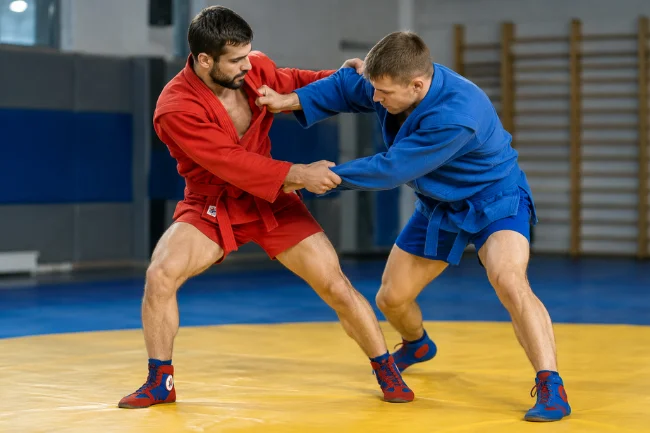
A highlight reel can make Sambo look like a series of explosive throws. I find it more useful to divide its techniques into four connected skills: establishing contact, breaking balance, finishing an attack, and reacting afterward.
Grips and Off-Balancing
A reliable grip is not merely about holding the jacket tightly. It lets you sense pressure, steer your opponent, and prevent them from moving freely. Small changes in foot position and upper-body tension can make a throw possible without a dramatic burst of strength.
The best throw often begins long before either athlete falls.
Throws, Trips, and Takedowns
Sambo uses foot sweeps, inside and outside trips, hip-based throws, body-lock attacks, and other takedown methods. Leg attacks are a recognizable part of its identity, although exactly what is permitted depends on the discipline and event rules.
The aim is not simply to lift someone. It is to create a direction in which they cannot comfortably recover their footing. A modest, well-timed trip may work better than an ambitious throw attempted from poor position.
Pins and Ground Control
After a takedown, athletes may try to stabilize their position and keep an opponent controlled. Sport Sambo rewards qualifying hold-downs, but the rules also encourage continued action rather than indefinite ground stalemates.
This makes the transition from standing to the mat especially valuable. If your opponent is already turning to escape during the fall, the chance to secure control may last only a moment.
Joint Locks and Submissions
Arm and leg submissions are an important part of Sambo grappling. Its reputation for leg locks comes from a culture in which attacking the lower body is a normal part of training rather than an unusual specialty.
However, no submission is universally legal across every age category or format. Chokes, for example, are associated with Combat Sambo but are not permitted in standard Sport Sambo. I recommend learning the rules of your specific program before copying techniques from a competition video.
How Does Sambo Competition Work?
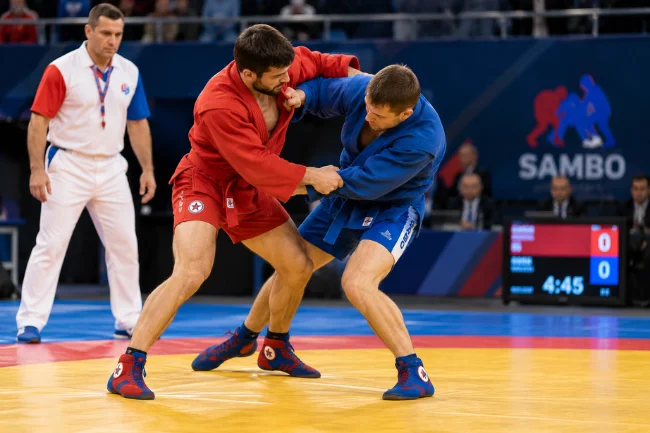
Most matches begin with two athletes standing on a designated competition mat. Officials evaluate their actions using a scoring system that accounts for how a throw is performed, how the opponent lands, and whether the attacker stays standing or falls.
In Sport Sambo, athletes may receive differing point values for effective throws and hold-downs. A clean throw that meets the criteria for total victory can end the contest at once. A legal submission can also produce an outright win, and a large enough points advantage can bring a match to an early finish.
At senior international level, bouts are generally five minutes, although age divisions and particular events can have different durations. Penalties for rule violations and inactivity-related procedures can affect the outcome too.
One detail worth knowing in 2026 is that FIAS updated its international rules to include an “activity” assessment when a bout has no decisive scoring or penalty difference. This helps officials distinguish purposeful engagement from a match in which neither athlete has earned points.
FIAS also clarified that gripping the shorts is permitted in Combat Sambo, not Sport Sambo. These are precisely the small rule differences that can surprise a competitor who trains in both formats.
I treat rule knowledge as part of technical preparation. A beautiful movement is not a competitive advantage if it earns no score or breaks a rule. Before entering an event, I would check the latest official FIAS rulebook and the organizer’s age-division requirements.
Sambo vs. Judo, Brazilian Jiu-Jitsu, and Wrestling
All four disciplines involve controlling another person, but the equipment and scoring systems change what athletes practice most. None is automatically better in every setting.
| Martial art | Typical competitive emphasis | Clothing or grips | Key difference from Sambo |
|---|---|---|---|
| Sambo | Throws, control, and permitted submissions | Jacket, shorts, shoes | Sport and combat formats have distinct rule sets |
| Judo | Throws, pins, and selected submissions | Full gi | Different leg-grab and submission restrictions |
| Brazilian Jiu-Jitsu | Position, guard work, and submissions | Gi or no-gi | Usually devotes more competition time to ground exchanges |
| Wrestling | Takedowns, exposure, and control | Singlet; no jacket grips | Joint-lock submissions are generally not part of competition |
Which Style Is Better for You?
If you love takedowns and want submission options, Sport Sambo is attractive. If you want to combine striking with grappling, Combat Sambo may fit your goals, provided you can train in a properly supervised environment.
Judo offers a deep throwing tradition, Brazilian jiu-jitsu offers extensive ground-position study, and wrestling builds excellent takedown fundamentals. Cross-training can be useful, but I would start by getting consistent instruction in one discipline rather than chasing the supposedly perfect combination.
What Are the Benefits of Training Sambo?
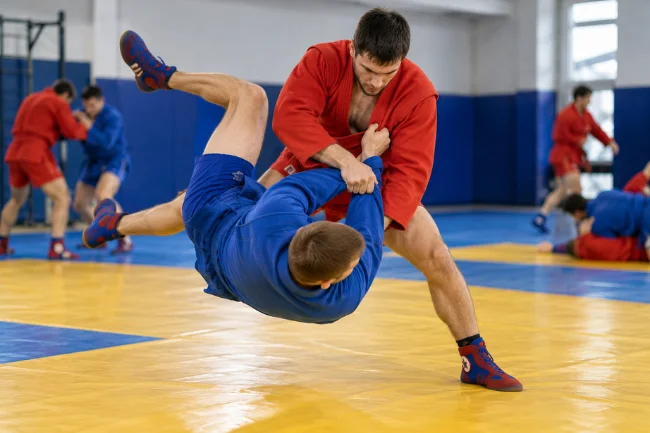
Sambo training can improve cardiovascular fitness, muscular endurance, balance, body awareness, and coordination. Sessions often involve repeated transitions between standing movement, controlled falls, and grappling, so the physical challenge feels different from a standard gym workout.
There is also a problem-solving element. You have to interpret a partner’s pressure and make decisions under time constraints. Over time, that can build composure in training, although it would be an overstatement to promise that martial arts automatically create confidence or emotional resilience for everyone.
Perhaps the most useful lesson is learning to work with resistance. A cooperative drill teaches the mechanics; a responsible, gradually resisting partner shows whether those mechanics hold up when the situation changes.
How to Start Sambo Training as a Beginner
You do not need to arrive strong, flexible, or familiar with martial arts terminology. You do need a gym that teaches newcomers safely and explains what its classes actually involve.
What Your First Class May Look Like
Expect a warm-up, movement drills, breakfall practice, basic gripping, a takedown lesson, and some controlled partner exercises. A responsible coach should adjust the difficulty to your experience and not expect you to spar at full intensity immediately.
I would focus on three early priorities: learning to fall safely, maintaining balanced posture, and recognizing when to release a grip or submit. These habits are less glamorous than throws, but they protect the time you hope to spend training over the coming months.
What Equipment Do You Need?
Some clubs lend equipment for trial sessions. Regular Sport Sambo training usually requires a kurtka, belt, shorts, and soft shoes. Combat classes may also require headgear, gloves, shin protection, a mouthguard, and other gear.
Buy equipment only after checking your coach’s requirements. For official competitions, uniform colors, approved designs, and certification can matter; a jacket that works for casual practice might not pass event inspection.
How Often Should You Train?
Two classes per week is a manageable starting point for many adults. It leaves space to recover, repeat the basics, and decide whether the training load suits your schedule.
Track practical improvements instead of counting techniques: safer falls, steadier balance when pulled, and better posture during a trip.
How to Choose a Good Sambo Club
Watch a beginner class before joining if possible. Look for clean mats, clear instruction, appropriate protective gear, and a coach who pairs students thoughtfully. Ask how submissions are supervised and how quickly beginners are introduced to live resistance.
I would also ask whether the club teaches Sport Sambo, Combat Sambo, or a hybrid program. A gym advertising “Sambo” may offer only one of those experiences. The name on the door matters less than what happens during class.
Is Sambo Effective for Self-Defense?
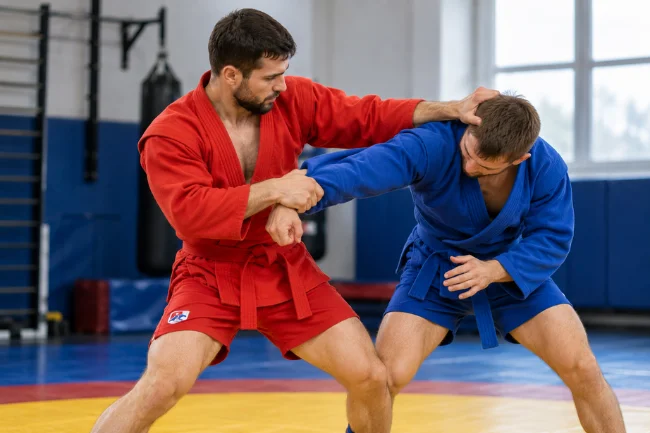
Sambo can develop useful skills for managing distance, staying balanced in a clinch, escaping grips, and controlling a resisting opponent. Combat Sambo adds experience with strikes, while Sport Sambo concentrates more heavily on grappling.
But real confrontations introduce obstacles that organized bouts deliberately remove: hard ground, bystanders, possible weapons, uncertain legal consequences, and attackers who do not follow sporting rules.
My view is that training should expand your options, not encourage you to fight. Awareness, de-escalation, leaving safely, and calling for help deserve a place beside any physical technique. For actual emergencies, local laws and circumstances matter more than a gym’s claims of having the most effective martial art.
Common Sambo Mistakes That Slow Progress
One mistake is trying to force throws with the arms while neglecting footwork. When the opponent’s balance remains intact, even a strong attacker can end up exhausted or countered.
Another is forcing submissions. Joint locks can injure a partner before pain becomes obvious. Apply pressure slowly, release on a tap, and practice unfamiliar techniques only under supervision.
A third is confusing competition success with complete self-defense preparation. The athlete who scores expertly under a specific ruleset still needs sound judgment outside the gym.
Finally, do not assume every Sambo school teaches the same curriculum. Assess the class, not just the highlight videos.
Is Sambo Right for You?
Sambo can suit adults who enjoy competitive grappling, athletes looking to improve their takedowns, and beginners who prefer practical, partner-based learning. It can also be adapted for different ages and abilities when qualified instructors use appropriate rules and progression.
It is a contact sport, however, and falls, strains, and joint injuries are possible. Anyone with a significant medical condition, recent injury, or uncertainty about contact training should seek individualized medical advice before participating.
Final Thoughts
Sambo stands out because it connects gripping, balance, takedowns, and control into one adaptable martial art. Its sport and combat branches give learners different ways to explore the same underlying skills.
If you’re curious, find a reputable club, observe a beginner session, and ask for a supervised trial class. The best introduction is not a spectacular throw on video; it is a coach who helps you understand why the throw works.
Frequently Asked Questions About Sambo
Is Sambo the same as Russian wrestling?
Not exactly. It developed in the Soviet Union and includes wrestling influences, but its jacket grips, submissions, and separate combat format give it distinct rules.
Does Sambo allow punches and kicks?
Combat Sambo permits regulated strikes, including punches and kicks. Sport Sambo is a grappling competition and does not permit striking.
Can beginners learn Sambo without experience?
Yes. A beginner-friendly club should teach breakfalls, balance, grips, and controlled partner work before intense sparring.
Is Sambo better than Brazilian jiu-jitsu?
Neither is universally better. Sambo often places more emphasis on throws, while BJJ generally offers deeper exposure to prolonged ground-position exchanges.
Is Sambo an Olympic sport?
No. Although FIAS received full IOC recognition in 2021, Sambo has not been included as a medal sport on the Olympic Games program.

Lauren Mitchell is a fitness and exercise specialist with 11+ years of experience helping people build strength, improve mobility, and maintain healthier lifestyles. She provides evidence-based fitness guidance focused on effective workouts, injury prevention, and sustainable exercise habits.