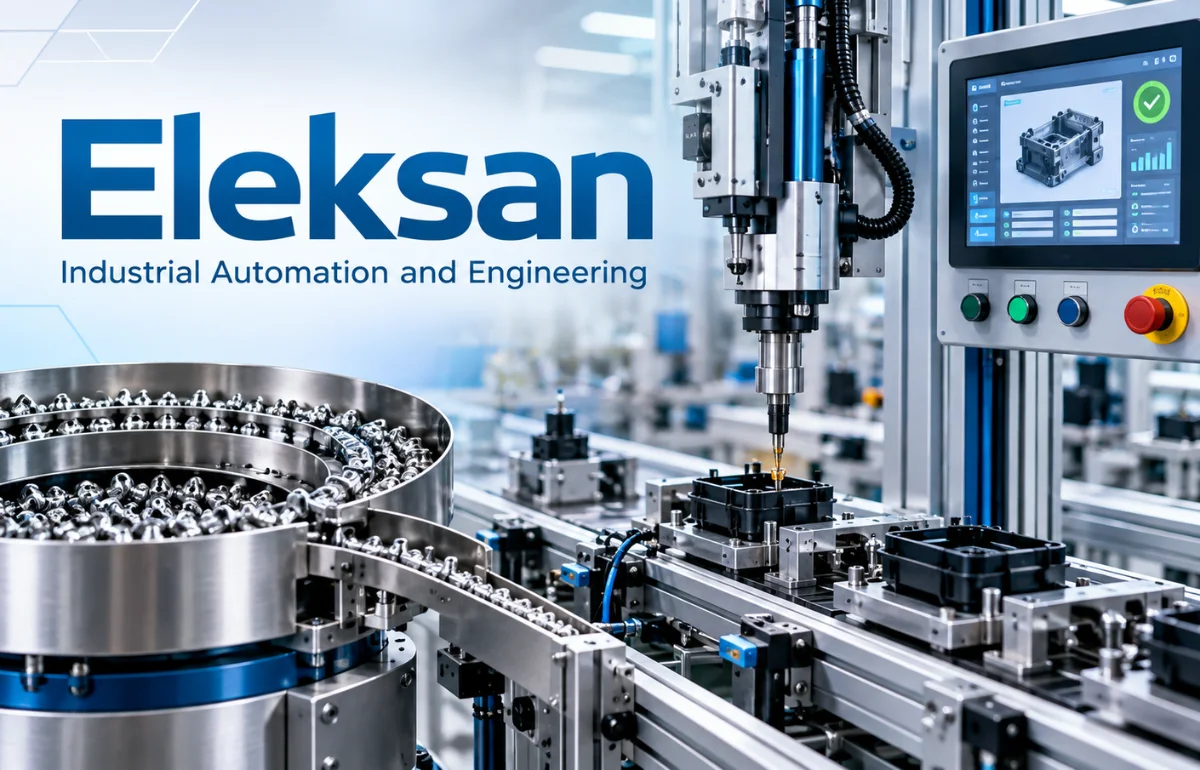
Eleksan is a Turkey-based engineering business known for industrial automation systems, custom machinery, electromechanical components, and dental laboratory solutions. Founded in Istanbul in 1970, Eleksan developed from a producer of electrical contacts, potentiometers, and resistors into a supplier of equipment that helps manufacturers assemble, move, feed, and test parts.
Its work includes automated screwdriving stations, vibratory feeders, assembly machines, and production-line applications. The name also belongs to other Turkish businesses, so identifying the correct company matters when researching products or requesting a quotation.
In this article, I focus mainly on the long-established engineering business associated with eleksan.com, explain what its technologies do, and show how to assess whether a proposed automation solution makes sense.
What Is Eleksan, and What Does the Company Actually Do?
The simplest way I describe Eleksan is as a company that helps factories turn repetitive production tasks into more controlled processes. Instead of selling only one standard machine, it describes a business built around application-specific engineering: designing equipment for the product, production volume, available space, and workflow involved.
Its published corporate information identifies machinery design and manufacturing, dental laboratory equipment, electromechanical production, and representation of international suppliers among its activities. That combination makes it more varied than a typical single-product automation brand.
There is a useful distinction here. Industrial automation does not always mean replacing every person with a robot.
Sometimes the better answer is a fixture that holds a component accurately, a feeder that presents screws consistently, or a semi-automatic station that takes strain out of one repetitive operation. That practical range is central to understanding the company’s offering.
The History Behind Eleksan
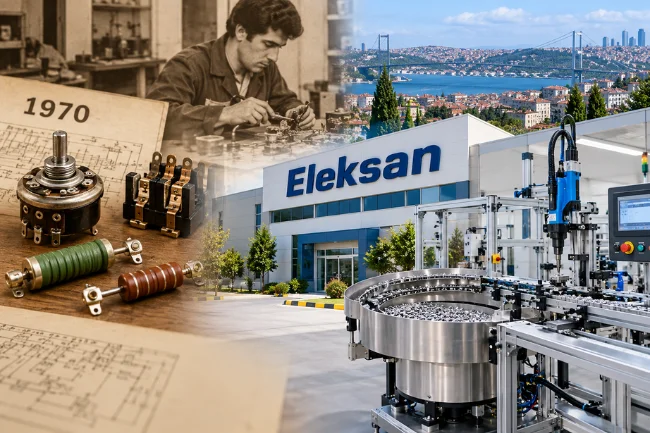
According to its published company history, Murat Tansever founded Eleksan in Istanbul in 1970. The early operation manufactured power potentiometers, resistors, and replacement contact sets for contactors.
These are relatively specialized electrical parts, but they established experience in precision production and electromechanical applications.
Around 1990, the business broadened into special-purpose machinery, automatic feeding equipment, and screwdriving stations.
It moved to a facility in the Dudullu industrial area in 1998. Its historical corporate profile describes approximately 2,100 square meters of enclosed production space; I would treat that as a published facility description, not independently verified current capacity.
The dental business began operating in 1995, and a training laboratory followed in 2005 through cooperation with Italian attachment specialist Rhein’83.
The company also reports completing more than 200 automation projects after its 1998 move, although the published statement does not establish a current project total.
What stands out to me is the progression: from making individual electrical components to engineering machines that coordinate multiple components and processes.
It explains why the company’s activities cross mechanical, electrical, and control-system boundaries.
Eleksan Products and Technologies Explained
Custom Assembly Systems
Assembly automation brings separate parts together in a repeatable sequence. Eleksan describes solutions ranging from operator-assisted workstations to fully automatic assembly lines, including indexed rotary tables and linear manufacturing arrangements.
A manufacturer might need a station that positions a housing, inserts a component, verifies placement, and transfers the finished unit onward.
The value comes from controlling the sequence and reducing avoidable variation, not simply from making the equipment look sophisticated.
Vibratory Bowl and Linear Feeders
Small components rarely arrive at an assembly machine in the correct orientation. Vibratory feeders solve that problem by moving parts through a shaped track so they arrive in a predictable position.
Eleksan lists ED-series circular and EL-series linear vibratory feeders. A bowl feeder can sort and orient bulk components, while a linear feeder can carry them toward the next operation.
Their performance depends heavily on the geometry, surface finish, weight, and consistency of the parts being handled.
I would never select a feeder on advertised speed alone. A fast feeder that regularly jams or presents parts incorrectly can create more downtime than a slower, stable one.
Automatic Screwdriving Stations
Screwdriving sounds straightforward until a factory must repeat it thousands of times with consistent torque and correct screw placement.
Eleksan describes pneumatic and electric screwdriving systems, supported by custom fixtures and automatic screw feeding.
The design challenge includes keeping the workpiece stable, delivering screws reliably, selecting the appropriate fastening method, and confirming that the joint meets the customer’s requirements.
Electric and pneumatic tools each have different cost, control, and maintenance considerations.
Machine-Tending and Material-Handling Systems
Machine tending automates the loading and unloading of equipment such as CNC machines or injection presses. Separate transfer and stacking systems move parts between workstations or organize them after processing.
These applications can reduce repeated handling and improve process consistency.
However, their success relies on accurate part presentation, compatible machine interfaces, safe access, and a realistic recovery procedure when something goes wrong.
Electromechanical Components
Eleksan’s historical product base remains visible in its descriptions of power potentiometers, fixed power resistors, and specialized equipment such as the Automak 1600 electromagnetic riveting press.
These products serve different purposes in a complete assembly line.
Potentiometers vary resistance, power resistors manage electrical loads under specified conditions, and a riveting press performs a controlled joining operation.
Buyers should match electrical and mechanical ratings to the precise application rather than assuming components are interchangeable.
Where Eleksan Technology Fits in Manufacturing
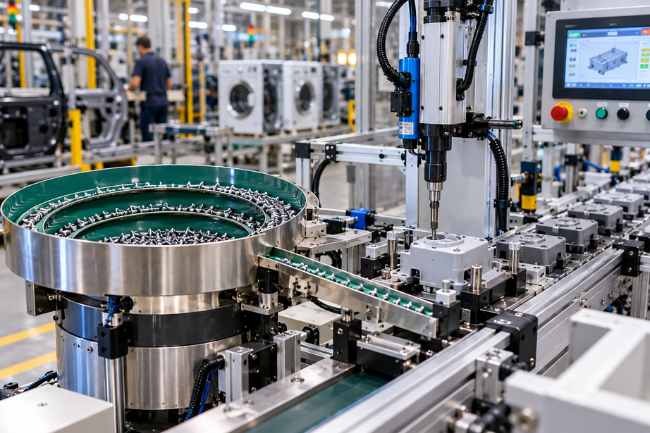
Eleksan names automotive, household-appliance, and medical-related manufacturing among the industries addressed by its automation work.
That makes sense because these environments often involve repetitive assembly, precise part handling, and consistent production standards.
Consider an appliance component assembled with several screws. A custom station could locate the housing, present each screw, complete the fastening sequence, and identify an incomplete cycle.
In an automotive-parts environment, a feeder might orient small clips for continuous assembly. These are illustrative applications, not claims about specific customer installations.
Other practical uses include packaging-line transfers, electrical component assembly, machine loading, and inspection fixtures.
The important question is not whether an entire factory can be automated. It is which operation causes the most avoidable waiting, defects, ergonomic strain, or inconsistent output.
Comparing Common Automation Approaches
Before requesting a system, I would separate the production problem from the type of machine. Different approaches solve different bottlenecks.
| Automation approach | Best suited to | Main point to check |
|---|---|---|
| Semi-automatic assembly station | Mixed tasks needing operator judgment | Ergonomics, repeatability, operator workload |
| Fully automatic assembly line | High-volume, stable product designs | Throughput, changeovers, fault recovery |
| Vibratory feeding system | Small bulk parts needing orientation | Jam rate, part variability, usable feed rate |
| Automatic screwdriving | Repetitive fastening operations | Torque control, screw delivery, traceability |
| Machine-tending system | Repeated loading and unloading | Machine compatibility, guarding, cycle matching |
A fully automatic system may look attractive on a proposal, but it is not automatically the best financial choice.
A product that changes every few months may justify more flexible tooling. A stable, high-volume part may support a dedicated machine with fewer manual interventions.
How I Would Evaluate an Eleksan Automation Proposal
Begin With the Actual Bottleneck
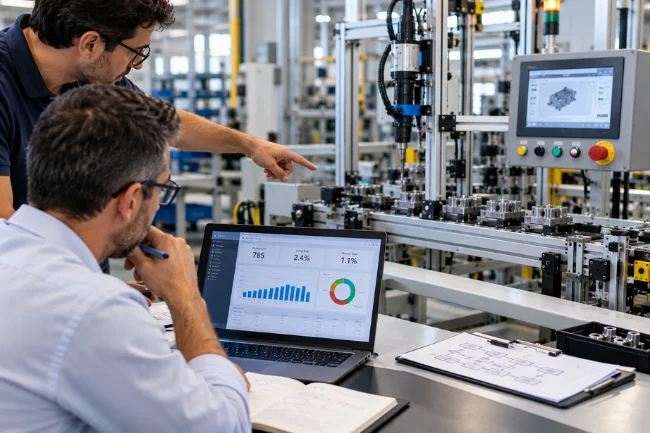
I would first document the existing process: units completed per hour, scrap, rework, stoppages, and operator involvement.
Without a baseline, it is easy to buy a sophisticated machine without proving that it improves the operation that matters.
Next, I would identify the limiting step. A faster feeder will not increase finished output if the downstream test station is already slower than everything else.
Ask for Representative-Part Testing
Product drawings tell an engineer a great deal, but real samples reveal surface differences, burrs, dimensional variation, and handling problems.
For a feeding or assembly application, I would ask whether trials include normal production parts rather than only carefully selected samples.
Testing should also cover foreseeable variation: different batches, the smallest acceptable part, the largest acceptable part, and the conditions under which operators perform changeovers.
Define Acceptance Criteria Before Installation
A proposal should say what success looks like. Useful criteria include accepted parts per hour, maximum allowed stoppages, changeover time, assembly quality, and documentation delivered at handover.
I particularly like specifying good output rather than raw machine cycles.
A machine may cycle quickly while still producing rejected units. Counting only completed, acceptable work prevents that difference from getting lost.
Confirm Support and Ownership
Ask who handles programming changes, spare parts, preventive maintenance, troubleshooting, and training.
Also clarify which software files, machine drawings, and operating instructions the customer receives.
Eleksan describes in-house design, CNC machining, mechanical assembly, electrical-control work, and PLC software development.
Those are useful capabilities to investigate, but each project still needs a written scope and specific support commitments.
The Hidden Costs of Automation: A Practical Check
Price alone is a poor measure of an industrial machine.
I prefer to look at total cost of ownership: purchase and integration, operator training, utilities, consumables, maintenance, replacement parts, production disruption, and future modifications.
I also use a simple weakest-link check. Picture the process as feeding, positioning, assembly, inspection, and discharge.
If any one stage consistently delivers fewer acceptable parts than the others, that stage sets the practical ceiling for the whole system.
For a useful quotation, I would request three figures separately: the machine’s demonstrated cycle time, its sustained good-part output over a representative trial, and the assumptions behind both.
This exposes differences between a laboratory demonstration and everyday production.
The financial case should include benefits beyond direct labor. Better quality, lower scrap, improved ergonomics, reduced handling, and more predictable scheduling may have value.
Equally, changeovers, maintenance, and downtime can erode an attractive spreadsheet forecast.
Safety, Reliability, and Technical Documentation
Industrial machines deserve a safety review before commissioning.
Depending on the application and jurisdiction, that may involve guarding, interlocks, emergency stops, electrical protection, safe maintenance access, and documented risk reduction.
ISO 12100 provides a framework for identifying machinery hazards and assessing and reducing risks. ISO 13849-1 addresses safety-related parts of control systems.
I would ask a supplier which standards apply to the proposed machine and what validation and documentation support its claims.
Simply mentioning a standard is not proof that a particular system complies with it.
Reliability also depends on how easily operators can recover from a jam or failed cycle.
Clear fault messages, accessible wear parts, sensible sensor placement, and documented restart procedures can be just as consequential as headline speed.
Eleksan’s Dental Equipment Business
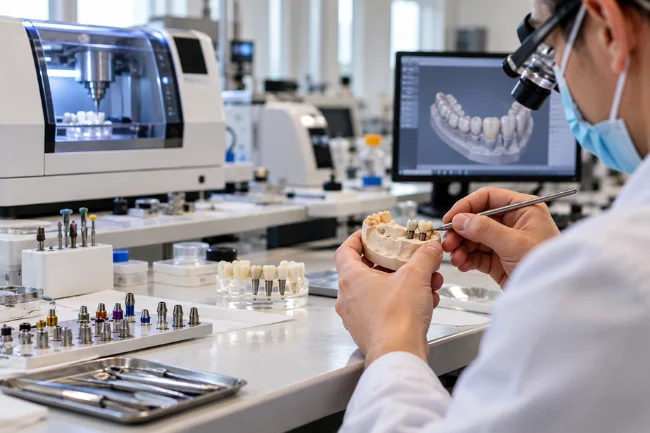
Industrial automation is not the only field associated with Eleksan. Its dental division describes laboratory equipment, attachments, implant superstructure-related products, consumables, and imported technologies from established suppliers.
The company traces this activity to 1995 and says it established a technical training facility in 2005 with Rhein’83.
Dental technicians and clinics have very different requirements from automotive factories, so buyers should treat this as a distinct product line with its own technical support, training, and product documentation.
I would verify the intended dental product’s manufacturer, applicable regulatory status, instructions for use, and local support rather than relying on the wider company’s industrial reputation as a substitute for product-specific evidence.
Why the Eleksan Name Can Cause Confusion
One detail worth checking before contacting a supplier is the website address.
The Eleksan name appears across businesses with different specialties, and search results may mix them together.
| Website or identity | Described focus | Useful distinction |
|---|---|---|
| eleksan.com | Industrial automation, electromechanical and dental solutions | Company history traces back to 1970 |
| eleksan.com.tr | Automatic gates, barriers and access systems | Its published history describes formation in 1999 |
| eleksan.net | Poultry-house and livestock equipment | Focuses on feeding, watering and ventilation |
These descriptions come from the businesses’ own websites. Similar branding does not, by itself, establish common ownership.
I would confirm the legal company name, quotation details, address, and official product documentation before making a payment or discussing a technical contract.
What Makes an Automation Supplier Worth Considering?
When I assess a supplier such as Eleksan, I look for evidence of application understanding rather than sweeping promises about efficiency.
The strongest proposal explains why a chosen feeding method, fixture, controller, and assembly sequence fit the customer’s actual part and production targets.
I also look for honest limitations.
Can the machine handle multiple product versions? Which wear parts are specific to the design? What happens if the upstream process stops? How are faults logged? Who can modify the PLC program years later?
Those questions are not criticisms of Eleksan; they are the checks I would apply to any custom-machine builder.
A credible answer makes investment decisions easier and reduces unpleasant surprises after commissioning.
Final Thoughts
Eleksan represents a practical side of industrial technology: combining mechanical design, component feeding, electrical controls, and automation to solve defined production problems.
Its long history and varied product range make it a relevant name to research, but the right purchase still depends on fit, measurable performance, safety, and support.
If you are considering an Eleksan product or system, start with the correct company website, prepare real sample parts and current production figures, and request a written proposal with clear acceptance tests.
That will tell you more than any broad promise of faster manufacturing.
Frequently Asked Questions About Eleksan
What is Eleksan best known for?
Eleksan Ltd. is known for custom industrial automation, vibratory feeders, assembly and screwdriving equipment, plus electromechanical and dental products.
Where is Eleksan located?
The engineering company lists an address in Ümraniye, Istanbul, Turkey, on its official contact page.
Does Eleksan manufacture custom machines?
Yes. Its published capabilities include mechanical design, CNC manufacturing, control panels, PLC programming, and assembly of application-specific machines.
Does Eleksan supply dental products?
Yes. Its dental division describes laboratory equipment, attachment systems, consumables, training, and selected imported products.
Is Eleksan the same company as the automatic-gate supplier?
Do not assume so. The gate-automation business uses eleksan.com.tr, while the industrial engineering company uses eleksan.com; verify the legal entity.

Noah Sterling is a technology research writer with 8+ years of experience covering emerging technologies, software trends, digital tools, and innovation. He creates practical, research-based articles to help readers understand the evolving technology landscape.