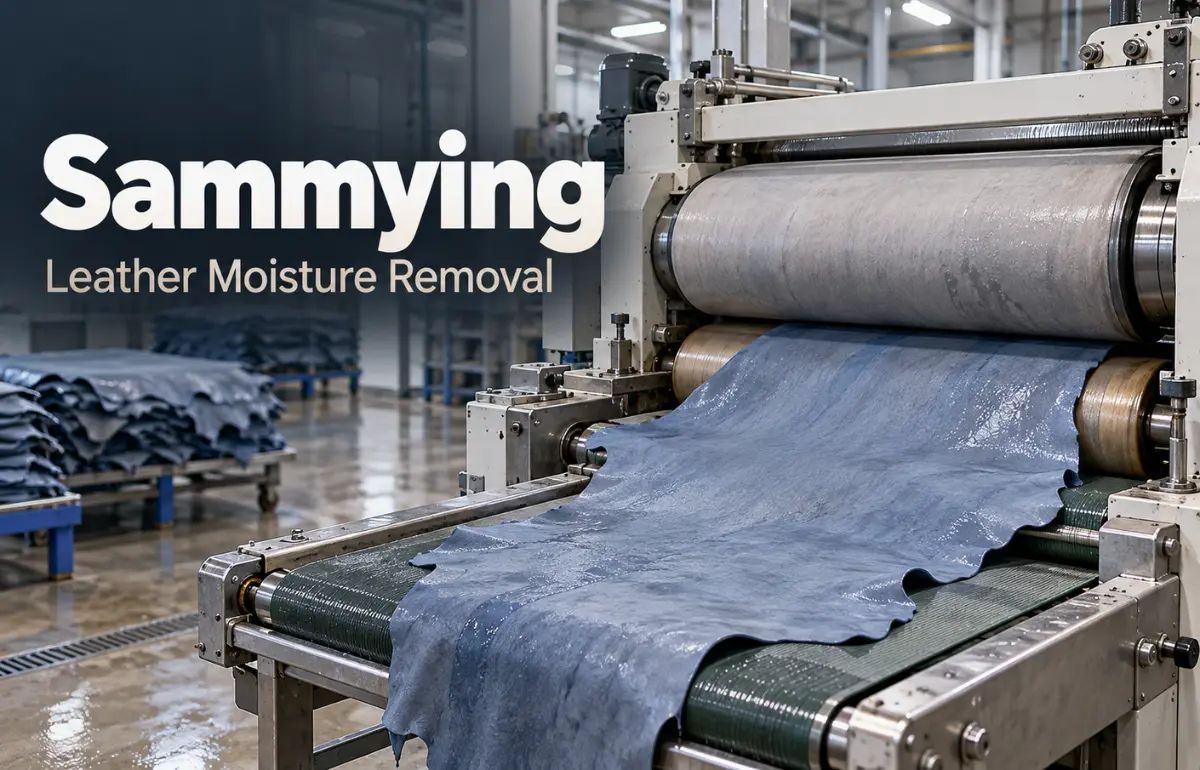
Sammying is a mechanical process used in leather manufacturing to remove excess water from wet hides and skins after tanning or other wet-processing operations. A sammying machine presses leather between rollers, often supported by absorbent felts, to squeeze out surplus liquid without completely drying the material. This makes the leather easier to handle and prepares it for further processing, such as splitting, shaving, setting out, or drying.
Sammying plays a significant role in maintaining consistent moisture levels, improving production efficiency, and reducing unnecessary handling difficulties.
Although the process sounds simple, its results depend on roller pressure, leather thickness, feeding speed, and machine condition. I find that understanding these factors is more useful than focusing only on how much water a machine can remove.
What Is Sammying in Leather Manufacturing?
Sammying, sometimes called samming or samming-out, is a mechanical dewatering operation in the leather tanning industry.
Freshly tanned leather contains considerable moisture because it has been treated in water-based chemical solutions. Before the material can undergo certain mechanical operations, some of that liquid must be removed.
This is where sammying comes in.
Unlike conventional drying, which removes moisture through evaporation, sammying uses mechanical pressure to extract excess liquid.
The leather remains wet and flexible after processing. The objective is not to produce completely dry leather but to achieve a suitable moisture condition for subsequent manufacturing operations.
Where Does Sammying Fit in the Leather Production Process?
The exact position of sammying depends on the tanning method and the type of leather being manufactured.
In a typical chrome-tanning process, the sequence may include:
- Preparation and tanning of hides or skins.
- Draining and conditioning of wet-blue leather.
- Sammying to remove surplus moisture.
- Splitting or shaving to achieve the required thickness.
- Retanning, dyeing, and fatliquoring.
- Further sammying or setting out, where required.
- Drying, conditioning, and finishing.
Not every tannery follows precisely the same sequence.
For example, some manufacturers use combined sammying and setting-out machines after dyeing, particularly when preparing leather for vacuum drying.
The central purpose remains unchanged: control excess moisture without damaging the leather structure.
How Does the Sammying Process Work?
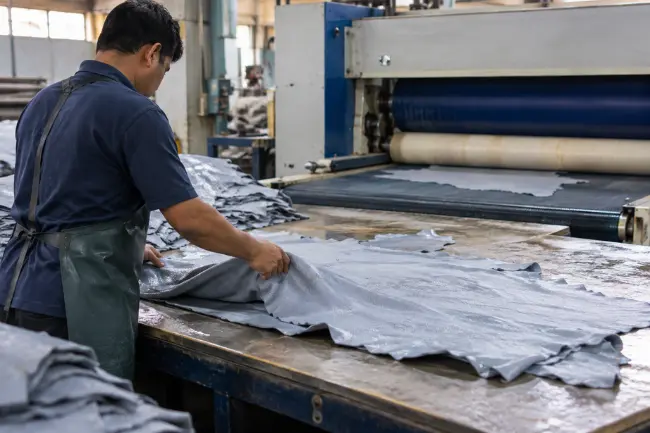
The working principle of sammying is straightforward. Wet leather passes through a machine where controlled pressure forces excess liquid out of its structure.
However, effective moisture removal requires more than simply squeezing the material.
1. Preparing the Wet Leather
Before processing, operators check the leather for folds, excessive wrinkles, and irregular positioning.
The hides are arranged according to the machine’s feeding requirements.
Proper preparation helps prevent uneven compression and reduces the possibility of marks or creases.
2. Feeding the Leather Into the Machine
The leather enters the sammying machine through a feeding table, conveyor, or suitable transport system.
In through-feed machines, moving belts or felts carry the material continuously through the pressing area.
The feeding mechanism must maintain steady movement while keeping the leather correctly positioned.
3. Applying Mechanical Pressure
The leather travels between pressure rollers or pressing assemblies.
Hydraulic or mechanical systems apply the necessary force, depending on the equipment design.
This pressure squeezes excess liquid from the leather.
Absorbent felts help support the material and allow extracted water to drain away from the pressing area.
4. Removing the Extracted Liquid
The expelled liquid is directed away through the machine’s drainage arrangement.
Because tanning chemicals may be present, the collected liquid must enter an appropriate wastewater collection or treatment system.
Efficient drainage also helps prevent extracted water from returning to the leather.
5. Discharging the Processed Leather
After passing through the rollers, the leather exits with reduced moisture content.
Operators check its condition before transferring it to the next production stage.
The material should remain sufficiently moist and flexible for the operation that follows.
Main Components of a Sammying Machine
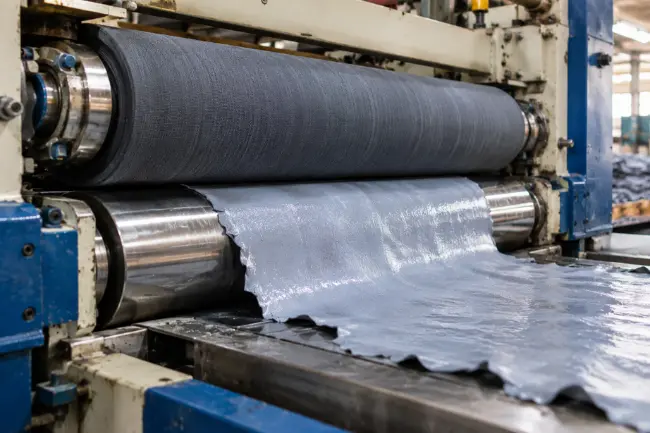
Modern leather sammying machines combine several mechanical systems to achieve reliable performance.
Pressure Rollers
Pressure rollers perform the main squeezing action.
Their arrangement, diameter, covering material, and applied force influence the effectiveness and uniformity of moisture removal.
Depending on the design, machines may use multiple pressing points to extract liquid progressively.
Sammying Felts
Sammying felts are specialized absorbent belts used between the leather and pressing components.
They help distribute pressure, transport the material, and provide drainage paths for extracted liquid.
Felts may be manufactured from synthetic fibers or mixed materials.
Their thickness, permeability, condition, and compatibility with the machine affect performance.
Hydraulic System
Many industrial sammying machines use hydraulic systems to control pressing force.
Hydraulic components may include cylinders, pumps, valves, and pressure-control arrangements.
Some advanced machines provide independent pressure adjustment across different pressing zones.
Feeding and Control Systems
Conveyors, rollers, adjustable drives, and control panels regulate material movement.
Certain machines include automatic felt-centering systems, spreading rollers, and variable-speed controls.
These features can improve processing consistency while reducing unnecessary manual adjustments.
Types of Sammying Machines Used in Tanneries
Different leather manufacturers require different equipment configurations.
Through-Feed Sammying Machines
A through-feed sammying machine processes leather continuously through its roller system.
This design is particularly suitable for production lines handling repeated batches of hides or skins.
Depending on the model, it may provide adjustable transport speed, multiple pressure points, and automatic felt tracking.
Combined Sammying and Setting-Out Machines
These machines perform moisture removal and leather spreading within one integrated operation.
The setting-out mechanism helps flatten the material and reduce wrinkles.
Combined equipment can reduce separate handling operations, although its suitability depends on the leather type and processing requirements.
Smaller-Width Sammying Machines
Smaller machines are available for tanneries handling skins or narrower leather pieces.
Their suitability depends on working width, production volume, hide dimensions, and the processing method.
I would never choose a machine based on overall size alone. Its ability to process the actual material consistently matters far more.
Sammying vs. Setting Out, Shaving, and Drying
Several leather-processing operations are closely connected, but they serve different purposes.
| Process | Main Purpose | Effect on Leather |
|---|---|---|
| Sammying | Remove excess liquid mechanically | Reduces free moisture |
| Setting out | Spread and flatten wet leather | Reduces folds and improves flatness |
| Shaving | Adjust leather thickness | Removes material from the flesh side |
| Drying | Remove additional moisture | Prepares leather for later processing and finishing |
Sammying and setting out are sometimes performed together, but they are not identical.
Similarly, sammying cannot replace final drying because mechanically pressed leather still contains significant moisture.
Understanding these differences helps prevent incorrect machine selection and production planning.
Why Is Sammying Important in Leather Processing?
Sammying contributes to production quality in several practical ways.
More Consistent Moisture Distribution
Uneven moisture can create difficulties during subsequent operations.
Controlled sammying reduces excess liquid and can help establish more consistent processing conditions.
However, uniformity depends on proper feeding, material preparation, and machine settings.
Better Preparation for Splitting and Shaving
Wet-blue leather must be in a suitable condition before thickness-adjustment operations.
Excessively wet or inconsistently conditioned material can be harder to process predictably.
Sammying prepares the material for subsequent handling without requiring complete drying.
Improved Production Efficiency
Mechanical dewatering reduces the amount of liquid remaining in the leather.
In some production routes, this can reduce handling difficulties and the moisture load entering later drying stages.
Nevertheless, actual time and energy savings depend on the complete production line.
Reduced Handling Problems
Wet hides are heavy and can be difficult to position accurately.
Removing surplus water can make them easier to handle.
This may support smoother movement between processing stations, particularly where conveyors and material-handling systems are integrated.
Greater Process Consistency
A properly adjusted machine allows operators to follow repeatable operating conditions.
When incoming leather characteristics remain comparable, consistent roller pressure and transport speed help reduce unnecessary variation between batches.
Factors That Affect Sammying Performance
One of the biggest mistakes in mechanical dewatering is assuming that higher pressure always produces better results.
I prefer to evaluate several factors together rather than relying on one setting.
Leather Thickness and Type
Thick bovine hides behave differently from thin sheep or goat skins.
Material thickness, fiber structure, tanning method, and initial moisture influence how the leather responds to compression.
Settings suitable for one material should not automatically be applied to another.
Roller Pressure
Pressure must be sufficient to remove excess liquid without causing unnecessary compression damage.
Excessive pressure may contribute to marks, distortion, or unwanted changes in the material’s appearance.
Operators should follow equipment specifications and validated production settings.
Feeding Speed
Transport speed affects processing time and interaction with the pressing assemblies.
A faster feed does not automatically produce greater effective output if the resulting leather requires reprocessing.
The best setting balances throughput with acceptable quality.
Felt Condition
Worn, contaminated, poorly tensioned, or improperly tracked felts can reduce machine effectiveness.
They may also contribute to inconsistent contact and drainage.
Regular inspections are therefore essential.
Initial Moisture Condition
Two hides of similar dimensions can contain different amounts of liquid before processing.
This means identical machine settings may produce different results.
For meaningful comparisons, incoming material conditions must be considered.
How to Measure Sammying Efficiency
Sammying efficiency should be measured rather than judged only by how wet the leather feels.
I would assess performance using three practical indicators: liquid removed, consistency across the processed material, and usable production output.
Measuring Weight Reduction
A simple production check involves weighing a comparable hide immediately before and after sammying.
Consider this illustrative example:
- Leather weight before sammying: 25 kg
- Leather weight after sammying: 22 kg
- Weight reduction: 3 kg
The percentage weight reduction is calculated as:
Weight reduction (%) = [(Initial weight − Final weight) ÷ Initial weight] × 100
In this example:
(3 ÷ 25) × 100 = 12%
The hide has lost 12% of its incoming weight during processing.
This is not the same as saying its final moisture content is 12%.
The difference matters because leather contains water, collagen, tanning substances, oils, and other materials.
Measuring Moisture More Accurately
A standardized laboratory procedure provides a more consistent basis for comparing leather samples.
For example, ISO 4684 describes the determination of volatile matter in leather.
However, the standard also explains that volatile-matter loss is not an exact measurement of water content because substances other than water may be lost during testing.
When comparing production batches, the measurement method and sampling conditions should remain consistent.
Checking Uniformity
Operators can compare samples from different areas of the same hide, including central and edge regions.
Consistent results across comparable locations help reveal whether pressure distribution or feeding needs attention.
A useful production record should include leather type, initial condition, machine settings, processing time, and inspection results.
That information is often more valuable than a manufacturer’s isolated productivity claim.
Common Sammying Problems and Their Causes
Even advanced sammying machines can produce unsatisfactory results when operating conditions are incorrect.
Uneven Moisture Removal
Some areas may remain wetter than others.
Possible causes include uneven feeding, poor felt condition, incorrect pressure settings, or differences in leather thickness.
I would first check whether the problem repeatedly appears in the same location before changing multiple settings.
Roller Marks and Surface Damage
Excessive pressure, contaminated contact surfaces, or unsuitable machine adjustments may leave visible marks.
Operators should examine the roller and felt condition and confirm the settings recommended for the material.
Wrinkles and Folds
Leather entering the machine incorrectly may develop folds or retain existing wrinkles.
Correct feeding and proper use of spreading equipment can reduce this risk.
Excessive Residual Moisture
Insufficient pressure, unsuitable feed speed, or reduced drainage effectiveness may leave too much liquid in the leather.
The appropriate response depends on the machine design and production requirements.
Repeated processing should not become a substitute for identifying the underlying problem.
Sammying Machine Maintenance and Safety
Preventive maintenance directly affects equipment reliability and leather quality.
A sensible maintenance program should include:
- Inspecting sammying felts for wear, damage, contamination, and tracking problems.
- Checking rollers and contact surfaces for irregularities.
- Monitoring hydraulic components for leaks and abnormal operation.
- Cleaning drainage channels and following approved felt-cleaning procedures.
- Inspecting conveyors, drives, and mechanical connections.
- Testing safety guards, interlocks, and emergency-stop devices according to the manufacturer’s instructions.
Maintenance frequency should follow the equipment manual and actual operating conditions.
Essential Operator Safety
Sammying machines contain powerful moving rollers that create serious trapping and crushing hazards.
Operators must keep their hands away from feed nips and moving components.
Guards and interlocks should never be bypassed.
Cleaning, adjustment, or repair work must follow an approved isolation and lockout procedure.
Only trained personnel should operate or service the machine.
A properly maintained machine protects both product quality and the people working around it.
Environmental Considerations in Sammying
Sammying removes liquid from leather, but that liquid does not simply disappear.
It becomes part of the tannery’s wastewater-management responsibility.
When processing chrome-tanned wet-blue leather, extracted liquid may contain chromium compounds and other tanning-related substances.
Collection systems should direct these streams toward suitable treatment or recovery arrangements, following applicable regulations.
Mechanical dewatering may also reduce the moisture load entering later drying operations.
However, energy savings should be demonstrated through actual production measurements rather than assumed.
I consider wastewater handling and energy performance essential parts of evaluating the process, not separate environmental concerns.
How to Choose the Right Sammying Machine
Choosing suitable tannery equipment requires a clear understanding of the production line.
Before selecting a sammying machine, I would examine the following factors.
Working Width and Capacity
The machine should accommodate the dimensions of the leather being processed.
Capacity should be evaluated using realistic production conditions, including material loading, feeding, and handling time.
Pressure and Speed Control
Look for controls appropriate to the leather types the tannery processes.
Adjustable pressure and transport speed may be valuable where production involves different thicknesses and materials.
Maintenance Requirements
Review felt replacement procedures, roller accessibility, spare-part availability, and hydraulic maintenance needs.
A technically capable machine may still be unsuitable if servicing causes excessive downtime.
Safety and Supplier Support
Check the machine’s safety features, documentation, installation requirements, and operator-training support.
Also consider spare-part lead times, warranty conditions, and the supplier’s technical service capabilities.
Total Operating Cost
Purchase price is only one expense.
Electricity, replacement felts, maintenance, wastewater handling, labor, and downtime all affect long-term cost.
The best machine is not necessarily the most expensive or fastest model. It is the one that consistently meets production requirements at an acceptable operating cost.
Conclusion
Sammying is an essential mechanical dewatering process that helps prepare wet leather for subsequent manufacturing operations. Its effectiveness depends on appropriate equipment, controlled pressure, suitable feeding conditions, and regular maintenance.
For tannery operators, I recommend starting with measurable production requirements rather than machine marketing claims. Compare moisture-removal performance, leather quality, safety, and running costs before making equipment decisions.
A well-managed sammying process can support more predictable leather production and better operational efficiency.
Frequently Asked Questions About Sammying
1. What is the main purpose of sammying?
The main purpose of sammying is to remove excess liquid from wet leather through mechanical pressure, preparing it for further processing without completely drying it.
2. What is the difference between sammying and drying?
Sammying squeezes excess liquid from leather using pressure, while drying removes additional moisture through processes such as evaporation.
3. Which machine is used for sammying leather?
A sammying machine uses pressure rollers, often with absorbent felts and hydraulic controls, to extract excess liquid from wet hides and skins.
4. Does sammying improve leather quality?
Proper sammying can improve processing consistency and prepare leather for subsequent operations. Results depend on moisture conditions, equipment settings, and handling.
5. What types of leather can undergo sammying?
Sammying can be used on various types of leather, including cow, buffalo, sheep, and goat, provided the machine and operating conditions suit the material.

Noah Sterling is a technology research writer with 8+ years of experience covering emerging technologies, software trends, digital tools, and innovation. He creates practical, research-based articles to help readers understand the evolving technology landscape.