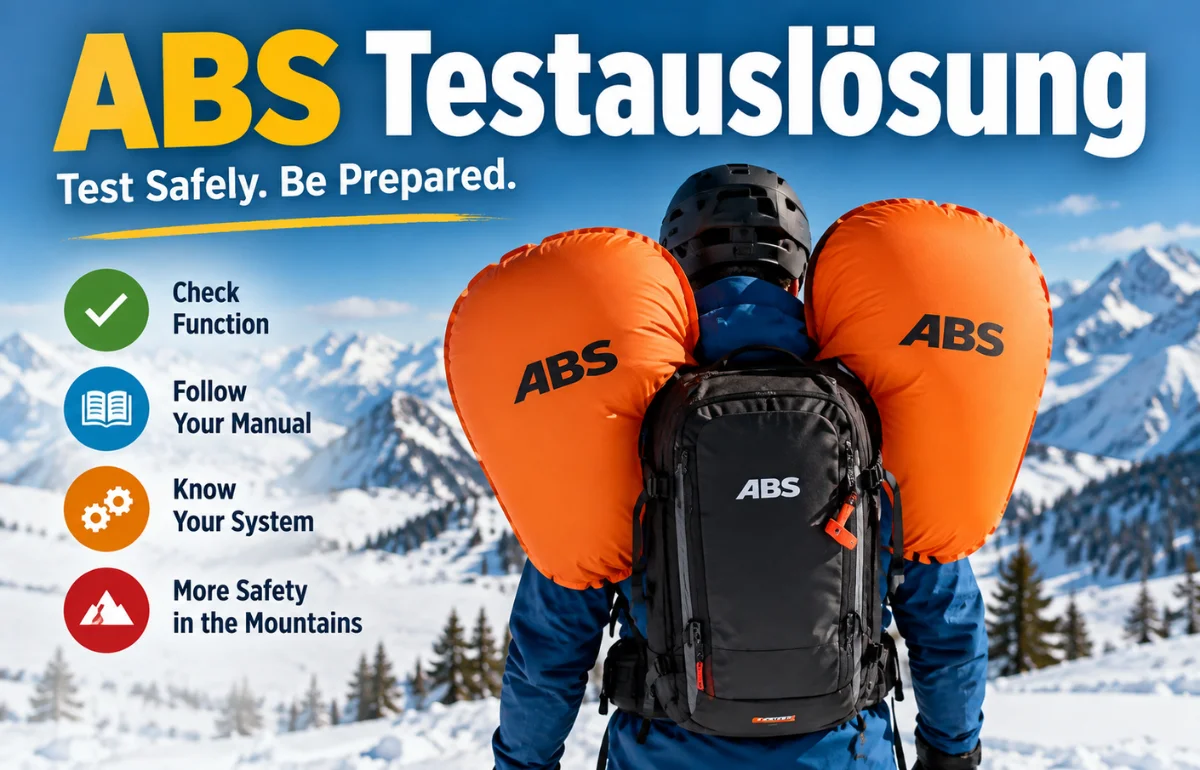
ABS Testauslösung means a test activation or test deployment of an ABS avalanche-airbag system. In practical terms, it means pulling the release handle to check the trigger and, during a full test, inflating the airbags. Some ABS systems also allow a dry trigger test without a cartridge, but that option depends on the exact model. I never treat the phrase as a universal instruction: the correct method is always the one specified in the manual for the backpack’s trigger system. A proper ABS Testauslösung can confirm basic function, reveal visible faults and help the pulling movement become familiar. It does not certify the backpack indefinitely, replace scheduled service or make unsafe avalanche terrain safe.
What Does ABS Testauslösung Mean?
The German word “Testauslösung” combines “test” with “release” or “activation.” ABS refers here to the avalanche-airbag manufacturer, not the anti-lock braking system in a car.
You may also see German terms such as “Auslösegriff” for release handle and “Patrone” for cartridge. “Patrone tauschen” means replacing or exchanging the cartridge after it has been discharged.
The purpose of a test depends on the method used. A full deployment checks the trigger, cartridge, inflation path and airbags together. A dry test checks only the release mechanism on a compatible system. Those are not equivalent tests, even though people sometimes describe both as an ABS Testauslösung.
Why a Test Deployment Matters
An avalanche-airbag handle is meant to be pulled under stress, often while the user is moving, wearing gloves and dealing with limited visibility. Reading about that action is not the same as rehearsing it.
I think of a test release as serving two jobs. First, it checks equipment. Second, it trains the user to locate the handle and pull decisively. That second benefit is easy to underestimate until thick gloves, winter clothing and an awkward body position are involved.
ABS currently recommends a training session with a filled cartridge before each season and a larger service every three years for applicable products. Older models may follow different schedules, so the production year and model manual still control the decision.
Identify the ABS System Before Pulling Anything
The safest starting point is not the trigger handle. It is the product label and manual.
Find the system name, backpack model, production information, cartridge type and trigger design. Check whether the airbag system has been modified, serviced or involved in an avalanche. If the model cannot be identified with confidence, I would stop and ask ABS or an approved service partner rather than experiment.
ABS publishes instructions for several product families, including EASY.TECH, SOLID, p.RIDE and different A.LIGHT, s.Light and s.Cape backpacks. ABS also sells electronic airbag products that do not use the same gas-cartridge procedure. Similar-looking packs can therefore require very different checks.
While comparing manufacturer manuals and competing explanations for this article, I found that model identification was the point most likely to be skipped. General advice often explains the pull correctly but fails to establish whether that pull is safe for the reader’s release unit. That is why I put the model check before every physical action.
| System or category | Typical test approach | Key point before testing |
|---|---|---|
| EASY.TECH | Compatible units can allow a dry trigger pull; a full test uses a filled cartridge | Confirm the system is armed and the viewing window shows the expected ready status |
| SOLID trigger system | Uses a cartridge and pyrotechnic release handle | Do not assume cartridge-free triggering is harmless; consult the exact instructions |
| p.RIDE and other inflator systems | Procedure depends on the specific inflator and backpack generation | Follow the matching manual and refill instructions |
| Electronic airbag system | Uses an electronic power and inflation system rather than the same cartridge sequence | Use its electronic self-test and deployment instructions, not a gas-system checklist |
This model-first check is one of the most useful improvements a safety article can make. “ABS backpack” is a brand description, not a complete operating procedure.
Full Deployment Versus Dry Trigger Test
The two tests answer different questions. I use the following distinction to keep the purpose clear.
| Test type | What happens | What it checks | What it does not prove | Cost or reset consequence |
|---|---|---|---|---|
| Full deployment | The handle is pulled and the airbags inflate | Trigger, cartridge, gas path, valves, airbag opening and visible inflation | Long-term reliability or internal condition beyond what the test reveals | Cartridge or inflator must be refilled or exchanged; system must be repacked correctly |
| Dry trigger test | The trigger is activated without inflating the airbags on a compatible model | Handle movement, release mechanism and status feedback | Cartridge pressure, valves, fabric, air path or full inflation | Usually no cartridge is consumed, but only when the manufacturer permits this test |
A click is not proof that the airbags would inflate. Conversely, a successful full deployment is only a snapshot of system performance at that moment. Neither result replaces inspection and service.
Checks to Complete Before an ABS Testauslösung
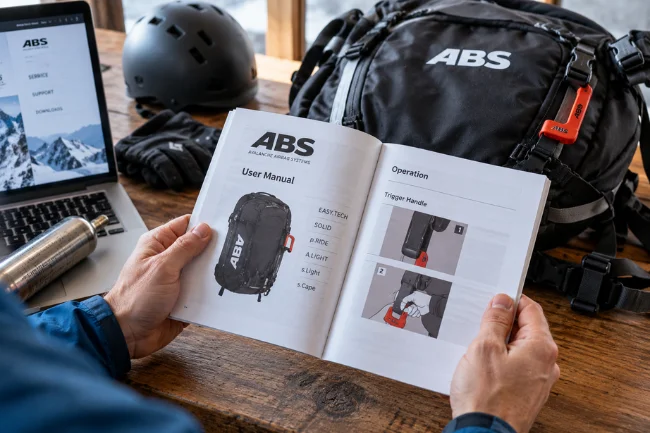
Read the exact manual
Download the instructions that match the system and backpack. Do not rely on a video for a newer model or a guide written for another brand. Check the publication date and any manufacturer service notices as well.
Choose an open testing area
An inflating airbag needs room. Clear people, pets, sharp equipment, open flames, heaters, shelving, lights and ceiling fans from the area. Outdoors can work if the ground is clean and dry and the bag cannot contact branches, rocks or vehicles.
Inspect the pack
Look at the shoulder straps, waist belt, leg loop, buckles, seams, airbag compartment and release cable or connection. Cuts, corrosion, loose parts, damaged stitching or a blocked airbag opening are reasons to pause.
Verify the cartridge
Use only the cartridge approved for the exact system. ABS advises checking its sealing plate and weighing the cartridge regularly. The total permitted weight is printed on the cartridge; according to the manufacturer, a deviation of more than five grams means it should not be used.
Never judge compatibility by thread size or appearance. A component from Mammut, Ortovox or another system is not interchangeable merely because it seems to fit.
Wear the pack realistically
Fasten the waist belt and leg loop as directed. Adjust the shoulder straps and position the handle where it will sit during a tour. I recommend wearing the gloves and outer layers normally used in winter because they change reach and grip.
How to Perform a Full ABS Testauslösung
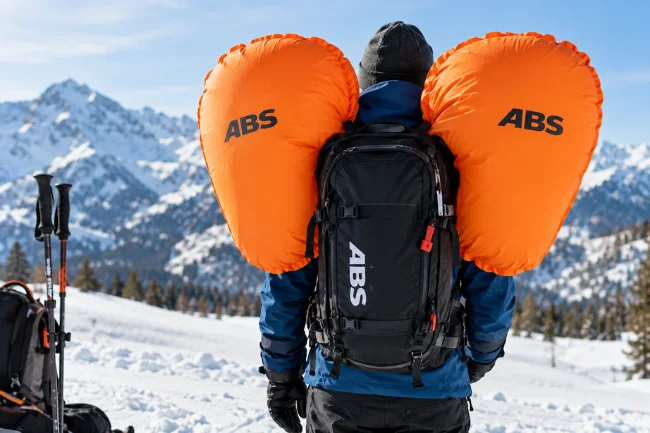
The manual remains the primary instruction, but a safe full-test sequence normally follows this order:
- Confirm that the airbag is correctly folded and its compartment is unobstructed.
- Reset or arm the trigger system exactly as the manufacturer directs.
- Inspect and install the correct filled cartridge or release unit without forcing the threads.
- Put on the backpack and secure every required strap, including the leg loop.
- Stand steadily in the clear testing area and warn anyone nearby.
- Reach for the handle with the hand you expect to use while skiing or riding, then pull once in a firm, continuous motion.
- Observe whether both airbags emerge cleanly, achieve their proper shape and remain inflated long enough for inspection.
Current ABS information states that its twin bags inflate in roughly three to four seconds on applicable gas systems. Do not place your face, hands or another object against the airbag compartment while it opens.
Leave the bags inflated while checking the fabric, seams, connections and valves. Listen for strong leakage and compare the two sides. If one bag stays closed, inflation is incomplete or pressure disappears quickly, do not use the backpack in avalanche terrain.
How a Compatible EASY.TECH Dry Test Works
EASY.TECH is designed to provide audible, physical and visual feedback during permitted cartridge-free practice. ABS instructs the user to activate the system before the pull and confirm that the viewing window is green.
After a successful pull, the user should hear a distinct click, feel the release and see the display change to red. Reset the system only as shown in the manual.
This is useful for practising handle location with different gloves and layers. It should not become casual repeated pulling, and it should never be copied on an unidentified or incompatible trigger. ABS warns that certain release handles or older arrangements can require service after activation without the pressure bottle.
How to Interpret the Result
A useful test needs a clear pass-or-stop decision. I use four layers of evidence rather than relying on the sound of the trigger alone.
- A correct click, physical feedback and status change during a permitted dry test mean the trigger responded as expected. Reset it according to the manual, remembering that inflation was not tested.
- If both bags open fully and hold their shape during a full test, the visible deployment was successful. Inspect, deflate and repack them before replacing or refilling the used component.
- If only one bag opens or either side inflates partially, a fault, obstruction, connection problem or packing error may exist. Stop using the pack and contact an approved service provider.
- If air escapes unusually fast or fabric, seams or valves appear damaged, do not attempt a home repair. Arrange a professional inspection.
- If there is no click, no status change or an unexpected indicator colour, do not keep installing or pulling components. Consult the manual or service center.
The unique practical point here is to separate trigger feedback, inflation performance, pressure retention and post-test readiness. Passing one layer does not automatically pass the other three.
What to Do After a Full Deployment
Do not rush directly from inflation to folding. Inspect the open airbags first and photograph any unusual shape, damage or one-sided result for the service technician.
Release the gas through the designated valve. Do not puncture the bag, twist the fabric or use a vacuum cleaner. If the airbag is damp, let it dry fully before repacking it exactly as the manual shows. Incorrect folding can obstruct the next deployment.
Mark the discharged cartridge or inflator immediately so it cannot be mistaken for a ready unit. Then follow the correct refill route:
- A SOLID release unit may require both the cartridge and release handle to be sent for refilling.
- An EASY.TECH refill normally involves the cartridge or pressure bottle specified by ABS.
- A p.RIDE system uses its corresponding inflator process.
Install the returned or replacement component only after checking its condition, fill status and service information. The system is not tour-ready until it has been reset, repacked and returned to the manufacturer-defined ready indication.
Service, Storage and Before-Tour Checks
A seasonal deployment is not the entire maintenance plan. ABS recommends a larger service every three years for current applicable products. A trigger handle containing an integrated capsule may also have a three-year replacement requirement; its expiry information should be checked on the handle.
Arrange inspection after an avalanche deployment, a hard fall, visible impact damage or any event that could have stressed the pack. Older equipment deserves extra care because age, storage conditions and discontinued components can affect service options.
Store the backpack clean and dry, away from heat, direct sunlight, oil, sharp tools and rodents. Follow the manual on whether the cartridge may remain installed during storage.
Before every tour, I would verify five things: the system is armed, the cartridge or power system is ready, the handle is visible and reachable, the airbag opening is clear, and the waist belt plus leg loop can be secured correctly.
Common Testing Mistakes
The most serious mistake is treating instructions as interchangeable. EASY.TECH guidance should not be copied onto a SOLID, p.RIDE or electronic system.
Another frequent error is installing a filled cartridge before the trigger has been reset. On some systems, the wrong order can discharge or puncture the cartridge. Testing in a cramped room, pulling repeatedly after an unexpected result and repacking from memory create additional risk.
Do not forget the final readiness check. A perfectly inflated test bag is of little value if the empty cartridge is returned to the pack or the airbag is folded incorrectly afterward.
What an Avalanche-Airbag Test Cannot Tell You
An ABS Testauslösung cannot forecast an avalanche, evaluate a slope or guarantee survival. An airbag may reduce burial risk in some avalanche situations, but it cannot compensate for poor terrain decisions, trauma, trees, cliffs or failure to deploy the system in time.
Carry a transceiver, probe and shovel, and practise companion rescue. Read the avalanche bulletin, choose terrain suitable for the conditions and turn back when uncertainty is too high. I treat the airbag as one layer in a safety system, never as permission to accept more risk.
Frequently Asked Questions
How often should I perform an ABS Testauslösung?
ABS recommends a full training deployment with a filled cartridge before each season for applicable systems; follow the schedule in your exact manual.
Can I test an ABS airbag without a cartridge?
Some EASY.TECH systems permit a dry trigger test, but other or older systems may not. Identify the trigger and read its manual before pulling.
Do I need a new cartridge after a full test?
Yes. A full deployment uses the cartridge or inflator, which must be refilled or exchanged before the backpack is ready again.
What should I do if only one airbag opens?
Stop using the pack in avalanche terrain and contact ABS or an approved service provider. Do not attempt an internal repair.
Does a successful test replace professional service?
No. A test shows how the system responded at that moment; it does not replace scheduled service, recall checks or damage inspection.
Final Check Before the Snow Season
A useful ABS Testauslösung begins with the model label, not the handle. Identify the system, use its current manual, choose the correct full or dry test, and judge the trigger, inflation, pressure retention and final reset separately.
Before your next tour, download the manual for your exact backpack and check its service history. If the model, cartridge status or test result is uncertain, contact ABS or an authorized service center before taking the pack into avalanche terrain.

Lauren Mitchell is a fitness and exercise specialist with 11+ years of experience helping people build strength, improve mobility, and maintain healthier lifestyles. She provides evidence-based fitness guidance focused on effective workouts, injury prevention, and sustainable exercise habits.