Uncuymaza is an uncommon internet term with no widely verified dictionary meaning, established historical origin, or single accepted use. At the moment, the most accurate description is that it is an emerging word whose meaning changes from one website to another. It has been presented as a Quechua expression, an Andean tradition, a Peruvian place, a food, an art style, and a modern creative label, but those claims do not carry equal evidence.
I examined the term as a researcher would: by separating documented use from repetition and attractive storytelling. What I found is more useful than another confident definition. Uncuymaza may acquire a stable meaning in the future, but readers should currently treat specific cultural, linguistic, or geographic claims as unverified unless a reliable primary source supports them.
Uncuymaza at a Glance
The difficulty with Uncuymaza is not a lack of definitions. It is the abundance of incompatible ones.
Some pages connect the word with Andean knowledge, healing, balance, community, or spirituality. Others describe a hidden location in Peru, a traditional preparation involving cuy, an Indigenous-inspired visual style, or a name born in digital culture.
Those descriptions create an illusion of depth, yet they cannot all establish the same origin. A term can be used online without being an ancient word, and a modern label can be inspired by a culture without historically belonging to that culture.
Here is the clearest current assessment:
| Claim about Uncuymaza | What would verify it | Current assessment |
|---|---|---|
| It is an established Quechua word | A recognized dictionary entry, documented speaker use, and linguistic analysis | Not sufficiently verified |
| It is an ancient Andean concept | Dated primary records, ethnographic research, or evidence from a named community | Not sufficiently verified |
| It is a place in Peru | An official geographic record, coordinates, maps, and local-government documentation | Not sufficiently verified |
| It is a traditional dish | Regional cookbooks, culinary archives, or documented community use of that exact name | Not sufficiently verified |
| It is an art or design style | Identifiable artists, exhibitions, publications, and consistent shared characteristics | Possible modern usage, not an established historical category |
| It is an invented digital term | A traceable first use, creator statement, archived page, or dated project | Plausible, but the original creation event remains unclear |
Why Does Uncuymaza Have So Many Meanings?
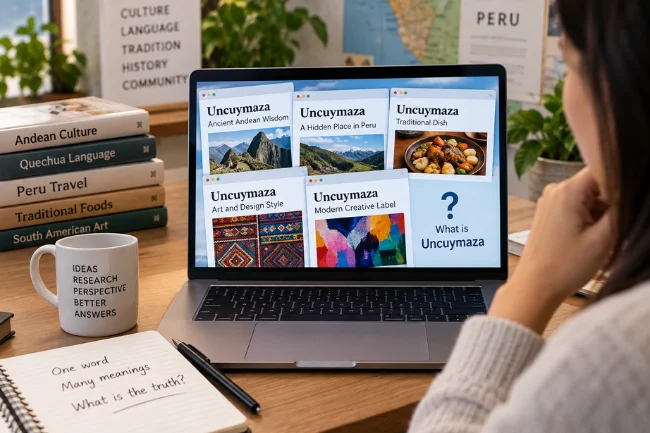
Rare keywords create a particular online environment. When a word has no dominant definition, the first few pages about it can shape what later writers believe it means.
One publisher may offer a cultural explanation. A second repeats it and adds a village, festival, or legend. A third sees both pages and assumes the details have been independently confirmed. Before long, repetition begins to resemble evidence even though every version may lead back to one unsupported claim.
I noticed another force at work: the word sounds as though it could belong to an existing cultural or linguistic setting. That impression makes elaborate origin stories feel believable. Sound, however, is not etymology. Similar-looking syllables do not prove that a complete word belongs to Quechua, Spanish, or any other language.
The uncertainty also makes Uncuymaza commercially flexible. It could function as a brand, fictional location, game element, art project, username, collection name, or community label. A newly coined word can be useful precisely because it has little existing baggage.
Is Uncuymaza a Real Word?
Yes, in the limited sense that people are writing, publishing, and searching for it. No, if “real” is meant to imply a settled dictionary definition or verified traditional origin.
Language is not controlled by dictionaries alone. Words can begin as inventions, errors, nicknames, product names, or online expressions. If a community adopts one consistently, the term may eventually gain a recognizable meaning. That process is called lexicalization: a new form becomes an accepted word through repeated, shared use.
Uncuymaza has not yet reached that clear stage. Its online appearances point in several directions, and no single community appears to control its meaning. For now, it is better described as an unattested or weakly attested emerging term rather than a standard lexical item.
That wording matters. “Not verified” does not mean “impossible,” and absence from a database does not prove that nobody has ever spoken or written the word. It means the available evidence is not strong enough to support a confident historical claim.
Is Uncuymaza a Quechua or Andean Term?
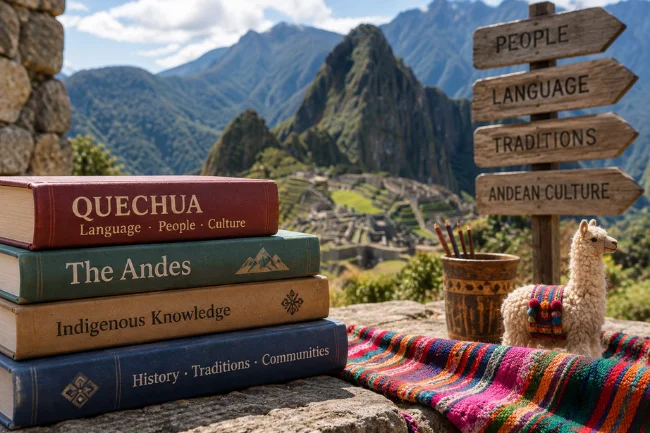
The Quechua explanation is one of the most repeated claims, but repetition alone cannot establish linguistic origin.
Quechua is not a single uniform variety spoken identically throughout the Andes. It is a language family with regional varieties and different written conventions. A serious etymology would therefore need to identify the relevant variety, region, spelling, component morphemes, pronunciation, and documented context.
A convincing case would include several forms of support:
- An entry in a credible Quechua dictionary or lexical database
- Examples from dated texts or recorded speech
- Confirmation from speakers in a named region
- A defensible breakdown of the word’s components
- Independent treatment by a linguist, historian, or Indigenous cultural authority
I did not find that evidence attached to the common online explanations. Instead, broad ideas such as harmony, healing, wisdom, land, and community are often attributed to the term without identifying who uses it or where the definition originated.
Those themes may genuinely matter in particular Andean communities, but attaching them to an unverified word can flatten many distinct peoples and traditions into a single marketable image. Responsible writing should name the community and source whenever it makes a cultural claim.
Could Uncuymaza Be a Place, Food, or Art Form?
Each interpretation needs a different kind of proof. Treating them as interchangeable is one reason the search results become confusing.
A Place in Peru
Some descriptions frame Uncuymaza as a secluded Peruvian destination with ruins, a central plaza, walking routes, colonial buildings, festivals, or galleries. Those details sound travel-ready, but a real destination should leave a geographic trail.
Before planning a visit, I would look for coordinates, a municipal jurisdiction, transport information, local accommodation listings, official maps, and references from people who live nearby. A poetic travel article is not enough to establish that a town exists under a particular name.
A Traditional Food
The middle of the word resembles “cuy,” the common Spanish name for guinea pig in the Andes. That resemblance may explain why some writers connect Uncuymaza with Andean cuisine.
It does not prove that the entire expression names a recognized dish. Verification would require the exact term in regional menus, culinary archives, cookbooks, oral histories, or interviews with cooks from a clearly identified area. Without that evidence, the food interpretation should be labeled speculation.
An Art and Design Label
The art interpretation is more plausible as a modern use. New creative movements and product collections often adopt distinctive invented names. Online descriptions associate Uncuymaza with geometric patterns, woven textures, earthy colors, natural materials, symbolic imagery, and visual storytelling.
Those elements already appear in many unrelated traditions and contemporary styles, so they do not define a movement by themselves. To establish Uncuymaza as an art category, I would expect to find artists who use the label, dated works, exhibitions, a shared statement, and informed discussion of cultural influence.
Using Indigenous-inspired aesthetics also brings responsibilities. Designers should credit specific sources, avoid copying sacred or community-owned symbols, and seek collaboration where appropriate rather than presenting a newly invented label as ancient heritage.
A Digital or Creative Identity
This is currently the least historically demanding interpretation. Uncuymaza can be used as a project name, fictional concept, brand, digital artwork, or online identity without claiming an ancient origin.
The meaning would come from the creator’s stated purpose and later community use. That would make it a contemporary coined term—not proof of a previously undocumented tradition.
My Research Check: What the Public Record Shows
To add a measurable layer to the discussion, I ran exact-term checks on September 21, 2026, rather than relying only on general search-result summaries.
Crossref, a major registry of scholarly publication metadata, returned no matching works for the query. OpenAlex, an open catalog of research works, also returned no results.
| Research check | Result on September 21, 2026 | What the result does and does not show |
|---|---|---|
| Crossref bibliographic query | Zero works returned | No indexed scholarly record was found; this does not cover every book, archive, or oral tradition |
| OpenAlex works search | Zero works returned | No research work was found in that index; it is not proof that the term has never been used |
| Review of competing web definitions | Multiple incompatible meanings | The term has online visibility, but repetition does not establish a common origin |
| Evidence attached to cultural claims | Usually absent or secondary | The claims need primary linguistic, historical, or community documentation |
This is a small but useful finding. A term presented as an established ancient concept would normally be expected to leave some trace in linguistic, historical, anthropological, or regional scholarship. The lack of an indexed result weakens confident academic claims, though it cannot settle the question by itself.
The most valuable missing evidence is still an attributable first use. An archived webpage, dated social post, published manuscript, trademark application, or creator statement could show when the spelling appeared and what it originally meant. Until that record surfaces, any precise creation story remains a hypothesis.
How to Judge New Claims About Uncuymaza

New explanations will probably continue to appear. I use five tests to decide whether one deserves confidence.
Identify the Earliest Traceable Source
Look past pages that repeat one another. Find the oldest dated occurrence you can verify, then ask whether it gives evidence or merely makes an assertion.
Ask What Kind of Claim Is Being Made
A language claim needs linguistic evidence. A location claim needs geographic evidence. A cultural claim needs community or historical documentation. A brand claim may need only a creator and a documented launch.
Check for Independent Corroboration
Ten pages repeating the same sentence are not ten sources. Reliable corroboration should come from records or experts that do not depend on the original page.
Watch for Excessive Specificity
Invented accounts often supply vivid details—an exact ritual, hidden village, ancient translation, annual festival, or traditional recipe—without naming a primary source. Specificity is useful only when it can be checked.
Distinguish Inspiration From Provenance
A modern artwork may be inspired by Andean textiles while its title is newly invented. Both facts can coexist. The mistake is turning influence into a false claim of historical authenticity.
What Uncuymaza May Become
Uncertain origin does not make the word useless. Its future meaning will depend on how people use it and whether one interpretation becomes dominant.
If a creator launches a project called Uncuymaza and clearly defines the name, that becomes a documented modern use. If artists collectively adopt it for a recognizable approach, it could develop into a creative label. If researchers later uncover a historical attestation, the linguistic assessment should change with the evidence.
This is how living language works: meanings are negotiated through use. The responsible position is not to freeze the word forever as “fake,” but to describe its current status accurately and update the record when better documentation appears.
Anyone planning to use the name commercially should also check trademarks, domain availability, social handles, and possible conflicts in the relevant country. A rare search term is not automatically free of legal or reputational risk.
A Responsible Definition to Use Today
The following definition captures what can presently be said without manufacturing history:
Uncuymaza is an emerging and ambiguously defined internet term associated with several modern cultural, artistic, geographic, and creative claims. No single meaning or historical origin has yet been established through widely recognized linguistic, scholarly, or primary-source evidence.
That definition leaves room for future discoveries while protecting readers from false certainty. It also separates three questions that are too often blended together: whether a term is used, what people currently mean by it, and where it historically came from.
Frequently Asked Questions
What does Uncuymaza mean?
Uncuymaza has no universally verified meaning. It is currently used online for several unrelated cultural, artistic, and creative ideas.
Is Uncuymaza a Quechua word?
No reliable dictionary entry or linguistic documentation has yet established Uncuymaza as a recognized Quechua word.
Is Uncuymaza a real place in Peru?
Online pages may describe it as a destination, but the location should not be treated as verified without official records, coordinates, and independent local sources.
Is Uncuymaza a traditional Andean dish?
The exact name has not been convincingly documented as a traditional dish; its resemblance to “cuy” is not enough to prove a culinary origin.
Did artificial intelligence create Uncuymaza?
That is a plausible theory, but no original prompt, model output, or dated creation record currently proves it.
Final Takeaway
Uncuymaza is best understood as an emerging term with competing online meanings, not as a verified ancient word, destination, recipe, or tradition. Its story is still developing, and the next credible source could change what we know.
If you encounter an older document, a dictionary entry, a mapped location, or a first-hand community source using the exact spelling, compare its date and provenance with the evidence above. That is the most useful next step toward giving Uncuymaza a history grounded in records rather than repetition.

Midori Michael is an independent digital content research writer with 8+ years of experience creating well-researched articles on digital marketing, business, technology, and lifestyle topics. She focuses on simplifying complex information through accurate research and clear editorial writing.