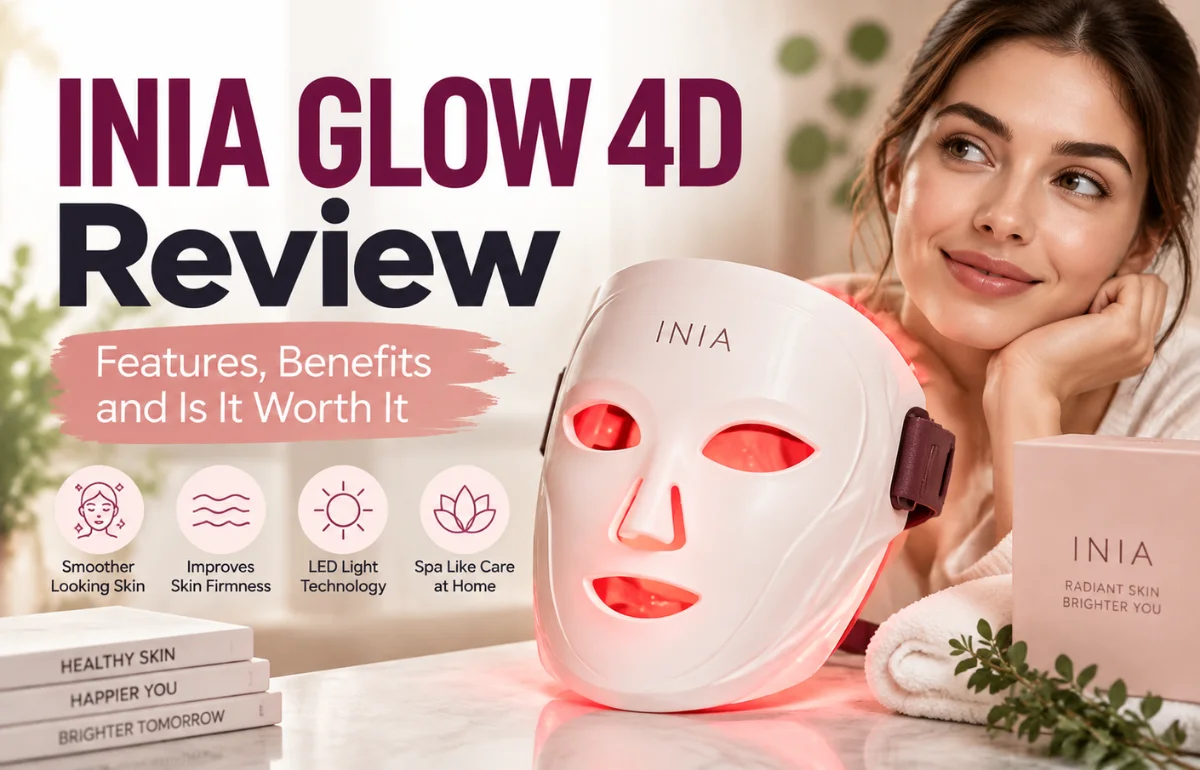
INIA GLOW 4D is a wireless LED face mask designed for home skincare treatments. It combines LED light with two near-infrared wavelengths, 850nm and 940nm, and includes a contoured lower-face section and magnetic cooling pads. The device is marketed for concerns such as fine lines and skin firmness. This red light mask belongs to the broader category of home light-therapy devices.
My INIA GLOW 4D review examines its specifications, practical appeal, limitations and alternatives. I reviewed the available product information and supporting research, but I have not worn or independently tested the device.
That distinction matters when deciding what to buy. I can assess the design and buying conditions; I cannot tell you that this mask reduced my wrinkles.
My Quick Verdict
I would shortlist the GLOW 4D if convenience and purchase price are high on your list. Its strongest buying argument, in my assessment, is the possibility of fitting light therapy into a routine you can actually maintain.
My assessment is more cautious if your decision depends on promises of dramatic lifting or proof that this model outperforms competing masks.
Before buying, I want three things settled: whether the fit works for my face, what evidence supports the exact model, and whether the return conditions allow a meaningful trial. Those questions matter more to me than a large discount percentage.
For a makeup option focused on concealing fine lines, see my Maybelline Instant Age Rewind Eraser Treatment Makeup guide.
What Stands Out About the Design?
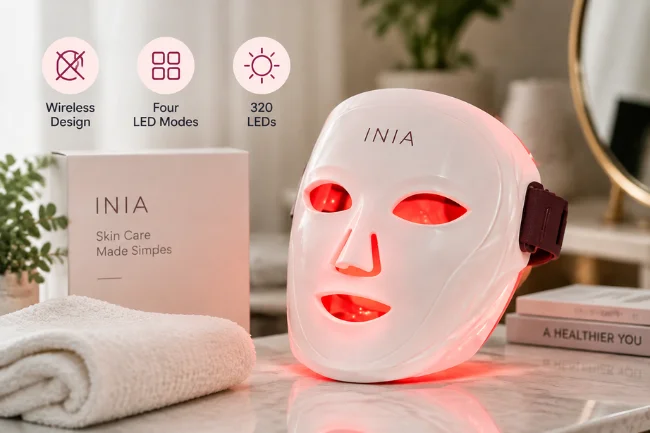
The manufacturer lists cordless operation, four LED modes and 320 LEDs. Inia also sells other beauty devices, so check the complete model name when comparing listings: GLOW 4D and GLOW Wireless are different products.
Wireless Use Could Remove a Daily Annoyance
A separate controller is another object to position, carry and put away. For someone who dislikes cables around their face, an integrated design could make the purchase more appealing.
My practical question is whether that convenience survives daily use. How often does the battery need charging? Can the controls be identified easily while wearing it? Is cleaning straightforward?
I have not measured battery life or handling, so those details need checking rather than inferring from promotional photographs.
Face Fit Deserves More Attention Than Styling
I pay attention to how a mask sits around the nose, cheeks and mouth before getting excited about its appearance.
My fitting checklist includes comfortable breathing, stable positioning and room to adjust the straps without creating pressure. Another useful question is whether opening your mouth or turning your head shifts the mask.
A product photograph shows one face at one angle. Demonstrations on several face shapes and clear dimensions provide more useful buying information than another close-up of illuminated LEDs.
If previous masks have pressed against your nose or slipped around your chin, make fit your first purchasing question.
Cooling Is a Separate Buying Consideration
The cooling accessory interests me as a comfort feature. Its preparation, attachment, cleaning and replacement requirements belong in the buying decision.
There is also a simpler question: will you use it? An accessory that adds preparation time may appeal to someone who enjoys a longer evening routine, while another buyer may prefer fewer parts.
I assess comfort and clinical performance separately. Enjoying a treatment is valuable, but it does not establish how much a wrinkle or pigmentation concern will improve.
What the Light-Therapy Research Actually Supports
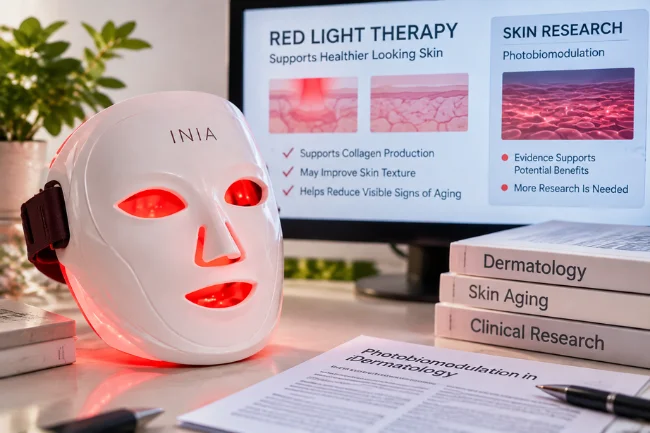
Red-light therapy, also called photobiomodulation, uses red or near-infrared light. The American Academy of Dermatology describes potential improvements in several signs of skin aging, while emphasizing that outcomes vary and further research is needed. Dermatologists may use it alongside other treatments.
There is research behind the treatment category. A controlled study published in 2014 reported improvements in skin roughness, appearance and measured collagen density after repeated treatments. However, it investigated different light sources, not the GLOW 4D.
I read that as a reason to take light therapy seriously, with a clear limit: it does not establish the effectiveness of every consumer mask.
For a stronger product-specific assessment, I want a report identifying the exact device, treatment settings, participant characteristics, comparison group and measurement methods. Before-and-after pictures alone leave several questions unanswered.
Does 940nm Automatically Make a Mask Better?
I would not choose a mask solely because its wavelength number is higher.
A scientific review of photobiomodulation parameters explains that treatment outcomes depend on multiple variables, including wavelength, power density, energy density, session duration and repetition. Differences in those parameters can contribute to inconsistent results.
In plain English, a wavelength tells you something about the light being used. It does not provide the complete treatment specification.
My follow-up questions are:
- What is the measured light output at the skin?
- What dose does the recommended session deliver?
- How evenly is that output distributed?
- Which settings were used in the product’s supporting study?
These questions establish what I need before accepting a claim of superior performance. A convincing answer should connect the device’s specifications with evidence about the intended skin concern.
Advantages and Limitations I Would Weigh
My assessment is positive about the concept, with reservations about what can be established without testing.
The potential advantages are practical: fewer external components to manage, attention to lower-face fit, and a purchase price worth comparing with established alternatives.
The limitations are equally relevant. I cannot verify comfort across face shapes, long-term battery performance or individual skin results from a sales page. I also have not verified an independent head-to-head study showing this mask produces better outcomes than the alternatives below.
That leaves a reasonable middle position. It is a candidate for further checking, rather than an automatic winner.
When a seller cannot answer a question, I record that as an unknown. Missing information is not automatically evidence of a fault, but it can still affect whether I am comfortable spending my money.
Three LED Face Masks Worth Comparing
I selected these options to compare purchasing priorities: wireless convenience, a simpler red-and-near-infrared setup, and a model with a third listed wavelength. This is a research-based shortlist, not a ranking from personal testing.
Specifications come from the manufacturer pages discussed here. They describe design differences, not equivalent treatment doses or guaranteed outcomes.
1. INIA GLOW 4D: My Convenience-Focused Candidate
I would investigate this option first if managing a separate controller would discourage me from using a mask.
That is a personal selection criterion, not a claim of stronger skin results. My next checks would be the current instructions and how the trial policy applies to an opened, normally used unit.
2. Omnilux Contour Face: A Focused Alternative
Omnilux lists red and near-infrared light, with ten-minute treatments and a rechargeable controller connected to the mask. Its suggested initial schedule is three to five sessions weekly for four to six weeks.
This option makes sense to investigate if you prefer a focused treatment format and do not mind the controller. I would not reject it simply because another mask advertises more wavelengths.
3. CurrentBody Skin Series 2: Another Lower-Face Option
CurrentBody lists three wavelengths, ten-minute sessions, a chin section and a clip-on controller. Its page also provides study information that a buyer can examine beyond the headline claims.
I would compare the actual study conditions with my intended routine. The presence of research is useful, but it does not make unlike devices interchangeable or establish a direct victory over INIA.
Model names matter here too. CurrentBody also markets a Series 3; the specifications above refer specifically to Series 2.
Price and My Cost-Per-Session Calculation
When checked on September 14, 2026, the GLOW 4D page displayed $209.99 before a promotional coupon. Prices and promotions can change.
I find cost per completed session more useful than the crossed-out retail price. The following calculation uses $209.99 and excludes tax, shipping, electricity and any future replacement costs.
These are budgeting scenarios, not treatment recommendations or predicted device lifespan. Follow the schedule supplied with your particular unit.
The purchase becomes harder to justify if it sits unused. Before ordering, I would choose a realistic weekly slot and consider whether preparation and cleanup fit that slot.
I would also write down what improvement would make the expense worthwhile to me. That prevents a low per-session figure from becoming an excuse to keep using something that provides no meaningful benefit.
The Return Policy Needs a Closer Read
When I checked INIA’s return policy, I found details that deserve attention before purchase.
It describes a 90-day guarantee for official-site purchases, requires prior approval and original packaging, and generally makes the customer responsible for return shipping unless the issue concerns product quality. It also excludes items with clear signs of use while recommending a period of use before assessing results.
That wording leaves a practical question: how does the company distinguish acceptable trial use from disqualifying signs of use?
My next step would be to ask support for written clarification before ordering. Confirm when the deadline starts, and keep the packaging.
This is not a prediction that a return will be refused. It is a way to establish the buying conditions before depending on them.
How I Would Build a Sensible Routine
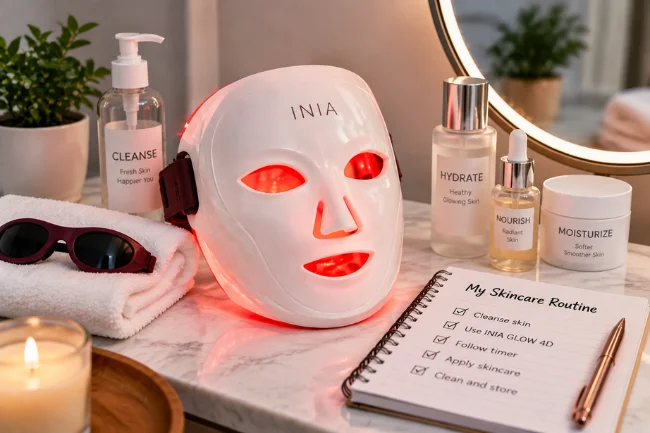
INIA’s usage guidance says to identify the exact model, begin with clean, dry skin, follow the prescribed mode and timer, and apply leave-on skincare afterward unless the instructions allow otherwise. Cleaning and eye-protection requirements should follow the supplied manual.
For planning, I would make the routine easy to repeat: keep the approved accessories together, allow time for cleaning and choose a point in the evening when I am not rushing.
Avoid borrowing settings from another mask or extending sessions to compensate for missed days. The same guidance advises against stacking modes unless the instructions specifically permit it.
How I Would Track Whether It Is Worth Keeping
My starting point would be baseline photographs and a written record of one or two concerns. Otherwise, it is easy to keep changing the definition of success.
For each comparison photograph, keep the room, lighting, camera position, facial expression and time of day as consistent as possible. Avoid filters and record changes to other skincare products.
My notes would cover completed sessions, comfort and visible changes. Reviewing them before the return deadline would help me decide whether to keep the device.
This is a personal tracking method, not a clinical experiment. It can support a clearer ownership decision without turning ordinary photographs into scientific proof.
I would also record practical frustrations. A device can look promising on paper and still be inconvenient enough that I stop reaching for it.
Who Should Get Advice Before Using It?
The AAD recommends discussing home red-light treatment with a dermatologist, particularly for people whose conditions or medicines increase light sensitivity. It also highlights pigmentation concerns for darker skin tones and the need to follow eye-protection instructions.
INIA’s guidance advises stopping for unexpected heat, marked irritation or visual symptoms. Persistent symptoms need professional advice.
If my main concern were a diagnosed skin condition, I would ask which treatment is appropriate before selecting a device. A product review cannot answer that individual medical question.
My Final Assessment
The INIA GLOW 4D deserves consideration if its design suits your routine and the price fits your budget. My interest rests on usability and purchase value; I want stronger model-specific evidence before making confident promises about results.
Before ordering, read the current instructions, clarify the return conditions and compare the features you will actually use. Those checks will tell you more about whether it belongs in your routine than a glowing testimonial.
Frequently Asked Questions
Does INIA GLOW 4D really work?
Light therapy has supporting research, but I have not independently verified this mask’s effectiveness. Individual results cannot be guaranteed.
How often should I use INIA GLOW 4D?
The product page suggests three to five sessions weekly. Follow the current instructions supplied with your exact model.
How long does INIA GLOW 4D take to show results?
The brand advertises changes within several weeks, but that is not a personal deadline. Assess your response without extending the prescribed treatments.
Can I apply skincare before using the mask?
Start with clean, dry skin unless your manual specifies a compatible product. Apply leave-on skincare afterward as directed.
Is INIA GLOW 4D worth buying?
I would consider it if the fit, routine and return terms suit you. Its specifications alone cannot establish whether you will see worthwhile results.
Disclaimer
This article shares research-based information and product details for general guidance. I have not personally tested INIA GLOW 4D, and results may vary by individual. Consult a skincare professional for personal advice.

Mia Anderson is a skincare writer with 8 years of experience creating practical, research-informed content about skincare routines, skin health, ingredients, and everyday self-care habits. She focuses on helping readers understand skincare choices through simple explanations and realistic routines while encouraging professional advice for specific skin concerns.