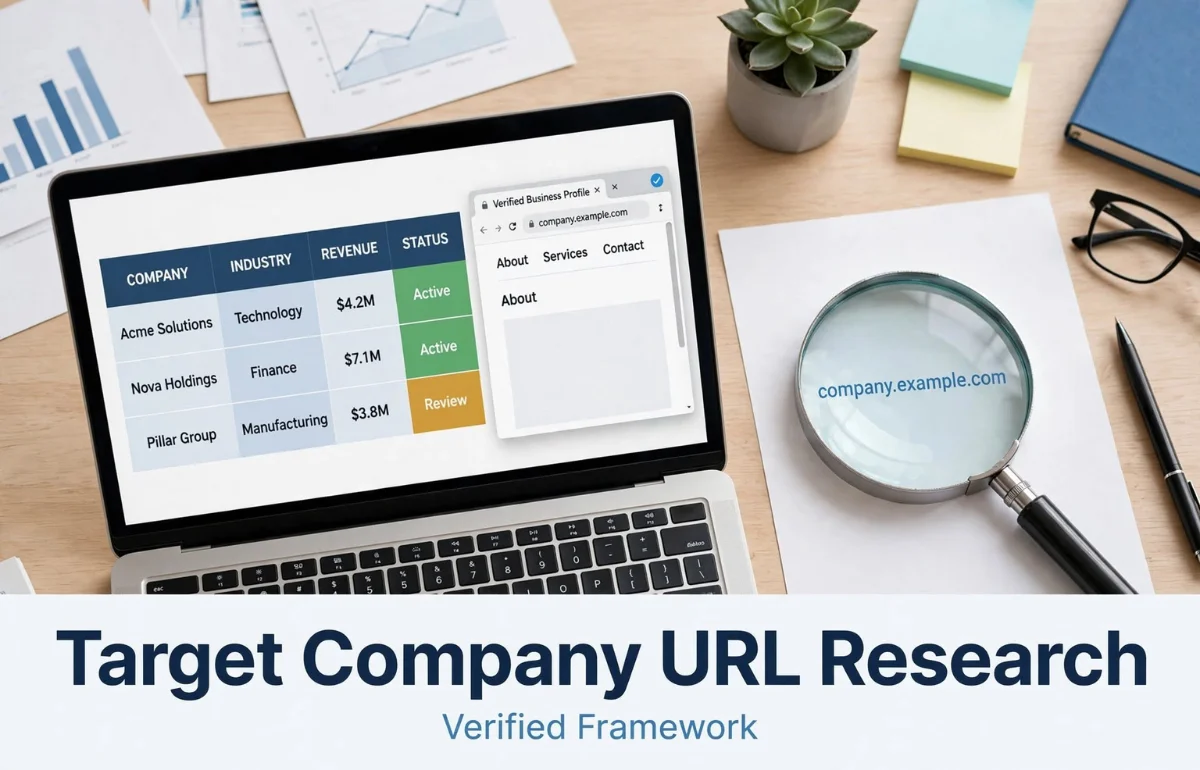
Target company URL research is the process of finding a business’s official website and confirming that it belongs to the organization you intend to research. It connects a company name with a verified web address by checking identifying details such as location, products, legal identity, and corporate relationships.
If you have a spreadsheet of prospective customers, employers, suppliers, or competitors, this research helps you attach the correct website to each record. A matching name is only a starting point: unrelated businesses can share names, and familiar brands can operate through several domains.
I recommend treating each result as a decision you can explain. Save the website, record the evidence behind the match, and leave uncertain cases open until you have enough information.
Decide What a Correct Result Looks Like
Before searching, write down what you need the URL for. That choice determines whether you should save a corporate homepage, a local business website, or a specific department’s page.
For sales prospecting, you may need the domain of the business unit that buys your service. For recruitment, you may need its careers page. For competitor analysis, you need the site serving the market you actually compete in.
I would keep these three concepts separate:
- Company: the organization or legal entity you are researching.
- Domain: an internet name such as
example.com. - URL: a complete address such as
https://example.com/uk/careers/.
A parent company and its subsidiary can share a website. One company can also have several websites. Treating the domain as a unique company identifier can therefore create duplicate records or incorrectly merge distinct businesses.
Prepare Company Names Without Losing Useful Evidence

Start with the original company name, country, and any known city or industry. Assign each row a record ID so you can reconnect results after sorting, exporting, or processing a batch.
Create a separate search-name column. Remove unnecessary spaces, correct confirmed spelling errors, and try a shorter trading name when the full legal name produces weak results.
Keep the original name intact. Words such as “Limited” or “GmbH” may be unnecessary in an initial search, but the complete legal name can help resolve an ambiguous match later.
Avoid merging records merely because their names look alike. Two branches may require separate sales records, while two differently spelled entries may represent the same business. Decide what counts as a duplicate before deleting anything.
For international research, retain the local-language name alongside its English version. An English transliteration may differ from the wording used on the company’s own website.
Find Candidate Websites Efficiently
For a small list, begin with the company name and its location. Add the industry or a distinctive product when results are ambiguous.
Useful searches include:
- Company name + city + official website
- Company name + country + product
- Full legal name + contact
- Local-language company name + location
Quotation marks can help when you need an exact phrase, but try an unquoted version too. The business may publish under a shortened name.
Search results, business directories, company profiles, and trade association listings can all suggest candidates. Record the source of each suggestion; finding the same address in several copied directories does not necessarily provide independent confirmation.
For larger lists, consider a company-domain lookup service, spreadsheet add-on, or enrichment API. Start with a small sample that includes obscure businesses and difficult names before committing your entire database.
Manual Research vs. Automated Lookup
I would choose a method based on the effort required to produce correct records. A fast lookup that creates hours of corrections may be a poor fit for your project.
Verify the Business Behind the Website
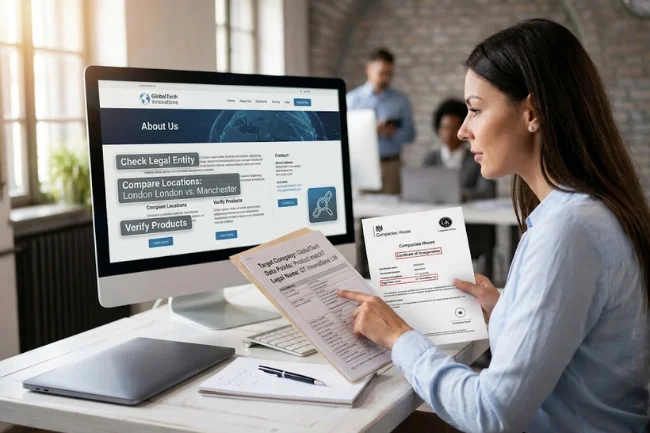
The central task in target company URL research is establishing the connection between an organization and a candidate domain.
Compare Several Identity Details
Open the website and compare its business name, location, products, and contact information with what you already know.
Read the About page for background and the legal pages for the operating entity. Look for a company number where one is published. Check whether the products actually match the business you intended to find.
An address difference needs investigation, but it does not automatically disqualify a candidate. A registered office, warehouse, and trading address may be different locations.
Corroborate the Match Outside the Candidate Site
Several pages on one website can repeat the same incorrect claim. I recommend finding corroborating evidence through a source already connected to the intended company.
For example, a relevant corporate registry can help you check legal identity. In the UK, Companies House provides information including registered addresses, previous company names, and filing documents.
Those details help establish which company you mean. They do not automatically prove that every website displaying them belongs to that company.
For unresolved cases, consider a parent company’s established website, an official corporate announcement, or confirmation through contact details you already trust. Keep the evidence link with your decision.
Use Domain Registration Data as Supporting Context
The Registration Data Access Protocol, or RDAP, provides access to current domain registration data. ICANN’s RDAP overview explains how the protocol works. I would use registration information as supporting context rather than make it my only ownership test.
A domain’s registration history cannot, by itself, establish that its current website represents your target business. Similarly, an attractive design or familiar logo needs corroboration.
Set Clear Rules for Accepting a Match
I recommend using written decision rules before reviewing a large batch. Otherwise, “verified” can mean something different for every person working on the file.
Here is a suggested framework, not an industry certification standard:
A tool’s confidence score can help prioritize review. Before interpreting it, check whether it measures name similarity, database matching, or something else.
Unless the provider explains and validates the score as a probability, a value of 95 should not be read as a proven 95% chance of correctness.
An Illustrative Example: Resolving a Similar Company Name

Imagine researching a fictional business called Cedar Lane Packaging Limited, described in your source file as a Leeds-based food-packaging supplier.
You find three candidates: a packaging supplier serving Leeds, an overseas design studio with a similar name, and a directory page displaying the exact legal name.
I would reject the design studio once its location and services establish that it is a different business. I would use the directory as a lead, then investigate the supplier’s own website.
Suppose its product pages match food packaging, its contact page matches the known trading location, and its legal information matches the intended entity. Next, seek corroboration of the website connection through an established company source or trusted contact channel.
The final research note should explain the decision: which identity details matched, where supporting evidence was found, and when the check occurred.
If the legal identity remains unclear, keep the candidate under review. An empty accepted-URL field is more useful than an unsupported match that appears finished.
Handle Regional Websites, Rebrands, and Shared Platforms
Global and Regional Addresses
A global homepage and a country-specific page can both be correct. Save the primary corporate address and the relevant regional URL in separate fields when your project needs both.
For example, a UK recruitment project may need the UK careers page even when the company’s main domain serves a worldwide audience.
Be careful when extracting domains automatically. Public suffixes include structures such as co.uk, so taking only the last two parts of a hostname can produce the wrong result. A maintained suffix-aware parser is preferable for bulk processing.
Rebrands and Redirects
When an old address redirects, investigate the destination before replacing the record. Look for an announcement explaining a rename, acquisition, or website move.
Keep the previous address and the evidence for the change. If the brand continues operating independently after an acquisition, its own website may still be the relevant result.
Careers Platforms and Hosted Websites
An external careers platform can legitimately host a company’s vacancies. Follow the careers link from the verified company website and save the destination separately from the employer’s domain.
A small business may also use a hosted page rather than its own domain. Preserve the full address; the platform’s main domain alone will not identify that business.
If no official website can be established, record that outcome without claiming the company does not exist. A failed website lookup and a closed business are different findings.
Build a Research Record Someone Else Can Check
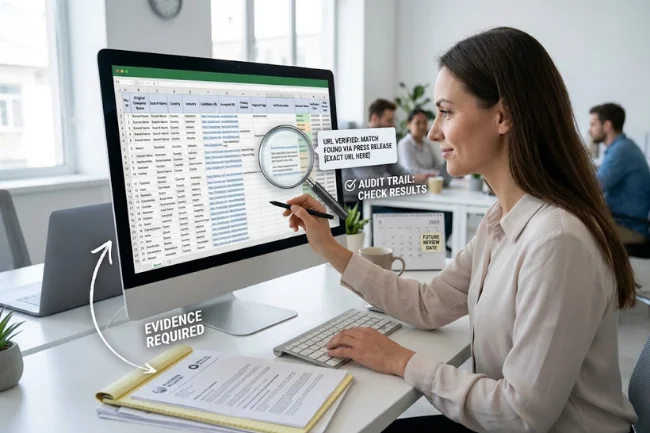
For target company URL research to remain useful, the spreadsheet needs to explain how each result was obtained.
I recommend these fields:
- Record ID and original company name
- Search name, country, and industry
- Candidate URL and accepted website URL
- Primary domain and relevant regional page
- Parent company or subsidiary relationship
- Evidence URL and short verification note
- Decision status, reviewer, and verification date
- Previous URL and next review date, when relevant
Keep website availability separate from identity verification. A previously verified domain may temporarily fail to load, while a working website may belong to the wrong company.
Also preserve exact evidence URLs. A homepage link alone may be insufficient when your decision depended on a particular announcement or legal page.
Measure Bulk Research Quality Beyond Match Rate
A tool that fills nearly every row can look impressive. The useful question is how many of those completed rows point to the intended businesses.
I recommend assessing three measures:
- Coverage: the proportion of input records receiving a candidate.
- Sample precision: the proportion of reviewed candidates confirmed correct.
- Usable yield: the proportion of all input records ending with an accepted result.
Consider an illustrative batch of 100 companies. A service returns 90 candidates, and manual review confirms 72 as correct. Its coverage is 90%, its reviewed-candidate precision is 80%, and its usable yield is 72%.
Those figures answer different questions. Record unresolved cases separately so reviewers can see where further research might improve the result.
For larger projects, review a random sample of apparently strong matches as well as ambiguous results. Checking only flagged cases can miss confident mistakes. Treat sample findings as estimates, not guaranteed accuracy for every unreviewed record.
Use AI for Organization and Evidence Review

AI can assist with tasks such as organizing names, comparing supplied details, and drafting concise verification notes. I would keep its instructions tied to evidence you can inspect.
A useful instruction is: compare the target company’s known identity with the candidate website, cite supporting pages, identify contradictions, and return “unresolved” when evidence is insufficient.
Require the system to distinguish information it actually retrieved from information it inferred. A suggested address without an accessible supporting source should remain a candidate.
For a production workflow, preserve tool errors and failed lookups instead of silently replacing them with guesses. This makes retries and human review much easier.
Turn Verified URLs Into Useful Business Research
Once identity is established, choose the next research task deliberately. For sales, inspect products, customer segments, and expansion announcements to understand potential fit.
For digital marketing, use the verified competitor domain to investigate content coverage, keyword opportunities, and relevant partnerships. Keep company identification and performance analysis as separate tasks so assumptions in one do not contaminate the other.
For recruitment, record the appropriate careers destination and geographic hiring scope. For supplier research, confirm which entity and location provide the product you need.
I would also set review dates according to how the information will be used. Recheck priority records before an important campaign, and investigate new redirects, conflicting company details, or inaccessible websites when they arise.
Start With Ten Companies You Can Verify Carefully

Good target company URL research produces a usable address and a clear reason to trust the match. Its value comes from accurate identity decisions, consistent records, and visible uncertainty.
Choose ten companies from your next project. Find their candidate websites, apply the same verification rules, and record your evidence. Use what those cases reveal to improve the process before expanding to a larger list.
Frequently Asked Questions
How do I find a company’s official website?
Search its name with its location or industry, then corroborate the candidate website using business identity details and an established source connected to the company.
Can I find company website URLs in bulk for free?
Some services offer limited free lookups. Check current allowances and export options, and verify returned candidates before treating them as final results.
How do I get company URLs into Excel or Google Sheets?
Use a compatible enrichment add-on or export a company list for bulk lookup, then import results while preserving record IDs and verification fields.
What should I do when two companies have the same name?
Compare country, city, products, legal identity, and corporate relationships. Leave the match unresolved if those details do not distinguish the intended business.
Does finding a company website prove the business is legitimate?
No. Identifying a website establishes a narrower connection; it does not establish the business’s reliability, financial health, or suitability as a supplier or employer.

Ethan Caldwell is a business research writer with 9+ years of experience covering entrepreneurship, market trends, business strategies, and industry insights. He focuses on creating clear, data-informed articles that help readers understand modern business concepts.