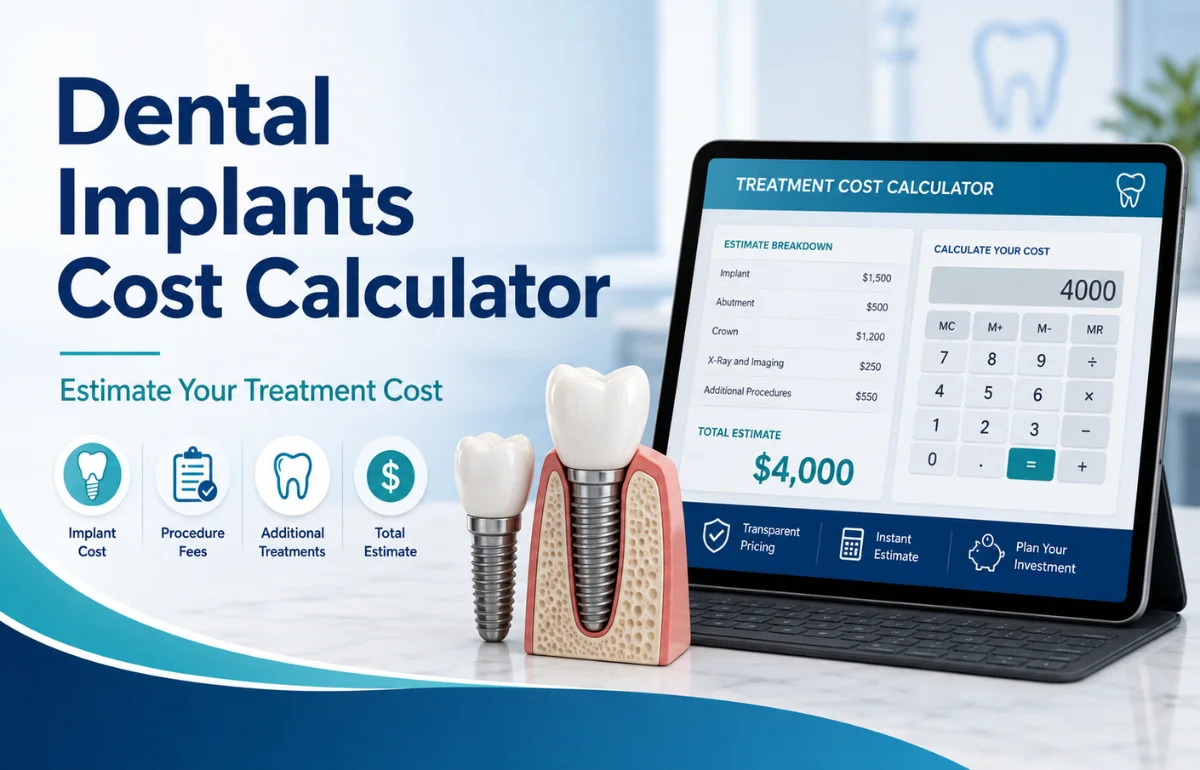
A Dental Implants Cost Calculator is an online budgeting tool that estimates what dental implant treatment may cost before you receive a formal clinical quote. It combines the number of missing teeth, treatment type, implant components, preparatory procedures, location, insurance benefits, and financing choices to produce a realistic price range.
A useful calculator estimates the complete restoration—not only the implant post—so it should account for the implant body, abutment, crown or denture, imaging, extractions, grafting, sedation, and follow-up care. I use the result as a planning figure rather than a diagnosis because only an examination and dental imaging can confirm what a patient needs. The FDA also describes an implant system as multiple connected parts and warns that individual anatomy and health conditions affect treatment risk.
How a Dental Implants Cost Calculator Works
Most calculators start with a base fee and add the services associated with the case:
Estimated cost = implant treatment + diagnostics + preparatory care + sedation + temporary teeth + final restoration + follow-up fees − expected insurance benefit
An advertisement may use “implant” to mean only the post placed in the jaw. A complete single-tooth restoration usually includes that post, an abutment connecting it to the replacement tooth, and the crown.
Delta Dental places the consumer cost of an individual implant without dental benefits at about $2,800 to $5,600. It also says the typical price includes surgical placement, supporting structures, and the crown.
Cost Inputs a Reliable Calculator Should Request
| Calculator input | What it changes | Why it matters |
|---|---|---|
| Number of teeth or arches | Implant and restoration fees | One tooth is priced differently from a bridge or full arch |
| Post, abutment, and crown | Complete restoration cost | A low advertised fee may cover one component |
| X-rays or CBCT imaging | Diagnostic costs | Planning must account for bone, nerves, and sinuses |
| Extraction or grafting | Surgery, materials, and healing time | The treatment site may need preparation |
| Sedation | Medication and monitoring fees | Local anesthesia and IV sedation have different costs |
| Temporary teeth | Interim restoration cost | Some packages include them; others do not |
| Insurance and network status | Out-of-pocket cost | Deductibles, maximums, and negotiated fees apply |
| ZIP code | Local fee assumptions | Prices vary among U.S. markets |
Average Dental Implant Costs in the United States
A cost calculator should show a range rather than one impressive-looking number. Published estimates differ because providers do not always include the same services.
Delta Dental reports $2,800 to $5,600 for an individual implant without benefits. A 2026 provider guide reports approximately $5,000 to $7,500 for a single tooth, $8,000 to $13,500 per arch for implant dentures, and $14,000 to $36,000 per arch for a fixed full-arch restoration. The provider notes that additional required dentistry may cost extra.
| Treatment type | Broad U.S. planning range | Commonly included |
|---|---|---|
| Single-tooth implant | $2,800–$7,500 | Post, abutment, and crown, depending on the quote |
| Implant-supported denture | $8,000–$13,500 per arch | Multiple implants and a removable denture |
| Fixed full-arch teeth | $14,000–$36,000 per arch | Implants, provisional teeth, and a fixed prosthesis |
| Full-mouth fixed restoration | $28,000–$72,000 | Upper and lower arches before possible add-ons |
These are budgeting ranges, not guaranteed prices. Complex extractions, grafts, gum treatment, premium materials, or deeper sedation can move a case above the table.
Costs People Commonly Leave Out
The weakness I see in basic implant calculators is that they count teeth but ignore the condition of the treatment site. Two people replacing the same tooth may receive different estimates because one has enough healthy bone and the other needs additional care first.
Diagnostic Records and Planning
The first phase may include an examination, panoramic imaging, CBCT scanning, digital impressions, photographs, or a surgical guide. Some practices bundle these services; others list them separately.
A calculator should ask whether diagnostics are included. Otherwise, an estimate can appear cheaper simply because planning fees are missing.
Extractions, Bone Grafts, and Sinus Procedures
A damaged tooth may require extraction. When the jaw lacks adequate bone, the clinician may recommend grafting or another site-development procedure.
An online form cannot diagnose this. I prefer calculators that display both “no graft expected” and “graft may be required” totals so the reader sees a realistic low and high scenario.
Final Tooth Materials and Temporary Teeth
Crowns and full-arch prostheses may use different materials, and laboratory complexity affects price. A temporary acrylic restoration is not the same product as a final zirconia restoration.
Ask whether the quote includes temporary teeth, the permanent prosthesis, its material, and any later conversion fee.
Sedation and Separate Providers
Some patients receive local anesthesia only; others use oral or IV sedation. The case may also involve a restorative dentist, periodontist, oral surgeon, and dental laboratory.
Separate offices can issue separate bills, so every provider should appear in the estimate.
A Better Way to Calculate Out-of-Pocket Cost
The treatment fee and the amount a patient pays are not the same number. I recommend calculating three outputs:
- Expected treatment total
- Upper planning total
- Estimated first-year out-of-pocket cost
The upper total should include uncertain items such as grafting, sedation upgrades, and provisional teeth. The first-year figure should account for insurance benefits, account funds, deposits, and financing charges.
Sample Single-Tooth Calculation
Suppose a complete implant, abutment, and crown is estimated at $4,200. The plan also includes a $350 extraction, $900 bone graft, and $300 diagnostic package.
The expected total is $5,750.
If the dental plan is expected to contribute no more than $1,500, the simplified out-of-pocket estimate is $4,250. The actual figure can change after allowed fees, deductibles, coinsurance, exclusions, and annual maximums are applied.
A good Dental Implants Cost Calculator should label this as an estimate and never present an insurance payment as guaranteed.
How Dental Insurance Changes the Estimate
Dental implant coverage varies widely. The American Dental Association identifies annual maximums, preexisting-condition restrictions, and cost-containment rules as common limitations. Delta Dental also advises patients to check deductibles, waiting periods, network status, and whether their plan covers implants.
Before trusting the result, enter information from the current plan document or insurer’s pre-treatment estimate:
- Annual maximum remaining
- Coverage percentage for surgery and prosthetic services
- Rules for the implant, abutment, and crown
- Missing-tooth or preexisting-condition clauses
- Waiting periods and network restrictions
- Replacement-frequency limits
- Exclusions for grafting, imaging, or sedation
Original Medicare generally does not cover routine dental services or items such as dentures and implants, although limited dental care may be covered when closely connected to certain covered medical treatment. Medicare Advantage benefits vary by plan.
HSA, FSA, Tax, and Financing Considerations
Dental treatment and artificial teeth may qualify as medical expenses under IRS rules, while cosmetic-only procedures are treated differently. IRS Publication 502 includes X-rays, extractions, dentures, artificial teeth, and other treatment for dental disease.
It also says only unreimbursed expenses above 7.5% of adjusted gross income may count toward the federal itemized medical deduction.
HSA and FSA eligibility depends on the expense and account rules. Keep the itemized plan, receipts, explanation of benefits, and proof of payment, then confirm eligibility with the plan administrator or a tax professional.
Financing changes cash flow, not the underlying treatment price. Add origination fees and total interest to the calculator, and check what rate applies after any promotional period.
How to Compare Two Implant Quotes Fairly
I never compare implant estimates by looking only at the bottom line. I normalize them first.
Place both quotes beside one checklist. Confirm that each includes the same treatment area, number of implants, abutments, temporary teeth, final restoration, material, extractions, grafts, sedation, imaging, surgical guide, follow-up care, and warranty terms.
Is the Quote per Implant, per Tooth, or per Arch?
One implant can support one crown, several bridge teeth, or part of a full arch. The pricing unit must match.
Does the Price Include the Permanent Restoration?
A surgical fee without the final crown or prosthesis is not a complete comparison.
Are Possible Add-Ons Listed With Prices?
A transparent estimate identifies optional and conditional services instead of leaving them as unknown charges.
Who Handles Complications and Maintenance?
Dental implants can restore chewing and help preserve surrounding structures, but complications may include infection, nerve injury, tissue injury, loosening, and implant failure. The FDA notes that some complications require another surgical procedure.
Ask what follow-up care is included and what happens financially if a component needs repair or replacement.
The Confidence Range Most Calculators Are Missing
A single number creates false certainty. I would rather see a calculator assign a confidence level:
- High: Examination and 3D imaging completed; itemized plan available
- Medium: Treatment type known, but grafting or material remains uncertain
- Low: Estimate based only on the number of missing teeth
This tells readers how much trust to place in the output. It separates early research from a clinically informed budget.
Another useful feature is a payment timeline. Implant care often spans multiple appointments, so a calendar can show likely payments for diagnostics, surgery, temporary teeth, and the final restoration. Delayed payment should never be mistaken for a lower total.
When a Calculator Is Useful—and When It Is Not
A Dental Implants Cost Calculator is useful for setting a savings target, comparing treatment categories, preparing insurance questions, and spotting incomplete promotional prices.
It cannot determine whether an implant is appropriate, how many implants are needed, whether grafting is required, or which material is best. Those decisions require a licensed clinician, an examination, medical history review, and appropriate imaging.
Use the calculator before the consultation, then replace its assumptions with the itemized treatment plan afterward.
Frequently Asked Questions
How Much Is One Dental Implant in the United States?
A complete single-tooth implant commonly falls within a broad planning range of about $2,800 to $7,500, depending on what the quote includes and whether extra procedures are needed.
Does Dental Insurance Pay for Implants?
Some plans contribute, while others exclude implants or limit payment through deductibles, waiting periods, annual maximums, and missing-tooth clauses.
Are Bone Grafts Included in Implant Prices?
Sometimes, but not always. Ask for an itemized quote showing whether grafting, materials, imaging, and follow-up care are included.
How Much Do Full-Mouth Dental Implants Cost?
A broad estimate for fixed treatment on both arches is roughly $28,000 to $72,000 before additional procedures, based on reported per-arch pricing.
Is an Online Dental Implant Calculator Accurate?
It can produce a useful budget range when the inputs are detailed, but only an examination and imaging can confirm the final treatment and price.
Plan With a Range, Then Get an Itemized Quote
The best calculator does not promise one perfect price. It shows what is included, identifies uncertain add-ons, estimates insurance conservatively, and gives both an expected and upper planning total.
Use a Dental Implants Cost Calculator to prepare for the conversation, then request a written plan covering procedure details, provider fees, insurance estimates, payment timing, and follow-up responsibility. That turns a rough online number into a budget you can use.

Daniel Reed is a dental health writer with 6 years of experience creating clear, research-informed content about oral hygiene, gum care, preventive habits, and everyday dental wellness. He focuses on making reliable information easy to understand while encouraging readers to seek professional dental care for diagnosis and treatment.