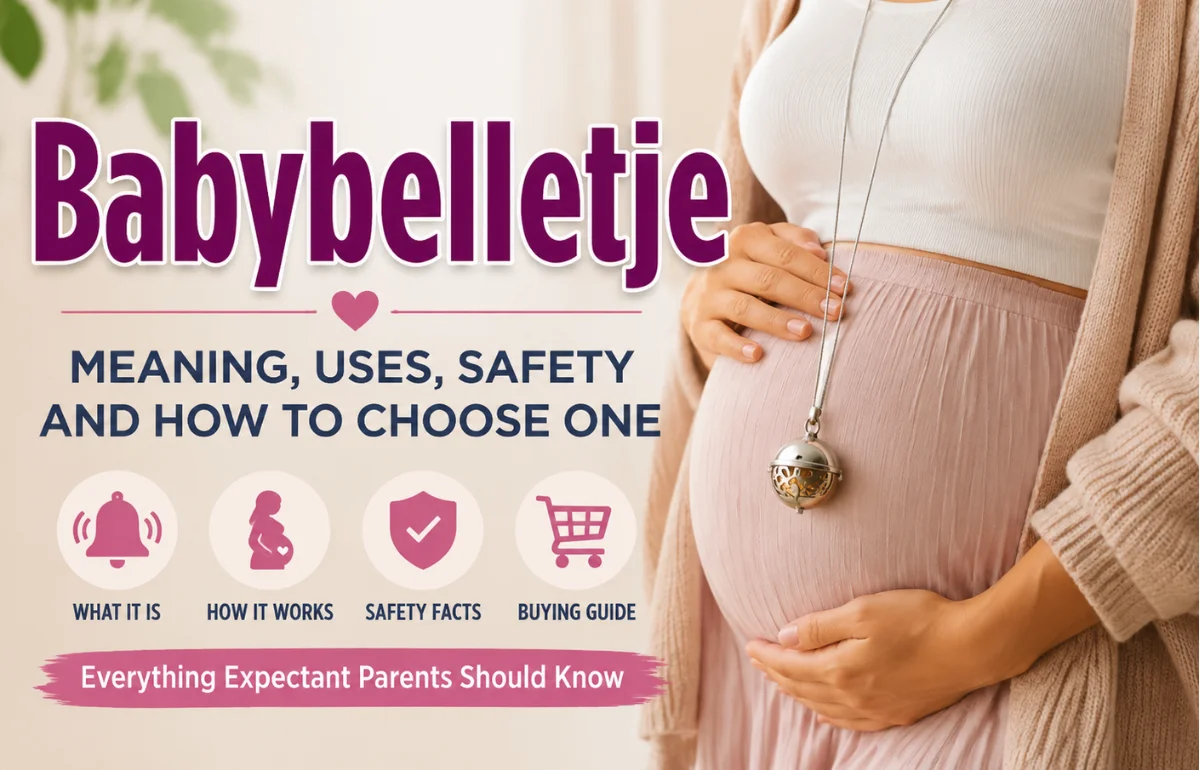
A Babybelletje is a long pregnancy necklace with a small pendant that makes a gentle chiming sound as the wearer moves. The pendant usually rests low on the abdomen, which is why it is also called a pregnancy bell, pregnancy bola, harmony ball, baby bell, or zwangerschapsketting. Many expectant parents wear one as a symbol of connection with their unborn baby and as a reminder to slow down during pregnancy.
The idea is simple: movement produces a soft, repeated sound. A fetus begins responding to sound during the second half of pregnancy, so some sellers claim the chime becomes familiar before birth. That is possible in a general sense, but there is no strong clinical evidence that a Babybelletje reliably calms a newborn, improves development, or influences fetal position. I treat it as meaningful jewelry and a bonding ritual, not as a medical device.
What Does Babybelletje Mean?
The word is Dutch in form. “Bel” means bell, while “belletje” is its diminutive form: a little bell. In online use, Babybelletje generally refers to a pregnancy necklace containing a softly chiming pendant, although sellers may use the term differently.
It is not connected to Mini Babybel cheese. The similar spelling causes confusion, but the products are unrelated.
A typical design combines a long chain or textile cord with a hollow pendant and a small internal ball or chime. The pendant is normally positioned over the lower part of the baby bump, where it can move freely without pressing into the abdomen.
Babybelletje, Bola, and Harmony Ball: Are They Different?
Shops use several names for similar jewelry. The differences usually involve branding, styling, or cultural storytelling rather than a completely different function.
| Term | Usual meaning | What to check |
|---|---|---|
| Babybelletje | Dutch-style name for a small pregnancy bell | Whether the pendant contains a working chime |
| Zwangerschapsketting | General Dutch term for a pregnancy necklace | It may be symbolic jewelry without a bell |
| Pregnancy bola | Long necklace with a chiming ball pendant | Material, length, and whether the ball is sealed |
| Harmony ball | Decorative chiming pendant, also sold outside pregnancy | Size, tone, and intended use |
| Angel caller | Spiritual or gift-oriented name for a chiming pendant | Treat protection claims as symbolism |
I would not choose one based on the name alone. Measurements, materials, construction, and safety information matter more than a romantic label.
How Does a Babybelletje Work?
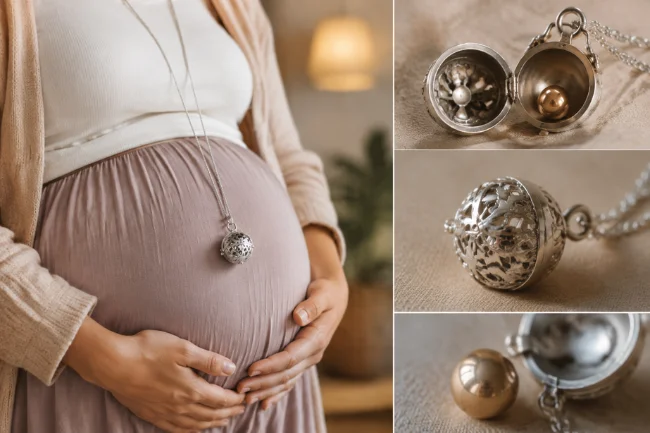
Inside the pendant is a loose component that touches or rolls against another surface. That movement creates a light ringing or chiming sound. Some pendants contain a ball inside a metal shell; others place the chime inside a decorative cage.
The sound should be subtle—audible to the wearer in a quiet room without resembling a loud handbell. For many people, its most realistic benefit is as a mindfulness cue. It can prompt the wearer to pause, breathe, touch the bump, or notice an ordinary moment.
Can a Baby Hear a Babybelletje in the Womb?
A fetus’s ears develop gradually. The CDC states that the ears are developed by about 20 weeks and that fetuses begin responding to sounds at around 24 weeks. Outside sounds are reduced and filtered before reaching the womb rather than heard with the same clarity as they are in the room.
A baby may therefore be exposed to some sound from a Babybelletje later in pregnancy, but no one can promise exactly what the fetus hears. The pendant’s volume, pitch, position, clothing, maternal tissue, movement, and stage of pregnancy all affect transmission.
Lower-frequency sounds generally travel through the body more effectively than high-frequency sounds. A delicate, high-pitched chime may be more muffled than marketing descriptions suggest. Research shows that repeated prenatal speech or music can create measurable memory effects, but that does not prove a small jewelry chime produces the same result.
What the Evidence Supports
- Hearing and responses to sound develop during the second half of pregnancy.
- The womb does not block every outside sound.
- Repeated auditory patterns can sometimes be remembered after birth.
- A familiar routine may be emotionally valuable to the parent.
What Has Not Been Proven
- That every fetus can clearly hear the pendant
- That it reliably calms a newborn
- That it improves intelligence, hearing, sleep, or development
- That a baby will move toward the bell or become breech because of it
I would be cautious with sellers using words such as “guaranteed,” “scientifically proven,” or “instant calming.” The product can be meaningful without exaggerated claims.
Why Do People Wear a Babybelletje?
A Personal Pregnancy Ritual
Pregnancy contains appointments, purchases, worries, and physical changes. A small daily ritual can create continuity. Some people touch the pendant when they feel movement, take a quiet breath when it chimes, or wear it during an evening walk.
I see the necklace as a prompt rather than a treatment. It cannot replace prenatal care, but it can turn ordinary movement into a moment of attention.
Symbolic Meaning
Designs often feature trees, moons, hearts, stars, flowers, wings, birthstones, or family initials. One wearer may associate the sound with protection, while another sees it as a record of a particular pregnancy.
Claims about ancient Mayan, Indonesian, Balinese, or Celtic origins are common online, but the historical trail is often poorly sourced. Responsible content should separate documented history from legend.
A Pregnancy Gift
A Babybelletje can work as a baby-shower or maternity gift because it recognizes the pregnant person, not only the future baby. It is less dependent on size, sex, nursery theme, or season than baby clothing.
Include a small card explaining the sound and meaning, while describing soothing benefits as traditional or anecdotal rather than guaranteed.
When Should You Start Wearing One?
There is no medical start date because it is jewelry, not a prenatal treatment. Some people wear it as soon as they receive it. Others begin around 20 to 24 weeks, when fetal hearing and responses to sound are developing more clearly.
Wear it for as long as it feels comfortable. During later pregnancy, adjust the cord so the pendant sits naturally over the lower bump without pulling on the neck.
Normal movement is enough to produce the sound. Deliberately shaking the pendant against the abdomen adds no proven benefit.
How to Choose a Good Babybelletje
A useful product page should provide exact specifications instead of relying on phrases such as “premium quality.”
| Feature | A practical choice | Why it matters |
|---|---|---|
| Length | Adjustable cord or chain, often around 100–120 cm | Accommodates a changing bump |
| Material | Clearly identified metal with nickel information | Helps people with sensitive skin |
| Construction | Securely closed or firmly assembled | Reduces the chance of loose parts |
| Sound | Soft and pleasant during normal movement | You may hear it throughout the day |
| Weight | Light enough for daily wear | Heavy pendants can pull on the neck |
| Finish | Smooth edges and durable plating | Limits snagging and premature wear |
| Seller details | Measurements, care, returns, and contact information | Signals accountability |
Material Matters
Silver, stainless steel, gold plating, brass, and textile cords are all commonly used. Plated jewelry may wear more quickly when it is exposed to moisture, perfume, skin products, or repeated friction.
“Hypoallergenic” is not a full material description. If you react to nickel or other metals, look for the actual composition and ask the seller when details are missing.
Listen Before You Buy
Because sound is the defining feature, an audio or video sample is more useful than a poetic description. A louder chime is not necessarily better, especially in an office, car, waiting room, or quiet home.
Try to listen through ordinary phone speakers as well as headphones. A recording will not sound exactly like the pendant in person, but it can help you avoid a tone you find sharp, tinny, or distracting.
Check the Cord and Clasp
An adjustable textile cord is flexible, while a metal chain may look more formal. Inspect the clasp, knots, jump rings, and pendant loop.
The necklace should not catch easily on zippers, handles, exercise equipment, or household objects. Remove it when the activity creates a snagging risk.
Is a Babybelletje Safe During Pregnancy?
For most adults, wearing a well-made pregnancy necklace is a low-risk activity. Practical concerns include skin sensitivity, broken components, snagging, excess weight, and misleading health claims.
It should not replace medical advice, fetal-movement guidance, scans, or hearing assessments. Contact a midwife or obstetric clinician when you have concerns about your pregnancy.
There is also no good evidence that wearing the pendant too high causes breech presentation. Babies change position for many reasons, particularly before the later stages of pregnancy. Claims that they will simply follow the sound of the bell should not be treated as medical guidance.
Be Careful With Aromatherapy Pendants
Some versions contain pads or porous stones for essential oils. “Natural” does not automatically mean suitable during pregnancy. NHS guidance advises discussing aromatherapy products with a midwife, doctor, or pharmacist because not every remedy is safe, and some maternity services restrict direct essential-oil exposure in early pregnancy or with certain medical conditions.
Do not let undiluted oil touch the skin through the pendant. Stop using a scented insert if it causes nausea, headache, wheezing, irritation, or dizziness.
Can You Use It After the Baby Is Born?
You can continue wearing it as adult jewelry, but a long necklace should not become an infant necklace or unsupervised toy. Do not place it around a baby’s neck, attach it to sleepwear, hang it in a cot, or leave it within reach during sleep.
The FDA and American Academy of Pediatrics warn that jewelry worn by infants can create choking and strangulation hazards. A Babybelletje is not the same as a teething necklace, but cords and detachable jewelry parts present similar physical risks around babies.
Some parents wear the pendant during supervised feeding. Keep the chain controlled, and stop if the baby grabs, pulls, mouths, or tangles it.
A safer keepsake option is to store it in a memory box, reserve it for adult wear, or pass it on when the child is old enough to use jewelry safely.
Caring for the Necklace
Remove the necklace before showering, swimming, sleeping, or strenuous exercise. Water, sweat, perfume, lotion, and cleaning chemicals can affect plating, cords, stones, or the internal chime.
Wipe it with a soft, dry cloth and follow the maker’s cleaning instructions. Avoid soaking a sealed pendant because moisture may enter the mechanism and change its sound.
Store it dry and separately so the chain does not knot or scratch the pendant. If the tone changes suddenly or the casing becomes loose, inspect it before wearing it again.
Common Babybelletje Myths

One common myth is that the pendant has scientifically proven calming powers. Prenatal sound learning is a genuine field of research, but it does not establish a guaranteed effect for pregnancy-bell jewelry.
Another claim is that the necklace trains the baby’s brain or makes the child more intelligent. There is no sound evidence for that promise.
You may also read that a particular metal, symbol, or traditional design offers physical protection during pregnancy. Such meanings can be spiritually or emotionally valuable, but they should remain separate from healthcare claims.
The most honest reason to own a Babybelletje is also the simplest: you enjoy its appearance, sound, symbolism, or the small ritual it creates.
A Thoughtful Choice, Not a Medical Promise
A Babybelletje is best understood as pregnancy jewelry with a gentle chime and personal meaning. It may support mindfulness, mark a special period, or become a treasured keepsake. It should not be sold as a guaranteed way to calm a baby or change pregnancy outcomes.
Choose one for its materials, comfort, construction, and sound. Then give it meaning through the way you use it—during a walk, a quiet breathing moment, a weekly bump photo, or another ritual that genuinely suits you.
Frequently Asked Questions
What is a Babybelletje?
It is a long pregnancy necklace with a small chiming pendant that usually rests over the baby bump.
From which week can a baby hear the bell?
Fetal ears develop by about 20 weeks, with responses to sound beginning around 24 weeks, but the exact chime reaching the fetus cannot be guaranteed.
Does a Babybelletje calm a newborn?
A newborn may respond to familiar sounds, but there is no strong evidence that a pregnancy bell reliably calms every baby.
Can a Babybelletje cause a breech position?
There is no good evidence that a pregnancy necklace causes a baby to move toward the sound or remain breech.
Is it safe to put the necklace on a baby?
No. Keep necklaces, cords, and small pendant parts away from infants because they can create choking and strangulation hazards.

Elena Whitmore is a parenting writer with 7 years of experience covering child development, family wellbeing, and everyday parenting. She translates research into practical guidance to help parents strengthen family relationships and support their children’s emotional and physical development.