
Eau Air is a phrase associated with the idea of water and air, especially in fragrance descriptions that suggest freshness, lightness, and an open, clean atmosphere. In French, eau means “water” and air means “air.” However, Eau Air is not an officially defined perfume concentration, a standardized fragrance family, or a universal name for one product.
Depending on the context, someone searching for Eau Air may be looking for an aquatic scent, an airy or ozonic perfume, or two separately named fragrances: EAU and AIR from Free Yourself.
The useful distinction is simple: water-inspired perfumes often suggest coolness and moisture, while air-inspired scents frequently emphasize citrus, greenery, and a feeling of space. Understanding that difference makes choosing a fragrance much easier.
What Does Eau Air Actually Mean?
The words sound like a ready-made perfume category, but they describe an impression rather than an industry standard. I treat Eau Air as a search phrase that needs context, not as a technical label printed on every bottle.
There are three ways to read it. Literally, it combines the French words for water and air. In scent language, it points toward perfumes that evoke sea breezes, rainfall, crisp leaves, or fresh linen.
In a specific product search, it may refer to EAU and AIR, two distinct eau de parfums in the Free Yourself Elements Collection.
This distinction matters because a perfume called AIR can still be an eau de parfum, and a fragrance named EAU does not necessarily contain more water or smell like plain water.
The naming describes a creative direction; the concentration describes a different aspect of the formula.
Also, do not confuse the phrase with air-to-water machines, air-and-water treatment companies, or French heating systems described as air/eau. Those are separate topics that happen to share similar words.
What Does an Eau Air-Style Fragrance Smell Like?
No two airy perfumes smell exactly alike. The common thread is a sense of transparency: the fragrance feels breezy or refreshing rather than dense, syrupy, or heavily spiced.
But that impression can come from several different fragrance families.
Aquatic and Marine Notes
An aquatic perfume might suggest rain on stone, a cool lake, sea spray, or damp air near the coast. Perfumers build these effects with accords, which are combinations of materials designed to create one recognizable impression.
Aquatic does not automatically mean salty. Some compositions are watery and floral; others suggest melon, mineral surfaces, or a sharper marine breeze.
The Perfume Society groups aquatic and ozonic fragrances within the broader fresh family, noting that synthetic aroma materials are often used to recreate environmental impressions.
Ozonic and Airy Notes
“Airy” is more about texture than a single ingredient. Think of the difference between standing in a crowded room and opening a window.
An ozonic accord may create a similarly spacious sensation through bright, cool, slightly metallic, or clean-smelling facets.
An airy perfume does not necessarily smell like the actual atmosphere. Ordinary air has no single signature fragrance; what we recognize as “fresh air” depends on nearby trees, rain, soil, seawater, and countless other environmental cues.
Citrus, Green, and Soft-Musky Notes
Citrus creates an immediate lift. Lemon, grapefruit, and bergamot can make the opening sparkle, while petitgrain and galbanum introduce leafy, bitter-green complexity.
Vetiver contributes a dry, grassy or woody character that stops freshness from becoming too simple.
| Scent Direction | Typical Impressions | Who May Enjoy It |
|---|---|---|
| Aquatic or marine | Cool water, sea breeze, mineral freshness | People who want a watery or coastal feel |
| Ozonic | Open air, rain-washed atmosphere, spaciousness | People who prefer abstract, clean scents |
| Citrus-green | Grapefruit peel, crushed leaves, herbal brightness | People who like crisp, energetic perfumes |
| Fresh floral-musk | Light blossoms, clean skin, soft woods | People who want gentle everyday freshness |
These are useful shopping descriptions, not rigid categories. One bottle may combine all four.
Eau vs. Air: A Real Fragrance Comparison
For a concrete example, Free Yourself sells EAU and AIR as separate unisex perfumes in its Elements Collection.
According to the brand, both are eau de parfums formulated at 20% fragrance concentration, but their published notes tell different stories.
| Detail | EAU Eau de Parfum | AIR Eau de Parfum |
|---|---|---|
| Opening notes | Grapefruit, lemon, pink pepper, bergamot | Grapefruit, lemon, green notes, galbanum |
| Heart notes | Petitgrain, blackcurrant, gardenia, orange blossom, aquatic notes | Cardamom, ginger, vetiver, lavender |
| Base notes | Musk, amber, white woods | Amber, musk, solar notes, moss |
| Overall character suggested by the notes | Watery, floral, gently fruity | Citrusy, green, aromatic, subtly warm |
| Likely preference | A softer, floral-aquatic mood | A sharper, herbal, breezy mood |
The note lists come from the brand’s official perfume notes page. The overall descriptions are my interpretation of those lists, not the results of a laboratory analysis or a hands-on wear test.
EAU: Water Interpreted Through Flowers
EAU pairs bright citrus with pink pepper before moving toward blackcurrant, gardenia, orange blossom, and an aquatic accord.
That structure suggests a fragrance with more floral body than someone might expect from a water-themed name.
Its musk, amber, and white-wood base is designed to provide softness after the brighter opening fades.
I would shortlist this style for someone who enjoys polished, fresh florals but does not want an overtly sugary perfume.
AIR: Freshness With a Green Edge
AIR starts with citrus and galbanum, then introduces ginger, cardamom, lavender, and vetiver.
Those materials suggest a more herbal, brisk direction. Amber, musk, moss, and solar notes add a warmer background.
How Perfume Notes Create the Feeling of Water and Air
The fragrance pyramid is a practical way to read a perfume description.
Top notes form the first impression, heart notes shape the central character, and base notes become more prominent as the scent develops.
The Opening Is Not the Whole Fragrance
A grapefruit-forward perfume may smell dazzling for the first few minutes, then turn floral, woody, or musky.
That is not a fault; it is part of the composition. Citrus materials often feel especially noticeable at first because many evaporate relatively quickly.
I recommend looking beyond the first three listed notes.
If you love citrus but dislike mossy or amber-heavy finishes, examine the base before ordering a large bottle.
A Note Is Not Always a Literal Ingredient
A list that says “sea breeze” does not mean seawater was poured into the bottle. Likewise, “solar notes” describe a warm, sunlit effect rather than one universally defined raw material.
Some impressions are created through several ingredients acting together.
The familiar watermelon effect of calone is a good example of how perfumery can suggest something recognizable without using the object itself.
Understanding this prevents a common shopping mistake: treating a marketing note list as a complete chemical formula.
The Dry-Down Decides Daily Wearability
A perfume can feel wonderfully fresh in the store but become too powdery, sharp, or musky later.
The opposite can happen too: a challenging green opening may settle into a pleasant clean-wood finish.
For an everyday scent, I pay particular attention to the hour after application.
That stage often tells me more about how the fragrance will fit a routine than the first spray does.
Is Eau Air the Same as Eau de Parfum or Eau de Toilette?
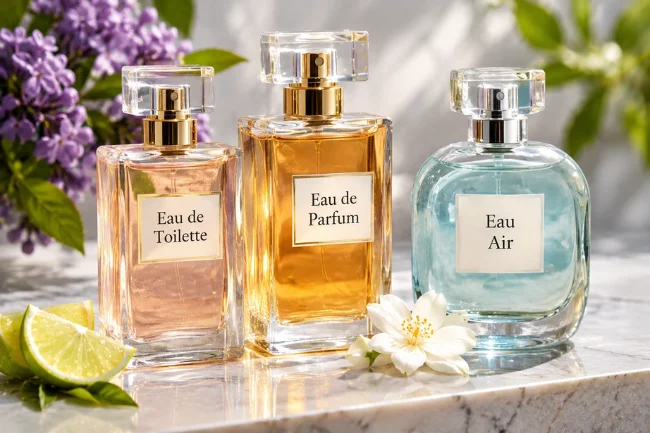
No. Eau Air describes an idea or possible search term; eau de parfum (EDP) and eau de toilette (EDT) are established concentration labels.
They refer broadly to the amount of aromatic concentrate in a fragrance solution, although brands vary in how they formulate and label their products.
An EDP is not automatically heavier or sweeter than an EDT.
A skillfully blended citrus-green EDP can smell more delicate than an intensely projecting EDT. Equally, concentration alone cannot promise a particular number of hours on skin.
When comparing fresh perfumes, I would consider three separate questions: What does it smell like? How far does it project? How long does it remain noticeable?
Those answers overlap, but they are not interchangeable.
The Perfume Society’s concentration guide explains the usual fragrance-strength distinctions and why the compositions can vary between versions.
This matters especially when a brand offers both EDT and EDP versions of a similarly named fragrance.
How to Choose an Airy Perfume That Actually Suits You
Start With Your Preferred Kind of Freshness
If you picture cool water and a quiet shoreline, start with aquatic accords, airy florals, and soft musk.
If you imagine citrus trees after rain, explore grapefruit, bergamot, petitgrain, and leafy green notes.
For a crisp, tailored effect, try vetiver, lavender, and light woods.
Avoid assuming that “blue” packaging guarantees an aquatic fragrance. Bottle color and campaign photography are not reliable substitutes for the composition.
Test It on Paper, Then on Skin
A blotter is helpful for eliminating scents you plainly dislike.
Skin testing matters more before purchase, because the fragrance develops in the warmth of your body and mixes with its natural scent environment.
Try one perfume on each wrist, follow the brand’s usage directions, and give each several hours.
Resist testing too many fragrances at once; after repeated smelling, your perception can become less reliable.
Step away between evaluations rather than spraying more to chase the opening.
Use a Simple Four-Point Wear Check
Instead of rating a sample by whether it smells “nice,” I suggest writing down four observations:
- Opening: Is the first impression citrusy, watery, green, floral, or sharp?
- After an hour: Does the heart remain pleasant, or has a distracting note emerged?
- Personal scent bubble: Is the fragrance noticeable only close to skin, or does it fill shared space?
- Later wear: Do you still enjoy the base, and does it suit the occasion you had in mind?
This small record makes comparison more dependable than memory alone.
It also distinguishes a scent that is easy to admire in a shop from one you would genuinely want to wear.
Match the Scent to the Setting
For work, shared transport, classrooms, or other close-contact environments, a restrained application is considerate.
A softer aquatic-floral or skin-musk profile may suit someone who wants understated freshness, but any perfume can be disruptive if oversprayed.
How Long Do Fresh and Airy Perfumes Last?
There is no trustworthy universal wear time for an “Eau Air” fragrance.
Longevity depends on the formula, your skin, the amount applied, weather, clothing, and how you perceive the scent over time.
If longevity matters, I recommend testing a sample during an ordinary day rather than relying on a single online claim.
Check after commuting, working, and spending time outdoors.
Ask a trusted person whether it is noticeable at a normal conversational distance; your own nose may become accustomed to it.
Applying fragrance to comfortable, moisturized skin can help some scents persist.
Unscented lotion is a sensible option, but avoid spraying irritated skin.
Do not assume more sprays always mean better performance; they may simply make the perfume intrusive.
Are Eau Air-Style Perfumes Safe for Sensitive Skin?
A fresh smell is not proof of a gentler formula.
Citrus, floral, botanical, and synthetic fragrance materials can all cause problems for someone who is sensitive to particular ingredients.
“Natural,” “clean,” and “hypoallergenic” do not guarantee that no reaction will occur.
The International Fragrance Association explains that fragrance allergens can affect susceptible users and that labeling and ingredient restrictions support safer choices.
If you have a known allergy, check the actual ingredient declaration rather than relying on the advertised scent pyramid.
If a perfume causes itching, redness, or burning, stop using it.
For repeated reactions, consult a dermatologist about identifying the trigger. The American Academy of Dermatology notes that fragrance allergy can cause contact dermatitis.
Sensitivity to strong scents is another issue.
Even when someone can tolerate perfume on their own skin, a heavily scented shared environment may be uncomfortable for others.
A light fragrance is not automatically a fragrance-free alternative.
Does an Airy Fragrance Have to Be Natural or Sustainable?
No. Airiness is a sensory effect, not an environmental certification.
Perfumers may use plant-derived extracts, laboratory-made aroma materials, or both to create it.
I would be cautious about judging sustainability from words such as “water,” “nature,” “pure,” or “green.”
Those terms can describe the intended mood without confirming where ingredients come from, how packaging is made, or whether refills are offered.
A more useful checklist is specific: Does the brand disclose bottle materials? Is the packaging recyclable in your area? Are refill options available? Does the company explain its sourcing claims?
Buying a sample first can also prevent an unwanted full bottle from going to waste.
Common Mistakes When Searching for Eau Air
The first mistake is assuming there is one universal perfume called Eau Air.
There may be products using similar language, but the phrase alone does not identify a single, standardized fragrance.
The third is buying solely for an aquatic or sky-blue advertisement.
A marine scent can include sharp synthetic facets, sweet fruit, or prominent white flowers. A green scent may be earthy rather than laundry-clean.
My rule is to read the brand name, exact product name, concentration, note list, and available ingredient information before trusting a search result.
Five minutes of checking can prevent a disappointing purchase.
Final Thoughts
Eau Air is best understood as a water-and-air-inspired fragrance idea, not a formal perfume category.
For a real-world reference, Free Yourself’s EAU leans aquatic and floral, while AIR leans citrus-green and aromatic.
Neither name alone tells you whether the fragrance will suit your skin or preferences.
Start by deciding what “fresh” means to you, compare the heart and base notes, and try a sample across a full day before choosing a bottle.
That simple habit leads to better purchases than chasing a beautiful name.
Frequently Asked Questions About Eau Air
1. What does Eau Air mean in perfume?
It combines the French ideas of water and air and is often used descriptively for fresh, aquatic, or airy scents. It is not a standard fragrance classification.
2. Is Eau Air a perfume brand?
Not necessarily. Free Yourself sells separate fragrances named EAU and AIR, but the combined phrase does not reliably identify one specific brand or bottle.
3. What is the difference between EAU and AIR perfume?
Free Yourself’s EAU features aquatic and floral notes, while AIR emphasizes citrus, green, aromatic, and warm notes. Both are sold as eau de parfums.
4. Are airy perfumes good for summer?
Many people enjoy citrus, aquatic, and green perfumes in warm weather because they can feel refreshing. The right choice still depends on the formula and your preference.
5. Does Eau Air perfume last all day?
There is no universal lasting time for the fragrance. Actual wear depends on the product, concentration, ingredients, skin, and conditions; test a sample to judge it.

Isabella Hart is a beauty and self-care writer with 7 years of experience creating practical content about skincare routines, beauty habits, personal care, and confidence-building practices. She focuses on sharing simple, research-informed guidance to help readers make informed choices and develop routines that support healthy, natural beauty.