Sallena is an uncommon personal name used mainly as a feminine given name in the limited name-directory records available, and it also appears as a family name. Its exact meaning and linguistic origin have not been firmly established. The spelling resembles Salena, Selena, and Selina, but resemblance alone does not prove that all these names share the same history.
Sallena has also appeared in historical surname discussions, although that does not establish a direct connection to every modern bearer.
In practical terms, Sallena is best understood as a rare name with several possible associations, rather than a word with one universally accepted definition.
I find that distinction useful because it gives parents and family-history researchers a more reliable starting point than an attractive but unsupported meaning.
What Does Sallena Mean?
The most accurate answer is that no single, well-documented meaning has been confirmed for the exact spelling Sallena. Some people may associate it with moon-related names because it looks and sounds similar to Selena. Others may encounter it in surname records rather than baby-name lists.
Those are different kinds of evidence. A meaning established for a related name cannot automatically be transferred to Sallena, just as a shared surname spelling does not establish a shared family tree.
I prefer to separate three questions: What does the exact name mean? Which established names does it resemble? And what meaning does a family personally attach to it?
For Sallena, the first remains uncertain, the second has useful clues, and the third can be deeply personal.
Is Sallena Connected to the Greek Word for Moon?
Possibly by modern naming influence, but not by a demonstrated direct etymology.
The ancient Greek name Selene means “moon” and belongs to the moon goddess of Greek mythology. Selena is a Latinized form of Selene, while Salena is described by the name reference Behind the Name as perhaps a modern creation influenced by similar-sounding names.
That makes “moon” a reasonable association to explain, not a verified literal translation of Sallena.
If I were describing this name to someone considering it for a child, I would say it has a sound reminiscent of moon-inspired names, without presenting that connection as fact.
Where Does the Name Sallena Come From?
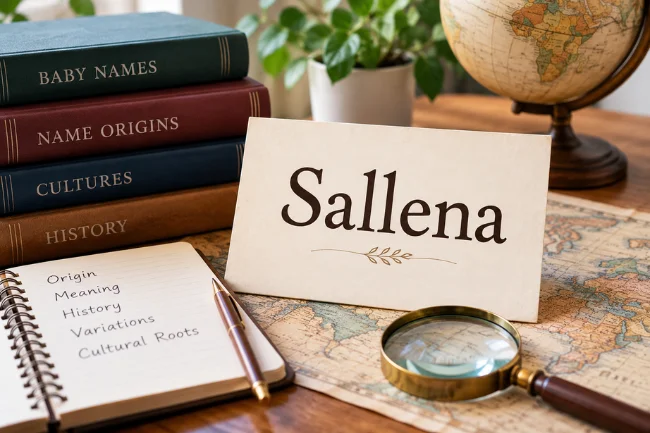
There is no established single birthplace, language, or naming tradition for the modern given name Sallena.
Its construction fits patterns found in several feminine names: an opening “Sal-” sound, a flowing middle, and a final “-a.” Such similarities can arise through family adaptation, creative spelling, regional pronunciation, or independent invention.
A name can develop more than once. One family might adapt Salena by adding another “l”; another might preserve an inherited spelling; someone else might select Sallena simply because they prefer how it looks.
Without dated records linking these decisions, choosing one explanation would be speculation.
This is where rare-name research becomes interesting. The absence of a definitive origin does not mean the name is meaningless. It means the available evidence supports more than one possibility, and the honest answer should keep those possibilities open.
A Possible Historical Roman Spelling Connection
A separate historical thread appears in accounts of the ancient Roman Saliena family, whose name has been recorded under multiple spellings, including Sallena.
These spellings belong to discussions of Roman family nomenclature, not proof that today’s given name descends from that family.
The distinction matters. A spelling used in antiquity and a modern name with identical letters may be historically related, or they may simply coincide.
I would require records connecting generations before calling Sallena an ancient Roman name in the genealogical sense.
Is Sallena a First Name or a Last Name?
It can be both.
The name directory Namespedia reports examples of Sallena as a given name, chiefly identified as feminine in its small indexed sample, and also reports surname occurrences.
These figures describe that site’s collection; they are not a global census of everyone named Sallena.
For surnames, Ancestry has a dedicated Sallena listing with census, vital, immigration, and other indexed records.
Its historical overview mentions a Sallena family in New Jersey in its 1920 United States records. That is evidence of surname use, not evidence that every Sallena family originated in New Jersey.
When researching a person, I would start by identifying which position the word occupies.
“Sallena Morgan” suggests a given name; “Alex Morgan Sallena” may suggest a surname. Even that can vary between cultures, so a complete document is better evidence than a search-result snippet.
How Do You Pronounce Sallena?
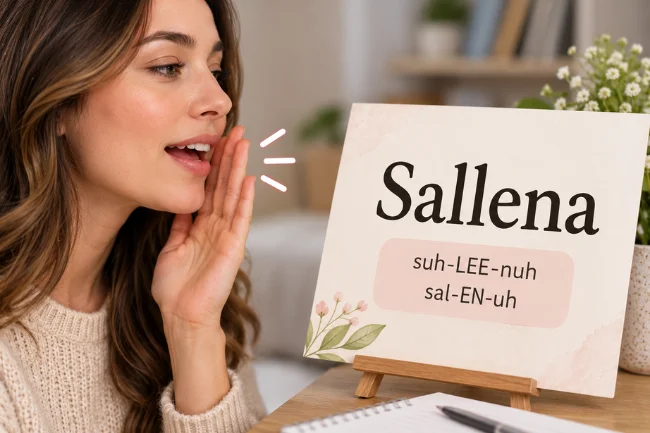
There is no universally documented pronunciation for this uncommon spelling.
English speakers might read it as “suh-LEE-nuh,” influenced by Selena or Salena, or as “sal-EN-uh,” emphasizing the double “l” and the following vowel.
A family may use another pronunciation entirely.
Because names belong to people, I would not declare one reading correct without hearing it from the person or family concerned. Written spelling alone cannot reliably establish stress, vowel quality, or whether the middle consonant feels extended.
The simplest solution is to ask: “How do you pronounce Sallena?” Then repeat the answer naturally rather than continually comparing it with Selena.
For a baby announcement, a short pronunciation note may help relatives learn the chosen reading quickly.
Does the Double “L” Change the Sound?
Not necessarily. In English, doubled consonants often change spelling more than everyday pronunciation.
In other languages, consonant length may matter. Without knowing the family’s linguistic background, neither rule should be imposed on this particular name.
Sallena vs. Selena, Salena, Selina, and Salina
These names look related, but they should not be treated as interchangeable. Some have documented histories; others are modern forms with less certain derivations.
| Name | What Is Established | Main Distinction |
|---|---|---|
| Sallena | Rare given name and surname; exact origin uncertain | Distinctive double “l” spelling |
| Selena | Latinized form of Greek Selene | Documented moon-related origin |
| Selene | Ancient Greek name meaning “moon” | Direct mythological and linguistic link |
| Salena | Modern feminine name; origin uncertain | Similar sound, single “l” |
| Selina | English variant of Celina or Selena | Established historical usage |
| Salina | Feminine name with uncertain naming history in English | Different middle vowel and spelling |
The comparison helps in two ways.
First, it prevents well-meaning relatives or websites from assigning Selena’s etymology to Sallena without evidence.
Second, it gives someone choosing a name a practical view of likely spelling corrections and mistaken searches.
I would treat these as names to compare, not automatically as exact variants of Sallena. A single letter may preserve a meaningful family choice.
How Rare Is Sallena?
The available evidence suggests that Sallena is uncommon, but an exact worldwide popularity rank is not reliably established by the sources reviewed.
Namespedia has only a small number of indexed examples, while Ancestry records show the spelling as a surname. Neither measures every birth or living person around the world.
For United States baby names, the Social Security Administration publishes annual data and lists beyond the top 1,000.
Its public datasets exclude counts below certain privacy thresholds, so a missing entry in a particular year should never be interpreted as proof that no baby received that name.
Why Rarity Figures Can Be Misleading
A baby-name website may count births, a genealogy platform may count document matches, and a name directory may count indexed appearances.
Their totals answer different questions. Even two records might refer to the same person, especially when marriage and census documents overlap.
I pay attention to a figure’s denominator: a count of what, from where, and from which period?
Without those details, a precise-looking “one in a million” claim can be less helpful than the simple statement that a name is rarely encountered.
Why Some Parents May Like the Name Sallena

Sallena offers something that many parents look for: a name that feels familiar in sound without being an everyday spelling.
Its ending aligns with names such as Elena and Selena, while the doubled consonant creates a recognizable visual identity.
I can see its appeal for parents who want a gentle-sounding name that does not require inventing an entirely new sequence of sounds.
It also offers nickname flexibility. Sal, Sally, Lena, and Leni are possible choices, though nicknames are preferences rather than formal rules.
Its uncommonness can be meaningful in a family with several similarly named relatives.
Another parent may want to preserve a grandparent’s spelling or combine familiar sounds from two family names. Those are valid personal reasons, even where no ancient dictionary meaning exists.
There is a trade-off, however.
An unusual spelling may need more frequent explanation at school, over the telephone, or in official records.
A distinctive name is not automatically easier to live with merely because it is memorable.
What to Consider Before Choosing Sallena for a Baby
I would begin with the complete name, not the first name in isolation.
Say Sallena with the intended surname, including any middle names. Check whether the rhythm feels natural and whether neighboring sounds produce an unintended phrase.
Next, decide on pronunciation together.
Parents sometimes assume everyone will stress the same syllable, then discover that grandparents, teachers, and neighbors hear it differently.
There is no problem with an unusual pronunciation, but agreement within the family makes introductions easier.
Then consider spelling.
Because Sallena resembles Selena and Salena, routine corrections may be part of daily life.
Try saying the name aloud and asking someone to write it down. That simple exercise reveals more about likely misunderstandings than a popularity chart.
Finally, check how the name will work through different life stages.
A baby announcement, a school register, a graduation program, and a professional email signature all present the name differently.
Sallena can suit these settings, but choosing it thoughtfully is more useful than calling it perfectly unique.
A Practical Name-Choice Check
| Question to Ask | What It Helps You Assess |
|---|---|
| Can relatives say it as intended? | Pronunciation consistency |
| Will people confuse it with Selena? | Likely spelling corrections |
| Does it flow with the surname? | Everyday rhythm and clarity |
| Is there a family reason for the spelling? | Personal significance |
| Am I comfortable with an uncertain etymology? | Confidence in the choice |
My strongest suggestion is not to let a polished but unsourced name-meaning page make the decision for you.
If a family loves Sallena for its sound, personal associations, or heritage, those reasons are substantial enough without an invented translation.
How to Research Sallena as a Family Name
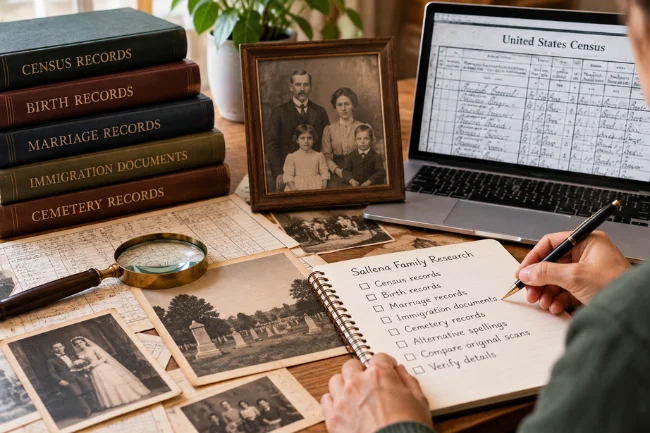
If Sallena is your surname, start with people you can identify rather than a dramatic origin story.
Write down the full names, approximate birth dates, and places associated with parents, grandparents, or older relatives. Then locate documents that connect one generation to the next.
Census returns, birth and marriage records, cemetery inscriptions, immigration documents, and older address directories may help.
Compare original scans with searchable transcriptions whenever possible.
A handwritten double “l” can be mistaken for a single letter, and a hurried indexer may confuse Sallena with Salena or another surname.
Search alternative spellings, but keep them in a separate research column until evidence connects them.
That way, a promising search result does not silently become a false ancestor.
A useful record should match multiple details, such as age, location, household members, and occupation—not just the surname.
I would also look at how the same individual signed their name.
A person’s own signature may tell a different story from the spelling assigned by a clerk. This is especially useful when several documents disagree.
Sallena Has Another Meaning in Pali—But It Is Not a Proven Name Origin
One easily overlooked detail is that lowercase sallena occurs in Pali, a classical language used in Buddhist texts.
It is the instrumental singular form of salla, a noun referring to an arrow, dart, or splinter. In context, that grammatical form can express something like “with an arrow.”
This is a linguistic coincidence worth recognizing because dictionary searches may return it.
However, a Pali word with the same Latin-letter spelling does not establish the meaning of the modern personal name Sallena.
Identical spellings can have entirely unrelated histories.
What Gives an Uncommon Name Its Identity?
For widely documented names, meaning often begins with an old language. For a rare name, meaning may develop through lived family history.
A parent chooses a spelling, a child uses it in different communities, and relatives attach memories to it over time.
I think it is helpful to distinguish etymological meaning from personal significance.
Etymology asks where a name came from linguistically. Personal significance asks why a particular family values it.
The second can be certain even when the first is unresolved.
This also explains why I hesitate to attach fixed personality traits to Sallena.
No name reliably predicts that someone will be creative, gentle, confident, or successful.
Those descriptions may sound appealing in baby-name marketing, but they are not facts about the people who carry the name.
An uncommon name deserves a factual description as much as a popular one does.
Its story becomes more interesting, not less, when the unanswered questions are acknowledged.
Final Thoughts on Sallena
Sallena is a rare, distinctive name used as both a given name and a surname.
Its spelling invites comparison with Selena and Salena, yet its exact meaning remains unverified.
The most useful approach is to appreciate those associations while keeping evidence and speculation separate.
If you are considering Sallena for a child, settle on the pronunciation, say it with the family surname, and decide what personal meaning it carries for you.
If you are researching your ancestry, begin with verifiable records and let the family story emerge from them.
Frequently Asked Questions About Sallena
What Does the Name Sallena Mean?
The exact meaning of Sallena is not firmly documented. Its resemblance to Selena suggests a possible moon-related association, not a proven translation.
Is Sallena a Girl’s Name?
Sallena appears mainly as a feminine given name in the limited directory records available, though a name’s use is ultimately a personal and cultural choice.
How Do You Pronounce Sallena?
Possible readings include “suh-LEE-nuh” and “sal-EN-uh.” There is no single verified standard, so the bearer’s pronunciation is the best guide.
Is Sallena the Same as Selena?
No. They are different spellings. Selena has a documented Greek connection through Selene; the exact etymology of Sallena remains uncertain.
Is Sallena a Rare Name?
Yes, the available name directories and family-history records suggest it is uncommon, although there is no verified global popularity ranking for the exact spelling.

Elena Whitmore is a parenting writer with 7 years of experience covering child development, family wellbeing, and everyday parenting. She translates research into practical guidance to help parents strengthen family relationships and support their children’s emotional and physical development.