


AICOT is a European cybersecurity project developing an artificial intelligence-driven defense platform for Operational Technology, or OT, used in critical infrastructure. In simple terms, it is designed to help operators monitor industrial networks, recognize unusual behavior, detect possible cyberattacks, and respond without disrupting essential physical processes. Its intended environments include energy systems, water facilities, transport networks, and manufacturing plants.
The project combines machine learning, anomaly detection, OT protocol analysis, Security Information and Event Management data, and cyber threat intelligence. It also explores privacy-focused intelligence sharing and European-built security technology. AICOT is not merely another consumer AI tool, and it should not be described as a finished security product with proven results. As of September 2026, its public materials present it as a funded project moving toward realistic pilot validation and Technology Readiness Levels 7–8.
AICOT at a Glance
When I reviewed the official project pages, I found that the most useful way to understand AICOT was to separate verified project facts from expected capabilities. That distinction matters because cybersecurity claims can sound established long before independent testing is available.
The project’s descriptive title is “AI-Driven Cyber Defense Platform for Operational Technology Environments in Critical Infrastructure.” Its website uses AICOT as the project name but does not provide a separate letter-by-letter expansion. Searchers should not mistake it for a company, certification, or established software category.
Why AICOT Focuses on Operational Technology
OT includes the hardware and software that monitor or control physical processes. A programmable logic controller may open a valve, regulate pressure, stop a conveyor, or operate part of an electricity network. These systems have different priorities from the laptops and cloud applications protected by ordinary IT security.
Many industrial sites also depend on equipment designed years or decades ago. The device may still perform its operational role reliably, yet lack modern authentication, encryption, logging, or patching options. Connecting these assets to IT networks and remote services creates visibility and efficiency, but it can also expose systems that were never designed for current cyber threats.
IT Security and OT Security Are Not the Same
This is the problem AICOT is intended to address. A useful OT defense platform must understand both network activity and the operational meaning behind it. A rare command is not suspicious only because it is unusual; it may be dangerous because of what that command makes a real machine do.
How the AICOT Platform Is Expected to Work

The public project description presents AICOT as a modular platform rather than a single detection model. Its components are expected to collect industrial security data, interpret OT communications, identify anomalies, provide alerts, and support informed response.
SIEM and Industrial Security Data
An OT-aware platform needs additional context. It may need to recognize an industrial controller, understand which devices normally communicate, identify a maintenance window, and distinguish an approved engineering action from an unexpected command.
AICOT builds on Logstail’s existing SIEM and data analytics capabilities, according to the official project overview. The proposed value is not simply collecting more logs. It is combining security events with industrial telemetry so that an alert reflects what is happening in the physical process.
Machine Learning and Anomaly Detection
Rule-based tools are effective when defenders already know the malicious pattern they are looking for. OT attacks, however, may use legitimate credentials or valid commands in a dangerous sequence. A fixed signature might not recognize that behavior as malicious.
Machine learning can establish a baseline for normal communication and flag deviations. Examples could include a controller sending traffic at an unexpected time, a workstation contacting a device it has never used before, or a command appearing at a frequency that does not fit normal production.
An anomaly is not automatically an attack. Maintenance, equipment replacement, or a change in production can also alter network behavior. The quality of AICOT’s alerts will therefore depend on context, model training, and whether operators can understand why the system classified something as suspicious.
Generative and Adversarial AI
The project aims to use generative and adversarial AI to improve the detection of stealth and zero-day attacks. Adversarial samples can help test a model against manipulated or uncommon behavior, especially when real labelled OT attack data is limited.
OT Protocol Analysis
Industrial protocols carry instructions between controllers, sensors, protective devices, and supervisory systems. AICOT’s public material names Modbus, DNP3, PROFINET, and IEC 61850 as examples of legacy or specialist protocols found in OT environments.
Protocol awareness lets a security platform examine more than IP addresses and connection volumes. It may help identify which industrial function was requested, whether the sender normally has that role, and whether the command makes sense at that point in the process.
What an AICOT Alert Could Look Like in Practice
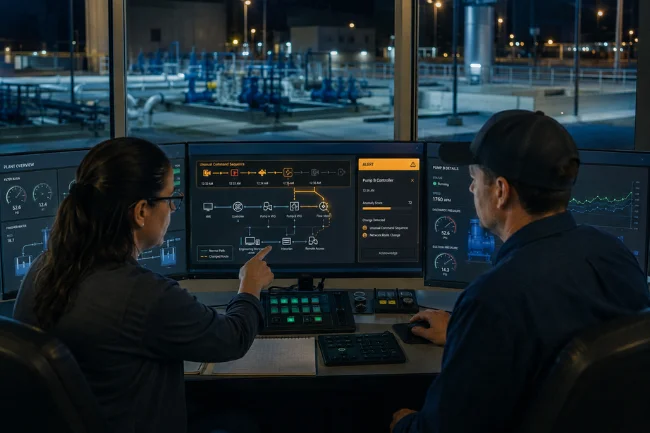
Consider a water facility where a supervisory workstation normally sends a limited set of commands to a pump controller during staffed hours. One night, the controller receives a valid-looking command from that workstation, but the timing, command sequence, and requested operating level do not match the established baseline.
A conventional system might allow the traffic because the device and credentials appear legitimate. An OT-aware detection layer could correlate the unusual time, rare command, changed network path, and physical operating state. It could then present those factors to an analyst as one explainable alert.
The safest response would depend on the process. Automatically blocking the command might prevent damage, but it could also interfere with pressure control or another safety function. A mature deployment would need predetermined response policies, human oversight, and a fail-safe mode agreed upon by cybersecurity engineers and plant operators.
This scenario is illustrative, not a published AICOT pilot result. I include it because it shows the difference between identifying abnormal network traffic and making a responsible decision inside a physical system.
Secure Cyber Threat Intelligence Sharing
Cyber Threat Intelligence, commonly shortened to CTI, includes malicious indicators, observed techniques, attacker behavior, and contextual information that can help another organization recognize a related threat.
Sharing industrial threat data is difficult. A report can reveal sensitive architecture, vulnerable equipment, production details, or an incident that an operator is not ready to disclose. Organizations also need to know who contributed the intelligence, whether it was altered, and who is authorized to access it.
AICOT proposes blockchain-supported, privacy-preserving CTI sharing to improve trust, auditability, and secure exchange. The idea is promising, but the public overview leaves several implementation questions open. It does not yet explain what information would be stored on-chain, how confidential data would remain private, who would operate the network, or whether standards such as STIX and TAXII would be used.
Those details will determine whether the approach solves a genuine coordination problem or adds complexity to an exchange that could be handled through conventional trusted infrastructure.
Which Critical Sectors Could Benefit?
Energy operators could use OT-aware monitoring to identify suspicious activity affecting substations, generation assets, or control networks. Water utilities could gain better visibility into pumps, valves, chemical processes, and remote facilities.
Transport organizations may need to protect signaling, station, fleet, or infrastructure-control systems. Manufacturers may use similar technology to monitor production lines, robotics, safety systems, and industrial networks containing equipment from multiple vendors.
The Benefits AICOT Is Trying to Deliver
The clearest potential benefit is earlier detection. If the platform recognizes a weak signal before an attacker moves deeper into an industrial environment, operators may have more time to investigate and contain the threat.
Other proposed advantages include better asset visibility, OT-specific alert context, detection beyond known signatures, and integration between industrial monitoring and an existing security operations center. A modular design could also allow organizations to add capabilities without replacing every deployed security tool.
AICOT supports a wider European policy goal as well. By developing European-native, interoperable cybersecurity technology, the project aims to reduce vendor dependence and strengthen the regional security supply chain. The official project page connects this objective with digital sovereignty, scalability, training, and technology reuse.
What AICOT Cannot Yet Prove Publicly?
There is a difference between a strong project design and a validated security outcome. As of September 2026, the official pages I reviewed do not publish detection accuracy, false-positive rates, response latency, dataset composition, independent evaluations, or detailed pilot findings.
That absence does not show that the technology is ineffective. It means readers should treat claims about performance as project goals until measurable results are released.
I would look for answers to several questions before assessing the platform for operational use:
- Which attack techniques and industrial protocols were tested?
- How does performance change between different plants and sectors?
- Can an operator understand why each alert was generated?
- How quickly can the system adapt after legitimate process changes?
- What happens if the AI service becomes unavailable or produces a wrong recommendation?
- Does AICOT only advise analysts, or can it initiate a response?
- How are models, dependencies, and updates protected against supply-chain compromise?
These questions turn a broad promise of “AI-powered security” into criteria that a critical-infrastructure operator can actually evaluate.
AI Governance, Safety, and Regulatory Fit
AI inside OT should be treated as a safety and governance issue, not only a detection upgrade. Models can drift as equipment, operating schedules, and production conditions change. Training data may be incomplete, while sensitive telemetry can create privacy, commercial, and national-security concerns.
The strongest design would keep people responsible for high-impact decisions, document model changes, test failure modes, and provide a manual fallback. It would also define when data may leave the OT environment and prevent an AI component from becoming a new route into the control network.
CISA’s guidance on integrating AI into OT emphasizes governance, testing, monitoring, human oversight, and fail-safe mechanisms. European deployments may also need to consider NIS2, the Cyber Resilience Act, the Critical Entities Resilience framework, the EU AI Act, and industrial standards such as IEC 62443. The exact obligations will depend on the operator, product role, sector, and deployment design.
Who Is Behind AICOT and What Is Its Current Status?
The official consortium page identifies a single-member consortium led by Logstail. The project receives funding from the European Union’s Digital Europe Programme under grant agreement No. 101249826 and aligns itself with the DIGITAL-ECCC-2024-DEPLOY-CYBER-07-KEYTECH call.
Its stated objective is to validate the platform in realistic OT pilot scenarios and progress toward TRL 7–8. In practical language, that target suggests movement beyond an early laboratory concept toward a system demonstrated in a relevant or operational setting. It does not, by itself, prove broad production readiness or commercial availability.
Readers evaluating progress should follow the official website for pilot announcements, technical publications, training material, and measurable validation results.
Why AICOT Matters
AICOT reflects a necessary change in industrial cybersecurity. Connected infrastructure needs monitoring that understands machines and processes, not only conventional network indicators. AI may help analysts connect subtle signals, prioritize investigations, and recognize behavior that fixed rules miss.
The Practical Next Step
AICOT is best understood today as an ambitious European OT cybersecurity project with a credible problem to solve and a technically broad proposed approach. Its combination of SIEM analytics, protocol awareness, anomaly detection, AI-assisted analysis, and protected intelligence sharing could improve critical-infrastructure defense if pilot testing confirms the claims.
For now, I recommend following the official project updates and judging future announcements against concrete measures: tested threats, false-positive rates, detection speed, explainability, operational safety, and integration cost. If you manage an OT environment, use those same measures to review your current monitoring program rather than waiting for any single platform to become a complete answer.
Frequently Asked Questions
What is AICOT?
AICOT is an EU-funded project developing an AI-driven cyber defense platform for Operational Technology used in critical infrastructure.
What does AICOT stand for?
The project describes itself as an “AI-Driven Cyber Defense Platform for Operational Technology Environments in Critical Infrastructure,” but its public site does not provide a separate letter-by-letter expansion.
Who is developing AICOT?
The official project material identifies a single-member consortium led by Logstail, with funding from the European Union’s Digital Europe Programme.
Is AICOT available for companies to buy?
The public pages reviewed in September 2026 describe pilot validation and development objectives, not a general commercial purchasing route.
How does AICOT protect critical infrastructure?
It aims to combine SIEM data, OT protocol analysis, machine learning, anomaly detection, and threat intelligence to identify suspicious industrial activity earlier.

Noah Sterling is a technology research writer with 8+ years of experience covering emerging technologies, software trends, digital tools, and innovation. He creates practical, research-based articles to help readers understand the evolving technology landscape.


