

How to Use AI for SEO and Content Strategy Complete Guide
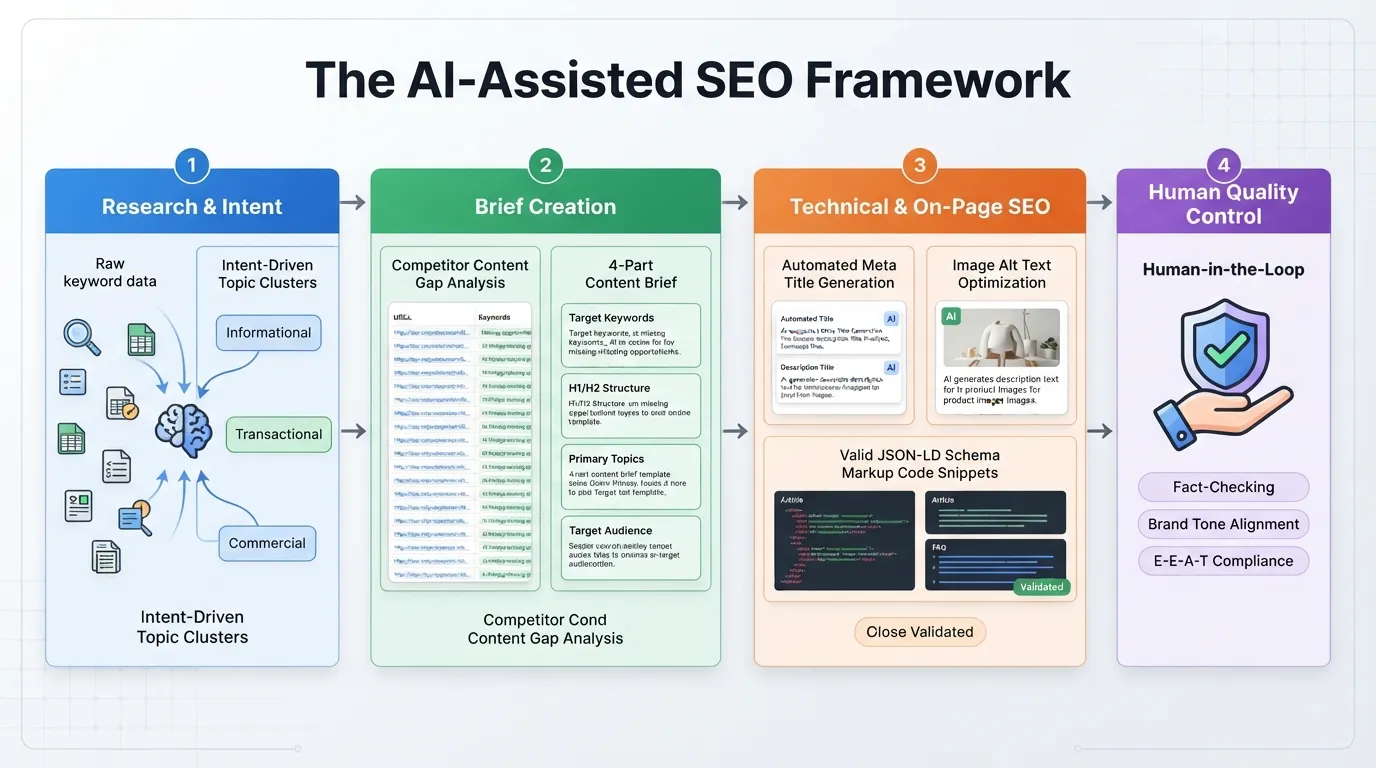
Search engine optimization (SEO) is evolving rapidly, and staying ahead of search engine algorithms while producing high-quality content at scale can feel like a moving target.
Direct Answer: To speed up your SEO workflow using AI without risking your search rankings, you must use artificial intelligence strictly for data processing, topic discovery, and initial drafting—while reserving critical evaluation, fact-checking, and strategic decision-making for human experts.
AI isn’t a replacement for strategy; it’s an efficiency catalyst designed to eliminate manual, repetitive tasks.
The Golden Rule of Modern SEO
When building a modern content workflow, always follow this foundational balance:
What AI Does Best: Handles large-scale keyword clustering, uncovers competitor content gaps, generates structured outlines, and drafts repetitive technical elements like metadata or schema markup in seconds.
What Humans Must Provide: Real-world experience, original perspectives, strict fact-checking, brand voice consistency, and genuine audience empathy—the exact signals Google looks for under its E-E-A-T (Experience, Expertise, Authoritativeness, Trustworthiness) guidelines.
What You Will Learn in This Guide
By following this step-by-step framework, you will discover how to:
Automate Technical Research: Discover high-intent, low-competition topic clusters using simple AI prompts.
Build Intent-Driven Outlines: Generate comprehensive content briefs that satisfy search intent and plug competitor gaps.
Streamline On-Page SEO: Automate metadata, image alt texts, and JSON-LD schema creation instantly.
Maintain E-E-A-T Compliance: Implement a robust human-in-the-loop review process to safeguard your site against thin content penalties.
Google Updates Compliance E-E-A-T & Helpful Content
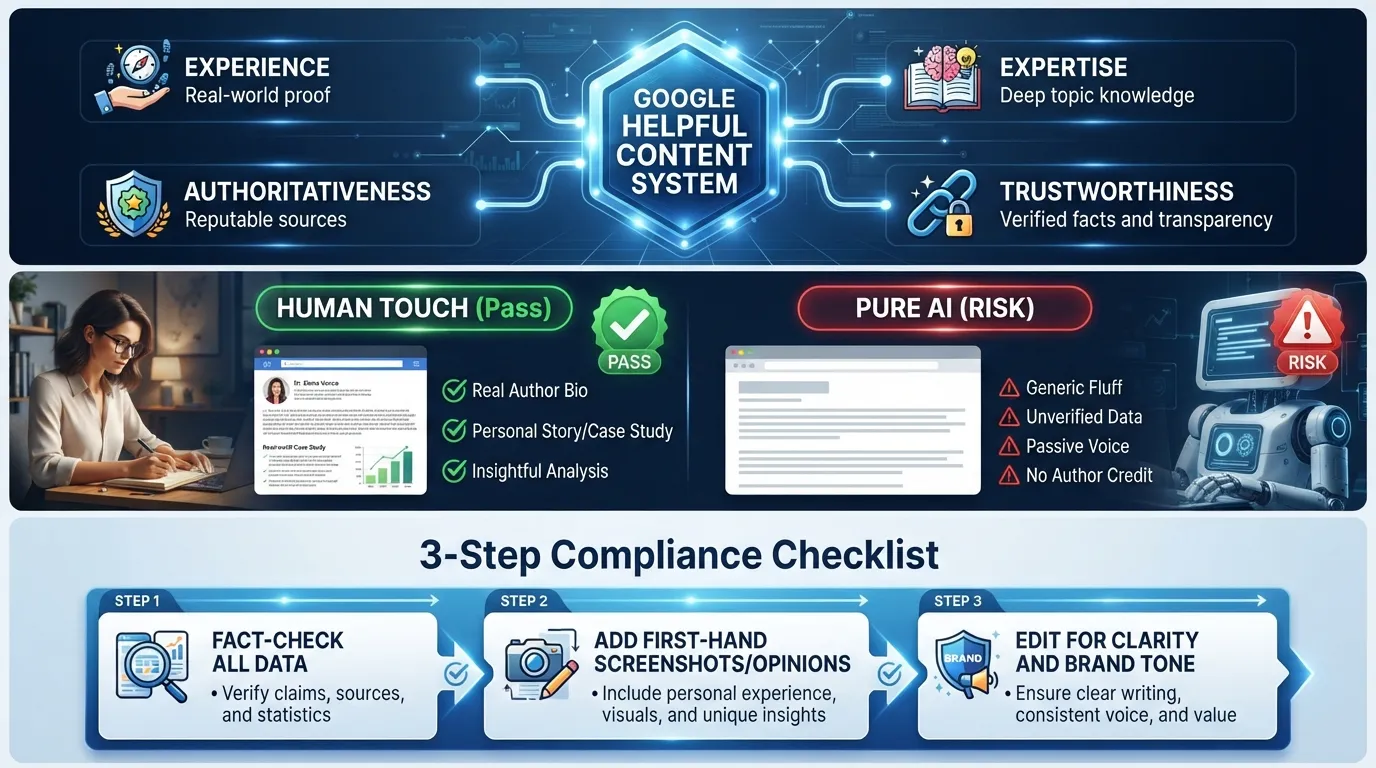
Google does not penalize content simply because it was written using AI. Google’s official stance is clear: it rewards helpful, high-quality content, regardless of how it is created.
However, Google heavily penalizes websites that use AI to publish low-quality, automated content in bulk just to manipulate search rankings. To rank safely in 2026, your AI-assisted workflow must strictly align with Google’s Helpful Content System and E-E-A-T guidelines (Experience, Expertise, Authoritativeness, and Trustworthiness).
How Google Evaluates AI-Assisted Content
Google uses automated ranking algorithms and human Search Quality Raters to evaluate every published page. They focus on three core principles:
People-First Intent: Was the article created to solve a genuine problem for a real human, or was it produced solely to target keywords and gain search traffic?
Information Gain (Value Addition): Does the piece bring fresh insights, unique perspectives, or practical data to the table—or does it merely rephrase top-ranking search results?
Clarity and Honesty: Is the information accurate, and is it transparent about who created, reviewed, or tested the material?
3 Ways to Add First-Hand Experience (E-E-A-T) to AI Text
AI language models can organize facts and summarize existing web data, but they cannot test products, use software, or hold personal viewpoints. To make your AI drafts rankable, you must inject genuine human experience using these three strategies:
1. Add Real Screenshots and Visual Proof
Show your readers actual proof instead of just describing steps in text. Include hands-on screenshots of your tools, custom dashboards, or testing workflows.
Example: If you are writing about AI prompts, include a screenshot displaying the exact prompt entered into the software along with the real-time response.
2. Include Mini Case Studies and Concrete Examples
Incorporate real-world stories, test results, or “behind-the-scenes” data that an AI tool could never generate independently.
Example: “When we tested this prompt structure on an e-commerce client’s site, organic click-through rates increased by 14% over three weeks.”
3. Share a Clear, Expert Stance
AI-generated text often sounds neutral and passive (“Some experts recommend X, while others prefer Y”). Real human experts hold decisive opinions based on practical work.
Example: State clearly which tools perform well in actual production environments and which ones you should avoid using.
Critical Red Flags to Avoid
When building content with AI, stay away from these three critical mistakes that trigger Google penalties:
1. Thin Content (Low-Value Fluff)
What it means: Thin content isn’t just short posts—it includes long, 2,000-word articles that lack actionable substance. AI tools often generate massive paragraphs filled with repetitive background info to inflate word counts.
Why Google penalizes it: Google’s algorithms look for fast, actionable solutions. If a reader has to wade through paragraphs of general introductions before finding a useful answer, Google marks it as poor user experience and drops the page rank.
How to fix it: Cut out generic introductory filler (“In today’s fast-paced digital world…”). Use direct answers, bullet points, and step-by-step guides right at the top of sections.
2. Hallucinated Data & Fake Sources
What it means: Large language models predict word patterns rather than verifying factual truth. Because of this, AI can invent fake statistics, assign quotes to wrong sources, or reference non-existent research studies.
Why Google penalizes it: Trustworthiness is the foundation of E-E-A-T. Publishing false metrics or broken links directly undermines your site’s credibility and overall trust score.
How to fix it: Manually fact-check every statistic, percentage, date, and claim generated by AI. Always locate and link to the primary, official source.
3. Over-Optimization & Keyword Stuffing
What it means: Forcing the primary keyword into every heading, intro, and paragraph, or cramming in unnatural subheadings purely to satisfy an SEO scoring checklist.
Why Google penalizes it: Modern search engines rely on Natural Language Processing (NLP) to understand context. Forced keyword density disrupts natural reading flow, leading to higher bounce rates and reduced search performance.
How to fix it: Write naturally for human readers first. Place the target keyword organically in the Title, H1, URL, and intro, then rely on natural semantic variations (LSI keywords) throughout the body text.
Step 1: Intent-Driven Keyword & Topic Clustering
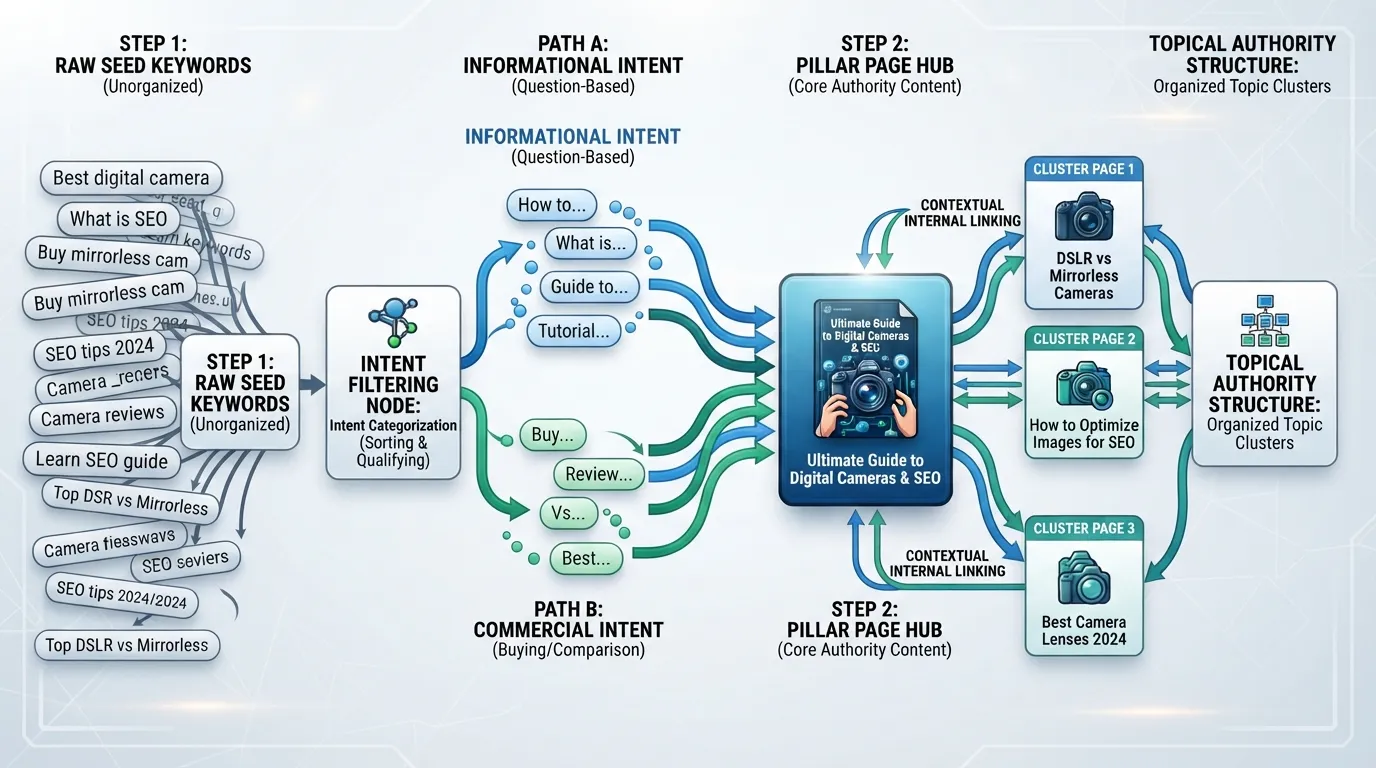
Keyword research in 2026 is no longer about chasing high search volumes; it is about capturing search intent—the exact reason behind a user’s query. Google’s semantic algorithms evaluate how well a website covers an entire topic, not just a single keyword phrase.
By leveraging AI, you can quickly discover low-competition keywords with clear commercial or informational intent and organize them into structured Topic Clusters.
Discovering Low-Competition, High-Intent Keywords with AI
Generic AI prompts yield generic keywords that every competitor is already targeting. To uncover hidden, high-converting topics, you need to prompt AI models to analyze user pain points and searcher psychology.
1. Uncovering Unanswered Questions (Informational Intent)
Top-ranking pages often miss specific, real-world user questions. Use this prompt to find those content gaps:
AI Prompt:
“Act as an expert SEO strategist in [Your Niche, e.g., B2B SaaS marketing]. Analyze the common challenges beginners face when trying to [Specific Goal, e.g., automate email outreach]. Identify 10 specific, low-competition questions or sub-topics that top-ranking articles usually gloss over. Focus on queries that indicate a clear problem-solving intent.”
2. Finding High-Intent Commercial & Transactional Queries
When users are ready to try a tool, take action, or make a decision, they search differently. Use this prompt to capture commercial intent:
AI Prompt:
“List 15 long-tail, high-intent search queries related to ‘[Your Niche / Tool Type]’. Focus on comparison queries (e.g., ‘X vs Y for small teams’), alternative queries (e.g., ‘best budget alternatives to X’), and specific feature use cases (e.g., ‘how to integrate X with Y’). Group them by user intent.”
Automating Topic Clusters & Pillar-Cluster Architecture
To build strong topical authority, your content should be structured using a Pillar-Cluster Model:
Pillar Page (Main Guide): Ultimate Guide to AI SEO
Cluster Page 1: AI Keyword Clustering Techniques
Cluster Page 2: How to Create AI Content Briefs
Cluster Page 3: Automating Schema & On-Page SEO with AI
3-Step AI Workflow for Cluster Mapping
Export Raw Keywords: Gather a raw list of 100+ seed keywords from your favorite SEO tool (Ahrefs, Semrush, or Google Keyword Planner).
Run the AI Clustering Prompt: Paste your keyword list into an AI tool using the instruction below:
AI Prompt:
*”Analyze the attached list of keywords. Group them into logical semantic topic clusters. For each cluster:
Assign a clear ‘Pillar Page’ title.
List 3 to 5 supporting ‘Cluster Page’ titles.
Define the primary search intent for each page (Informational, Commercial, or Transactional).
Ensure there is zero keyword cannibalization between clusters.”*
Establish Internal Linking Logic: Every cluster page must contain a contextual link pointing to the pillar page, and the pillar page should naturally reference each cluster page. This signals to Google that your site is a complete, structured resource on the topic.
Step 2: Competitor Gap Analysis & Brief Creation
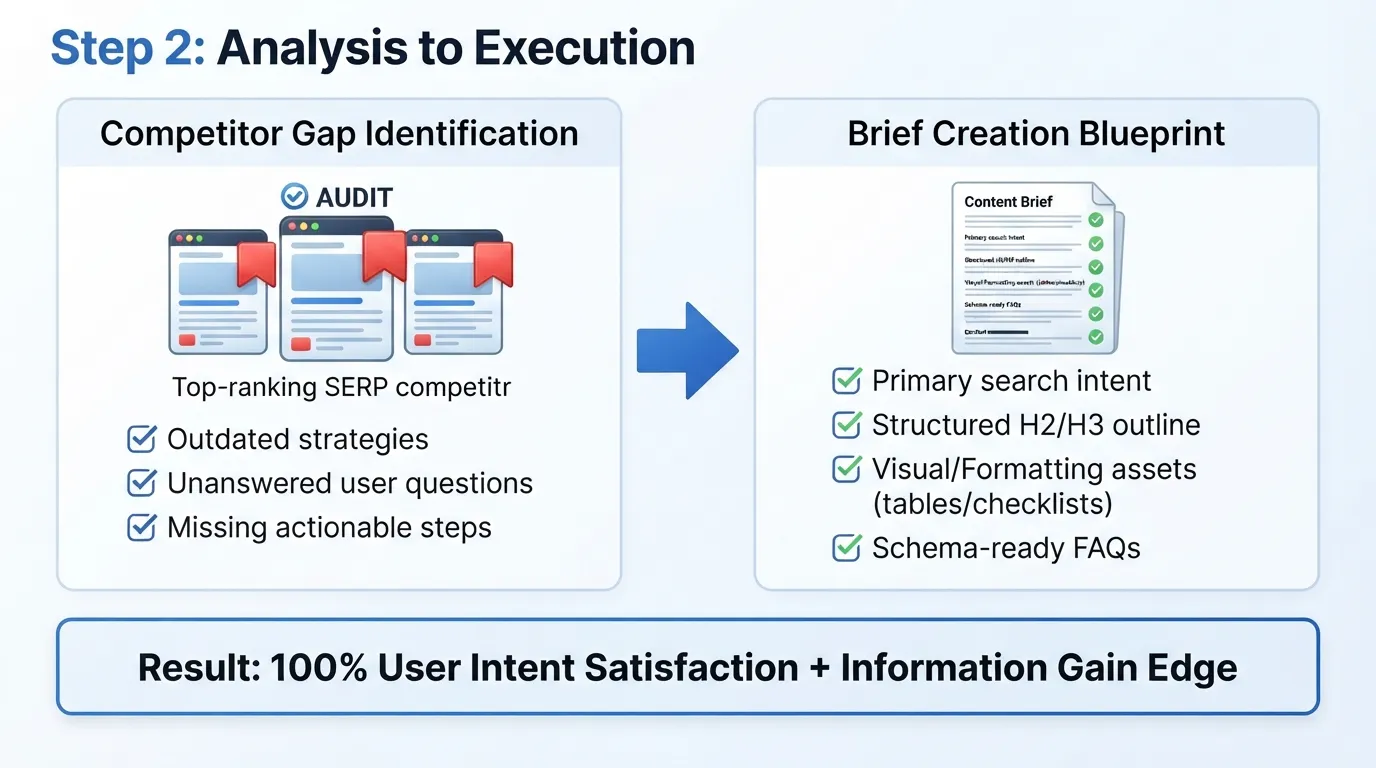
Once you have identified your primary keyword and target topic, the next step is analyzing what the current top-ranking pages are doing—and more importantly, what they are missing.
Creating a content brief using AI allows you to spot competitor weaknesses (content gaps) and design an outline that delivers a superior, all-in-one answer to satisfy user intent.
Finding Content Gaps in Top-Ranking Competitor Pages
Most top-ranking articles suffer from two major issues: they are either outdated or they skip crucial actionable details. Instead of copying what competitors have already written, use AI to extract their weaknesses and find opportunities for Information Gain.
1. Extracting Missing Information
Copy the headings (H2, H3) or raw text from the top 3 ranking articles for your keyword and feed them into your AI tool with this prompt:
AI Prompt for Content Gap Analysis:
*”Below are the outlines of the top 3 ranking pages for the keyword ‘[Your Keyword]’. Analyze all three outlines and identify:
Important sub-topics or practical steps that ALL three competitors failed to cover.
Questions that a user reading these articles would still be left asking.
Outdated strategies or vague advice that can be replaced with concrete, updated 2026 steps.”*
Building a Search-Intent Driven Content Brief
A great content brief serves as the blueprint for your article. It ensures your final draft covers every angle of the user’s search goal without adding unnecessary fluff.
4-Part Structure of an Effective AI-Generated Brief
Target Search Intent: Explicitly define whether the searcher wants a quick step-by-step solution, a product recommendation, or a technical explanation.
Required Headings & Sub-Headings (
H2,H3): Map out the logical flow of the article from introduction to conclusion.Information Gain Elements: List specific original items to include—such as custom comparison tables, downloadable checklists, or hands-on screenshots.
Primary and LSI Keywords: Placement instructions for target terms across headings and body text.
The All-In-One Brief Generation Prompt
Use this prompt to generate a complete, gap-free content brief in seconds:
AI Prompt for Brief Creation:
*”Act as a senior content strategist. Create a detailed content brief for a comprehensive article titled ‘[Target Title]’.
Include the following sections in the brief:
Search Intent & Goal: What specific problem must this article solve for the reader?
Outline Structure: Logical
H2andH3headings that cover all basic concepts plus the competitor content gaps we identified.Visual & Formatting Assets: Suggest places where tables, bullet points, or screenshots should be added to improve readability.
Questions to Answer (FAQs): 3-4 specific user questions to include for Featured Snippets.
Ensure the brief strictly avoids generic introductions and focuses on practical, hands-on instructions.”*
Step 3: On-Page & Technical SEO Automation
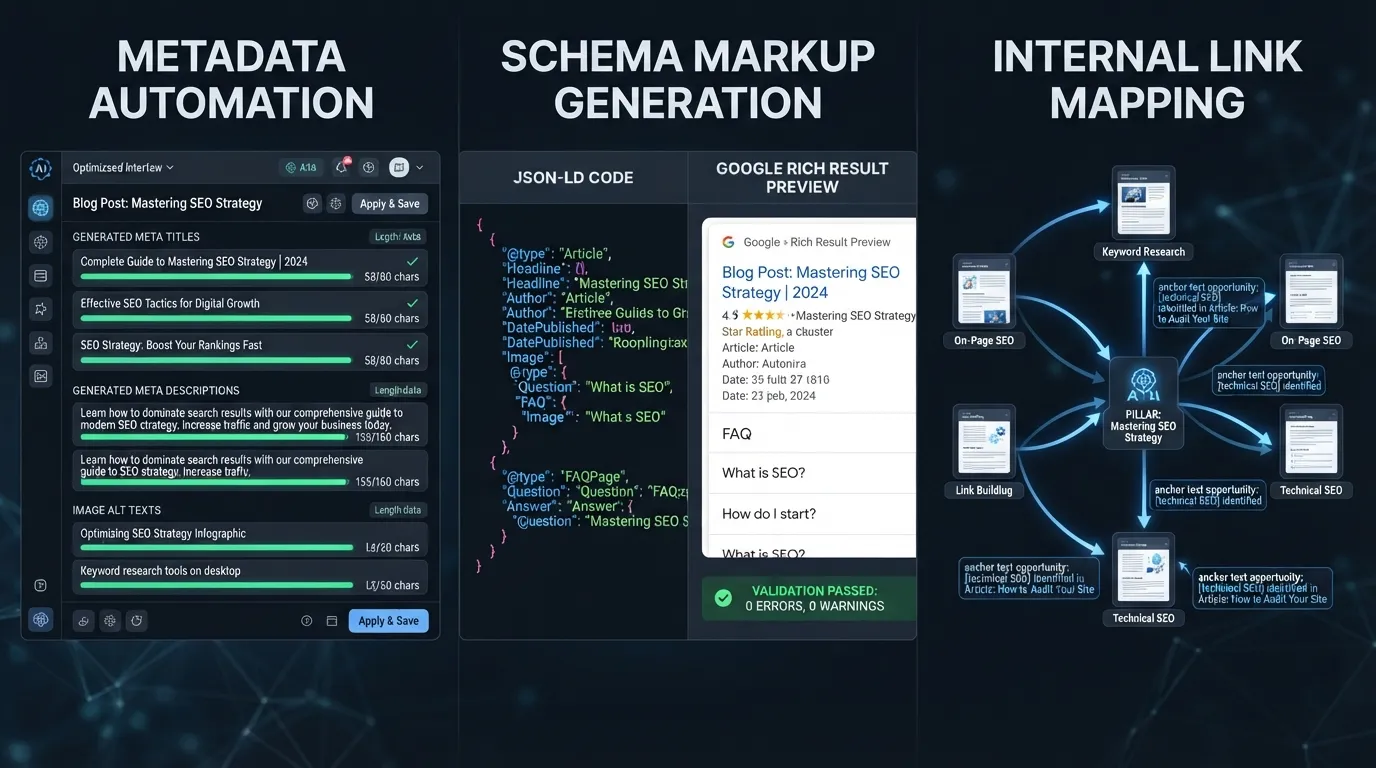
While high-quality content satisfies the human reader, technical on-page elements ensure search engines can crawl, understand, and index your page efficiently.
AI tools excel at generating structured data, optimized metadata, and internal linking strategies in seconds—eliminating manual effort while maintaining precision.
1. Automating Meta Titles, Descriptions & Image Alt Texts
Meta tags are your primary hook in search engine results pages (SERPs). AI can generate multiple click-optimized title and description options that align with search intent and stay within character limits.
A. Meta Title & Description Generator Prompt
AI Prompt:
*”Generate 5 click-worthy Meta Title and Meta Description pairs for an article titled ‘[Article Title]’.
Primary Keyword: ‘[Your Primary Keyword]’
Constraints: Meta Titles must be under 60 characters. Meta Descriptions must be under 155 characters and include a clear call-to-action (CTA). Focus on high click-through-rate (CTR) without using sensationalist clickbait.”*
B. Image Alt Text Generator Prompt
To improve accessibility and rank in image search results, use this prompt for your article visuals:
AI Prompt:
“Write concise, descriptive image alt text for an image showing ‘[Describe what is visible in the image, e.g., A user setting up an automated keyword clustering prompt in ChatGPT]’. Include the keyword ‘[Target LSI Keyword]’ naturally while keeping the alt text under 125 characters.”
2. Generating Correct JSON-LD Schema Markup
Schema markup (structured data) helps search engines understand the context of your page and display rich snippets in search results (like star ratings, publication details, and expandable FAQs).
A. Article Schema Markup (BlogPosting / Article)
Copy and adapt this JSON-LD schema template for your blog post’s <head> section:
JSON
{
  "@context": "https://schema.org",
  "@type": "Article",
  "headline": "How to Automate SEO & Content Strategy Using AI in 2026",
  "description": "Learn how to leverage AI tools to automate keyword research, content briefs, and technical SEO workflows while staying fully compliant with Google EEAT guidelines.",
  "author": {
    "@type": "Person",
    "name": "Your Name or Brand"
  },
  "publisher": {
    "@type": "Organization",
    "name": "Your Company Name",
    "logo": {
      "@type": "ImageObject",
      "url": "https://example.com/logo.png"
    }
  },
  "datePublished": "2026-07-20",
  "mainEntityOfPage": "https://example.com/ai-seo-automation-guide"
}
B. FAQ Page Schema Markup (FAQPage)
Adding FAQPage schema makes your frequently asked questions eligible to appear directly in Google search results.
AI Prompt for Schema Generation:
“Convert the following 3 questions and answers into valid, clean JSON-LD
FAQPageschema markup. Do not wrap it in unnecessary HTML tags, only output valid JSON-LD code.”
JSON
{
  "@context": "https://schema.org",
  "@type": "FAQPage",
  "mainEntity": [
    {
      "@type": "Question",
      "name": "Does Google penalize AI-generated content?",
      "acceptedAnswer": {
        "@type": "Answer",
        "text": "No, Google does not penalize content simply for using AI. Google rewards helpful, high-quality content regardless of how it is produced, as long as it adheres to E-E-A-T guidelines."
      }
    },
    {
      "@type": "Question",
      "name": "How do I add E-E-A-T to AI text?",
      "acceptedAnswer": {
        "@type": "Answer",
        "text": "Incorporate real-world screenshots, original case studies, hands-on test data, and decisive expert opinions that AI models cannot generate independently."
      }
    }
  ]
}
3. Identifying Contextual Internal Linking Opportunities
Internal links distribute page authority across your site and help Google discover new pages. You can use AI to map out where your new article should link out—and which existing articles should link into your new post.
AI Prompt for Internal Link Mapping
AI Prompt:
*”Below is a list of published URLs and their main target topics from my website:
[Paste 5-10 related URLs and titles]
Analyze these URLs against my new draft titled ‘[New Article Title]’.
Identify 3 logical places in the new draft where I can contextually link OUT to my existing articles. Suggest the exact anchor text to use.
Identify 3 existing articles that should link IN to this new post, along with suggested anchor text and placement context.”*
Step 4: Quality Control & Human Editorial Process
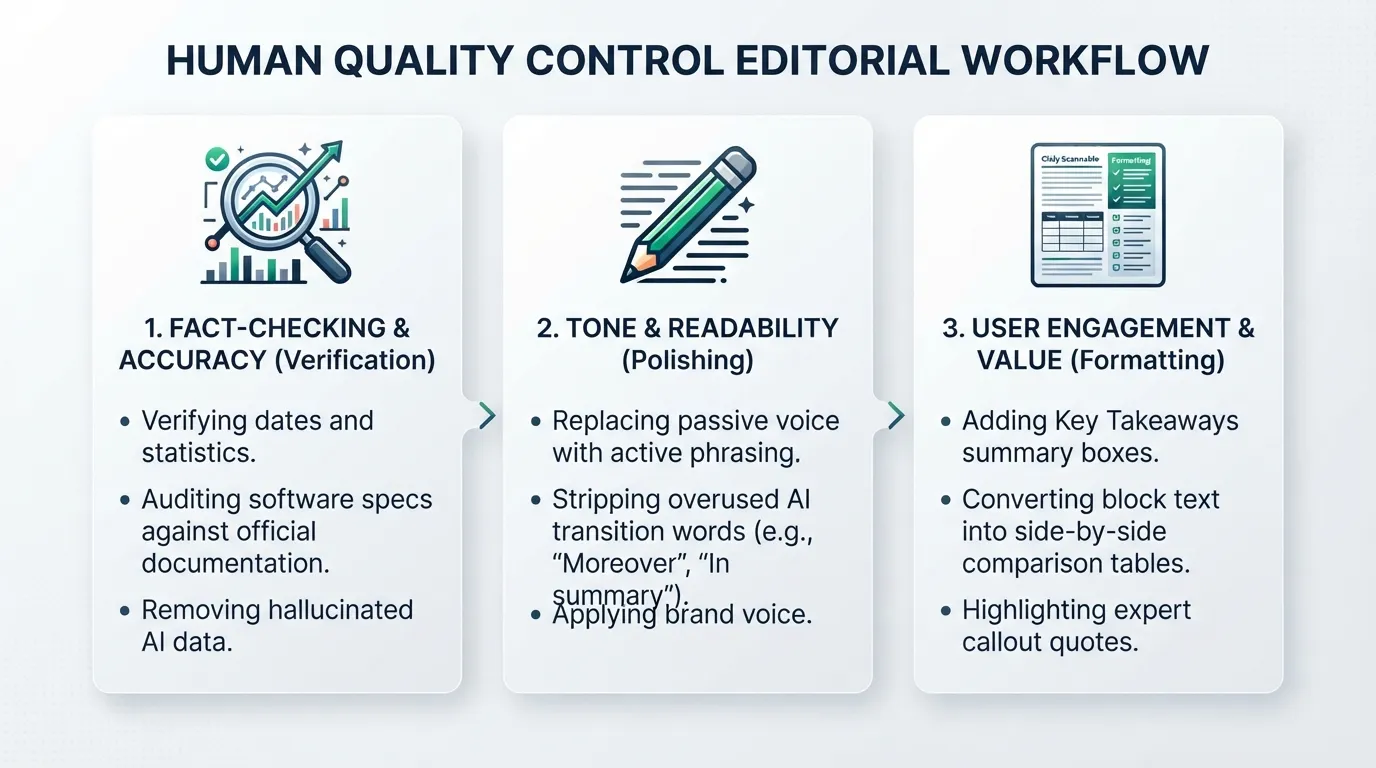
Generating a draft with AI is only half the battle. Publishing raw, unedited AI content is the quickest way to lose rankings, alienate readers, and trigger Google quality filters.
The Human Editorial Process bridges the gap between raw AI efficiency and true topical authority. Every piece of AI-assisted content must pass through a strict three-stage human quality check before publication.
1. Fact-Checking AI Outputs & Eliminating Hallucinations
AI language models predict sequences of words—they do not possess real-time factual awareness or genuine understanding. As a result, they frequently generate incorrect statistics, outdated product specs, or fictional research papers.
The Fact-Checking Protocol:
Verify Every Statistic & Claim: Never accept numbers like “Studies show a 40% increase in productivity” without finding the primary source. If you cannot trace a stat to an authoritative original source, remove it or replace it with verified data.
Audit Tool & Software Specs: If the AI mentions software features, pricing tiers, or platform policies, verify them directly on the official software documentation.
Check Dates & Temporal Accuracy: Ensure all dates, algorithm names, and industry standards reflect current benchmarks.
2. Polishing Brand Tone, Flow, and Readability
Unedited AI text has a distinct, robotic rhythm. It overuses passive voice, relies on predictable transition phrases (“In today’s fast-paced digital world,” “Furthermore,” “In conclusion”), and stays excessively neutral.
Human Editorial Polishing Guide
| AI Flaw | Human Editorial Solution |
| Passive, repetitive sentence structures | Rephrase into active voice. Vary sentence lengths (mix short, punchy statements with longer explanations). |
| Monotone & generic corporate voice | Inject brand personality. Use direct language (“you”, “we”) and take a firm stance based on experience. |
| Overused transition words (“Moreover”, “Furthermore”) | Delete fluff words. Transition between subheadings with direct problem statements or logical next steps. |
3. Adding High-Impact User Engagement Elements
Online readers scan content before reading it deeply. Transforming long walls of plain AI text into visual, scannable elements directly improves user dwell time and lowers bounce rates.
Mandatory Visual & Structural Additions:
Key Takeaways Box: Place a brief summary box right beneath the introduction or main headings so mobile readers get immediate value.
Comparison Tables: Convert long, descriptive paragraphs comparing tools, features, or methods into side-by-side comparison tables.
Actionable Bullet Lists: Break down multi-step instructions into clear, bulleted items starting with action verbs.
Callout Quotes & Warnings: Highlight expert tips, critical warnings, or major takeaways using blockquotes or visual callout boxes.
Editorial Rule of Thumb: If a reader scrolls through your article in 10 seconds, they should still be able to understand 80% of the core value through headings, tables, bold text, and bullet points alone.
Essential Checklist & Conclusion
Integrating AI into your SEO and content strategy offers unmatched speed and scale, but long-term success depends on quality control. By blending automated research, outline generation, and metadata optimization with strict human editorial oversight, you create high-performing content that satisfies both search engines and human readers.
Before pushing any AI-assisted article live, run it through this quick pre-publish quality check.
10-Point Pre-Publish AI SEO Checklist
| # | Check Item | Status / Action Needed |
| 1 | Search Intent Match | Does the article directly answer the user’s primary query in the first two paragraphs? |
| 2 | Primary Keyword Placement | Is the main keyword naturally included in the Title, URL, H1, and first 100 words? |
| 3 | Fact Verification | Are all numbers, statistics, and dates manually checked against official sources? |
| 4 | E-E-A-T Signal Addition | Does the post include original screenshots, real-world examples, or personal insights? |
| 5 | Content Gap Resolution | Does this guide cover practical details that top-ranking competitors missed? |
| 6 | Fluff Removal | Are generic introductory filler and repetitive transition words deleted? |
| 7 | Scannability & Layout | Are long text blocks broken up with H2/H3 subheadings, tables, and bullet points? |
| 8 | On-Page & Schema | Are meta tags optimized and valid JSON-LD schema markup implemented? |
| 9 | Internal & External Links | Does the post link out to trusted sources and connect internally to related site pages? |
| 10 | Mobile Readability | Is the text easy to skim on mobile screens with clear formatting and short paragraphs? |
Frequently Asked Questions (FAQs)
Q1: Does Google penalize AI-generated content?
Answer: No, Google does not penalize content simply because it was created using AI. Google’s official guidelines state that it rewards high-quality, helpful content regardless of how it is produced. However, Google heavily penalizes low-quality, automated content generated purely to manipulate search rankings without adding real value.
Q2: How do I add E-E-A-T to AI-assisted content?
Answer: To build E-E-A-T (Experience, Expertise, Authoritativeness, Trustworthiness), inject human touchpoints that AI cannot fake. Add original screenshots of your workflow, share real-world test results or case studies, state decisive expert opinions, and ensure every claim is fact-checked and backed by primary sources.
Q3: What is the best workflow balance between AI and Humans?
Answer: The optimal workflow follows the formula: Efficiency = AI | Accuracy & Trust = Human Expertise. Use AI for heavy lifting—such as keyword clustering, outline generation, initial drafting, and JSON-LD schema creation. Reserve strategic direction, fact-checking, brand tone polishing, and final editing strictly for human experts.
Final Thoughts
AI is one of the most powerful tools available to digital marketers today, but it works best as an co-pilot rather than an autopilot. When you combine automated efficiency with human judgment, you produce articles that rank higher, build trust, and drive consistent organic growth.